
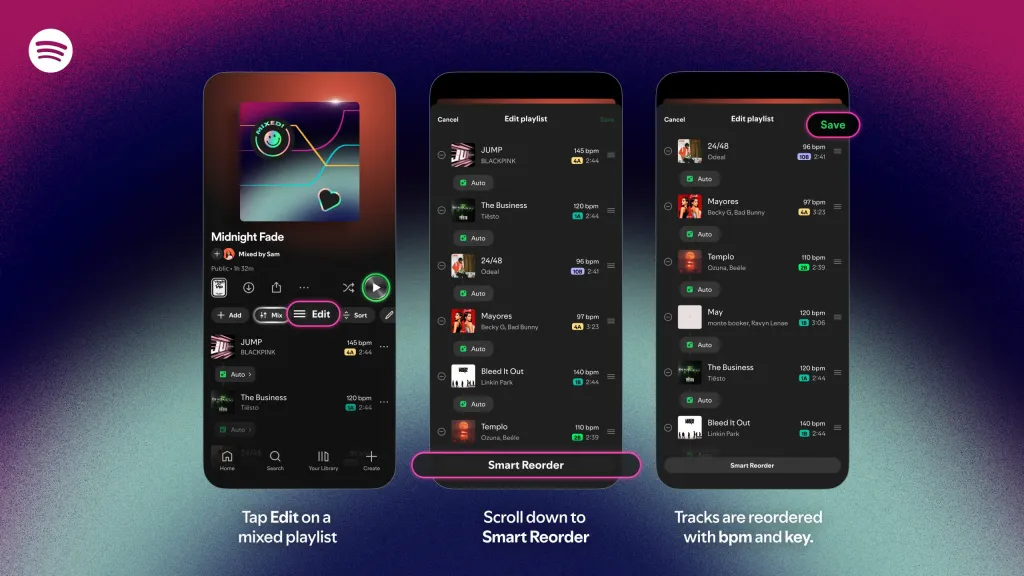
Spotify is rolling out a new playlist feature designed to improve how songs flow into each other. Called Smart Reorder, the update gives Spotify Premium subscribers a way to automatically rearrange tracks in a playlist based on tempo and musical key, two technical elements that influence how smooth transitions feel between songs.
The Smart Reorder feature reflects a broader shift in the music streaming space, where platforms are focusing less on pure catalog size and more on playback experience. As listeners increasingly treat playlists like curated DJ sets rather than static collections, transitions matter more. Abrupt tempo jumps or clashing keys can disrupt the mood of a workout session, party mix, or late-night listening queue.
With Smart Reorder, Spotify analyzes beats per minute (BPM) and key signatures to cluster songs that are harmonically and rhythmically compatible. The result is a reordered playlist that aims to reduce jarring shifts in energy. Tracks with similar speed and tonal structure are grouped together, creating a more continuous listening arc.
Using the feature is straightforward. Premium users open a playlist, tap the Mix option, then select Edit to enable Smart Reorder. Once activated, Spotify reorganizes the playlist automatically. The adjustment is non-destructive, meaning users can revert or manually tweak the order afterward.
The addition builds on Spotify’s previous work around crossfade and customizable transition points introduced last year. Those tools allowed listeners to control how one track blends into the next, but they still relied on manual setup. Smart Reorder shifts more of that process into automation, aligning with Spotify’s broader strategy of algorithm-driven personalization.
Competition in this area is intensifying. Apple Music recently expanded its transition system with AutoMix in iOS 26, which automatically blends tracks without requiring user input. The growing emphasis on seamless playback suggests streaming services see transition quality as a meaningful differentiator, especially as core features like offline playback and lossless audio become more standardized across platforms.
For Spotify, Smart Reorder reinforces its positioning around intelligent playlist management. The company has long leaned on algorithms to generate Discover Weekly and other personalized mixes. Extending that logic to song sequencing is a natural progression.
Whether Smart Reorder becomes a widely used tool will depend on how noticeable the improvements are in real-world listening. For casual users, manual playlist order may not be a priority. But for listeners who care about energy progression and tonal cohesion, especially during workouts or events, automated BPM and key matching could reduce friction.
As music streaming competition tightens in 2026, refinements like Smart Reorder show how platforms are looking beyond catalog size and exclusives. The battle is increasingly about subtle quality-of-life improvements that shape how music feels, not just what’s available to play.