

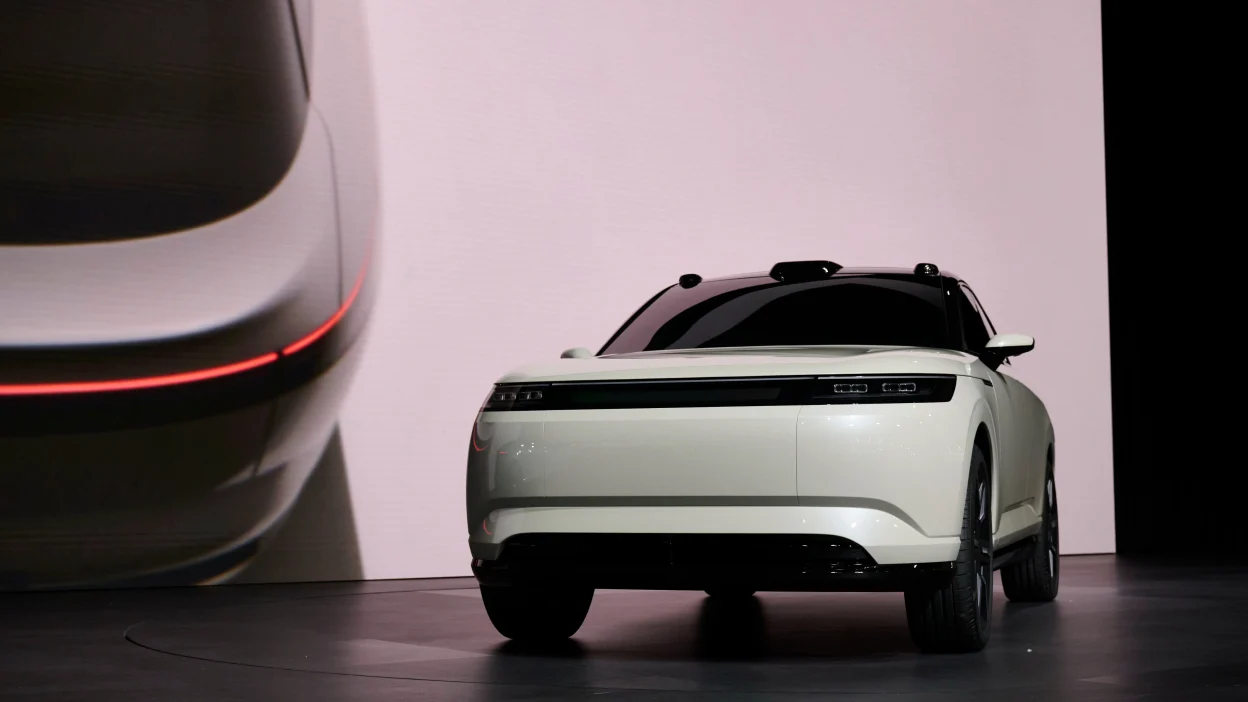
At CES 2026, Sony Honda Mobility returned with the AFEELA 1, this time framing the electric sedan less as a concept and more as a near-production vehicle. For anyone who saw the car at last year’s show, the experience feels familiar, almost deliberately so. The design language, the emphasis on screens, and the positioning of the car as a rolling digital environment remain intact. What has changed is the level of refinement, suggesting the project has moved out of its experimental phase and closer to real-world readiness.
Sony Honda Mobility used its keynote to reiterate a philosophy it has been consistent about since AFEELA was first unveiled: the idea of the car as a “creative entertainment space.” Rather than selling performance figures or aggressive styling, the company continues to focus on what happens once you’re inside the vehicle. The panoramic dashboard display still dominates the cabin, stretching across the width of the interior and acting as the main interface for navigation, media, and apps. It remains the most distinctive feature of the AFEELA 1 and reinforces how strongly the car aligns with Sony’s consumer electronics DNA.
Alongside the sedan, the company also showed an SUV-style concept called AFEELA Prototype 2026. Despite the name, Sony Honda Mobility indicated that this vehicle would not reach production until at least 2028. Visually and conceptually, it appears to be a taller, larger sibling to the AFEELA 1, though details remain limited. For now, it functions more as a signal of long-term intent than a concrete product announcement.
Inside the AFEELA 1, entertainment continues to be a central theme. One of the more talked-about features is PlayStation Remote Play, which allows owners who already have a PlayStation 5 to stream games to the rear-seat displays using a DualSense controller. The feature was teased previously, but this year’s demonstrations showed a more stable experience. While it does not support 4K streaming, input lag was minimal and performance held up even in a crowded show environment. It remains a niche feature aimed squarely at people already invested in Sony’s gaming ecosystem, but it now feels functional rather than aspirational.
The in-car AI assistant, also called AFEELA, returns with modest improvements. Powered by Microsoft Azure OpenAI, it is described as a personal agent capable of natural conversation and personalization over time. In practice, it behaves much like other modern in-car assistants, handling navigation, app control, and basic vehicle settings. It is competent, occasionally charming, but not radically different from what drivers may already be used to elsewhere.
Where the AFEELA 1 does show meaningful progress is in overall usability. Screen transitions feel faster, app switching is smoother, and the interface is more responsive than before. The cabin itself feels quieter and more composed, suggesting attention has been paid to ride comfort and noise isolation. Rather than adding more experimental features, Sony Honda Mobility appears to be focusing on stability and polish, a sensible move given the car’s price and ambitions.
That emphasis on time spent inside the car extends beyond entertainment. The AFEELA 1 supports productivity-focused apps such as Zoom, positioning the cabin as a place for calls and meetings as well as leisure. The implementation works, though the wide camera framing can feel less flattering than a traditional laptop setup, capturing more of the interior than the person speaking.
All of this refinement comes at a clear cost. The AFEELA 1 is priced from $89,900, with higher trims pushing past $100,000, placing it firmly in the luxury EV segment. At that level, buyers will expect not just novel ideas but reliable execution. Based on this year’s showing, Sony Honda Mobility seems aware of that expectation and is prioritizing the fundamentals ahead of the car’s planned rollout in California later this year.
Rather than reinventing itself between CES appearances, the AFEELA 1 has settled into a more confident version of what it set out to be from the start. It still feels more like a Sony product than a traditional car, but in 2026, that may be exactly the point.