

Samsung’s first tri-fold smartphone has achieved an unexpected milestone, becoming the first device from the company to fail a bend test conducted by popular durability reviewer Zack Nelson. The test, published on Christmas Day for the nearly 10 million subscribers of the JerryRigEverything YouTube channel, offers an unfiltered look at the physical limits of Samsung’s most ambitious foldable design to date.
From the outset, the video frames the TriFold as a device that demands careful handling. Upon startup, the phone presents a series of on-screen warnings advising users not to remove the protective film on the inner display, to avoid exposure to small particles such as sand, and to follow a specific folding sequence that begins with the panel without cameras. These cautions, while not unusual for foldable devices, underscore how sensitive the hardware is compared with conventional smartphones.
As with all JerryRigEverything tests, the evaluation follows a familiar routine: scratch testing, exposure to grit, a flame test, and finally the bend test. The TriFold’s large, flexible inner display, which expands to roughly 10 inches when fully opened, shows the expected vulnerability to pointed objects. This behavior is consistent across foldable OLED panels, which prioritize flexibility over surface hardness and are not designed to withstand sharp pressure.
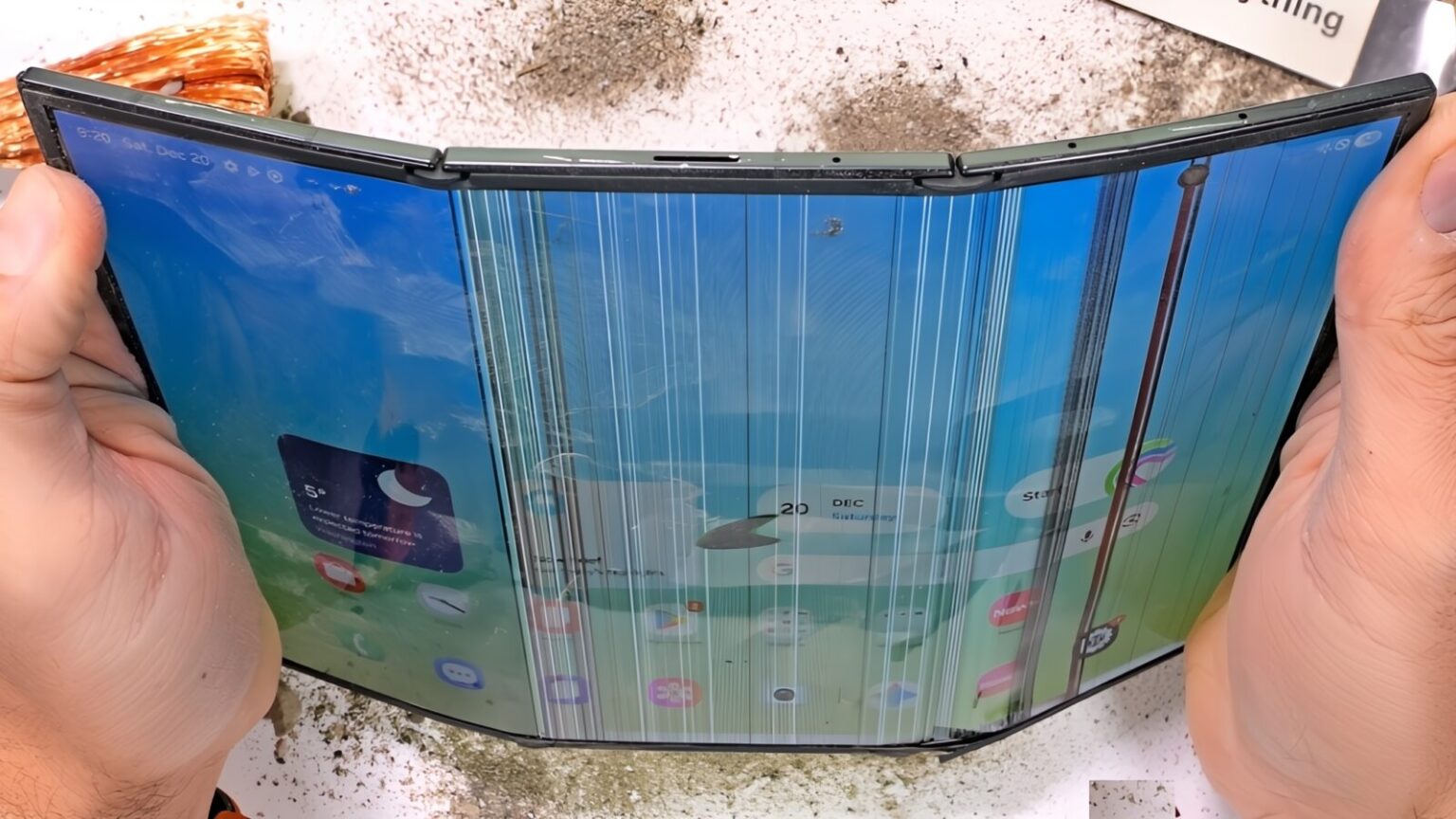
The test becomes more concerning once debris is introduced. Nelson pours a substantial amount of grit onto the device, acknowledging that the quantity is extreme but useful for revealing structural weaknesses. The hinges, which are central to the TriFold’s design, struggle audibly as dirt works its way into the moving parts. Nelson remarks that he would be hesitant to place the phone on anything other than a very clean surface, highlighting a practical concern for everyday use rather than an edge-case scenario.
The most notable moment comes during the bend test. Applying pressure with his hands, Nelson causes the TriFold’s screen to fail within seconds. While the phone does not snap apart, the display flickers and effectively gives up, marking the first time a Samsung handset has failed this particular test on the channel. That distinction, while informal, is significant given Samsung’s long history with foldable hardware.
Nelson’s conclusion is measured rather than dismissive. He describes the TriFold as an impressive piece of engineering when treated with care, but one that leaves little margin for rough handling. In practical terms, the test suggests that the device is better suited to users who are meticulous with their hardware and less forgiving of environments where dust, grit, or accidental stress are common.
The durability test does not necessarily indicate a flaw so much as a trade-off. As Samsung continues to push foldable designs toward larger and more complex form factors, durability remains one of the key challenges that will determine whether these devices can move beyond early adopters and into broader, everyday use.