


Qualcomm has introduced two new mobile processors aimed at lower-cost smartphones, reinforcing the company’s continued investment in both 4G and entry-level 5G devices. The Snapdragon 6s 4G Gen 2 and Snapdragon 4 Gen 4 were unveiled quietly, but together they offer a clear snapshot of how Qualcomm sees the near-term future of the budget and mid-range smartphone market.
The Snapdragon 6s 4G Gen 2 is positioned for devices that do not require 5G connectivity, a segment that remains relevant in many regions. Built on a 6nm manufacturing process, it represents a step forward from its predecessor, which was based on an older 11nm node. Qualcomm says the updated Kryo CPU can reach clock speeds of up to 2.9GHz, delivering a sizable performance uplift compared to the previous generation. Graphics performance has also been improved, with the Adreno GPU offering higher efficiency and support for displays up to 1080p+ with refresh rates of 120Hz.
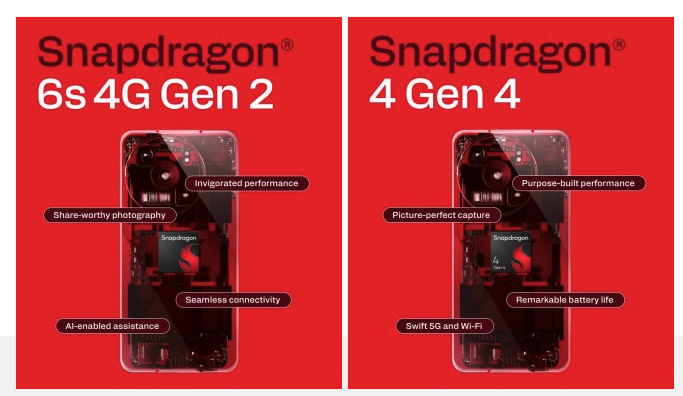
Memory and storage support remain modest but appropriate for its target category. The chip supports up to 8GB of LPDDR4X RAM and UFS 2.2 storage, along with USB 3.1 connectivity and Quick Charge 3. Camera capabilities include support for sensors up to 108 megapixels and a triple ISP that allows multiple camera streams, though video capture is capped at 1080p at 60 frames per second. Connectivity reflects the chip’s positioning, with a 4G LTE modem, Wi-Fi 5, and Bluetooth 5.2.
The Snapdragon 4 Gen 4, by contrast, brings 5G support to Qualcomm’s more affordable lineup. Despite skipping a Gen 3 designation, the new chip introduces a sub-6GHz 5G modem compliant with Release 16 standards, offering substantially faster theoretical speeds than its 4G counterpart. It is produced on a more advanced 4nm process and features a CPU configuration designed to balance efficiency and everyday performance rather than raw power.
This processor also supports faster memory and storage standards, including LPDDR5 RAM and UFS 3.1, alongside USB 3.2 Gen 1 and Quick Charge 4+. Display support mirrors that of the 6s 4G Gen 2, while camera and video capabilities remain similar, with 1080p video recording and no AV1 decoding support.
Together, these launches suggest Qualcomm is hedging its bets. While 5G adoption continues to grow, the company is acknowledging that 4G devices will remain part of the global smartphone landscape for some time. The first smartphones powered by the Snapdragon 6s 4G Gen 2 and Snapdragon 4 Gen 4 are expected to arrive in 2026.