
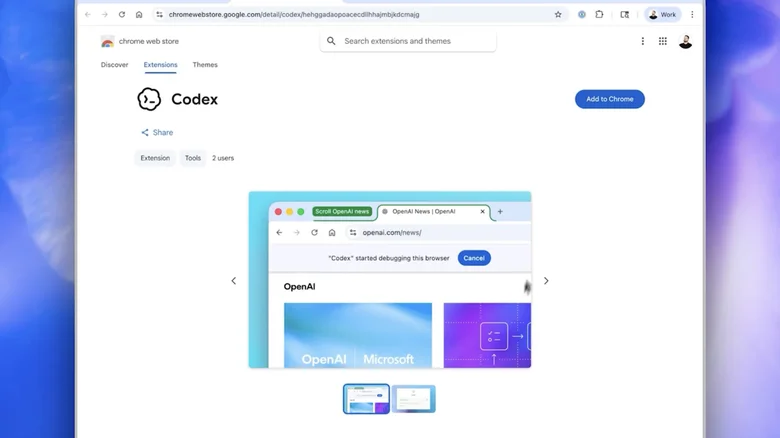
OpenAI has released a Chrome extension for its Codex coding assistant, extending the tool’s reach beyond its initial macOS app into everyday browser workflows. Announced on May 7, 2026, the plugin enables features such as testing web applications directly, pulling context from multiple open tabs, and working alongside Chrome DevTools while users handle other tasks. These additions aim to make Codex more practical for developers who already spend significant time in browsers, while also opening the door for broader use by designers, analysts, or anyone whose work involves web-based interfaces.
The extension builds on Codex’s earlier rollout as a standalone macOS application in February 2026, followed by incremental updates in April. OpenAI has signaled plans for an eventual unified app that would combine Codex with ChatGPT and its in-development browser, Atlas. The Chrome version supports both Windows and Mac systems, reflecting a deliberate push toward cross-platform accessibility in a space long dominated by specialized IDEs and command-line tools.
Coding has become one of the more tangible success stories for large language models, with tools like Codex, GitHub Copilot, and others demonstrating real productivity gains in autocomplete, debugging, and code generation. Yet these systems still struggle with larger architectural decisions, edge cases, and maintaining consistency across complex projects. The new browser integration addresses a practical pain point—context switching between documentation, live previews, and development consoles—but it also highlights ongoing limitations. Relying on tab context, for instance, risks incorporating outdated or irrelevant information if users have cluttered workspaces, potentially leading to subtle errors that are hard to spot without careful review.
For non-professional users, the appeal lies in lowering the barrier to simple scripting or automation tasks that traditionally required deeper technical knowledge. Many routine computing activities now happen inside browsers, from data analysis in spreadsheets to customizing web apps. A tool that understands this environment could prove useful beyond traditional software engineering. At the same time, the rapid expansion of OpenAI’s coding offerings raises familiar questions about dependency. As assistants become more embedded in workflows, teams risk over-reliance on suggestions that may not fully grasp organizational standards, security requirements, or long-term maintainability.
Historically, browser extensions for development have come and gone, from early Firebug iterations to modern tools like React DevTools. OpenAI’s entry adds generative capabilities to that lineage, but success will depend on reliability, privacy handling of code and tab data, and how well it integrates without slowing down the browser. The company has not detailed exact performance characteristics or free versus paid access tiers for the extension, which could influence adoption.
Overall, the Codex Chrome plugin represents a logical step in OpenAI’s effort to meet developers where they work rather than forcing them into new standalone environments. It strengthens the case for AI-assisted coding in daily browser use, yet it also underscores that these tools remain aids rather than replacements. Their value will ultimately be measured by how much they reduce friction without introducing new categories of mistakes or maintenance headaches.