
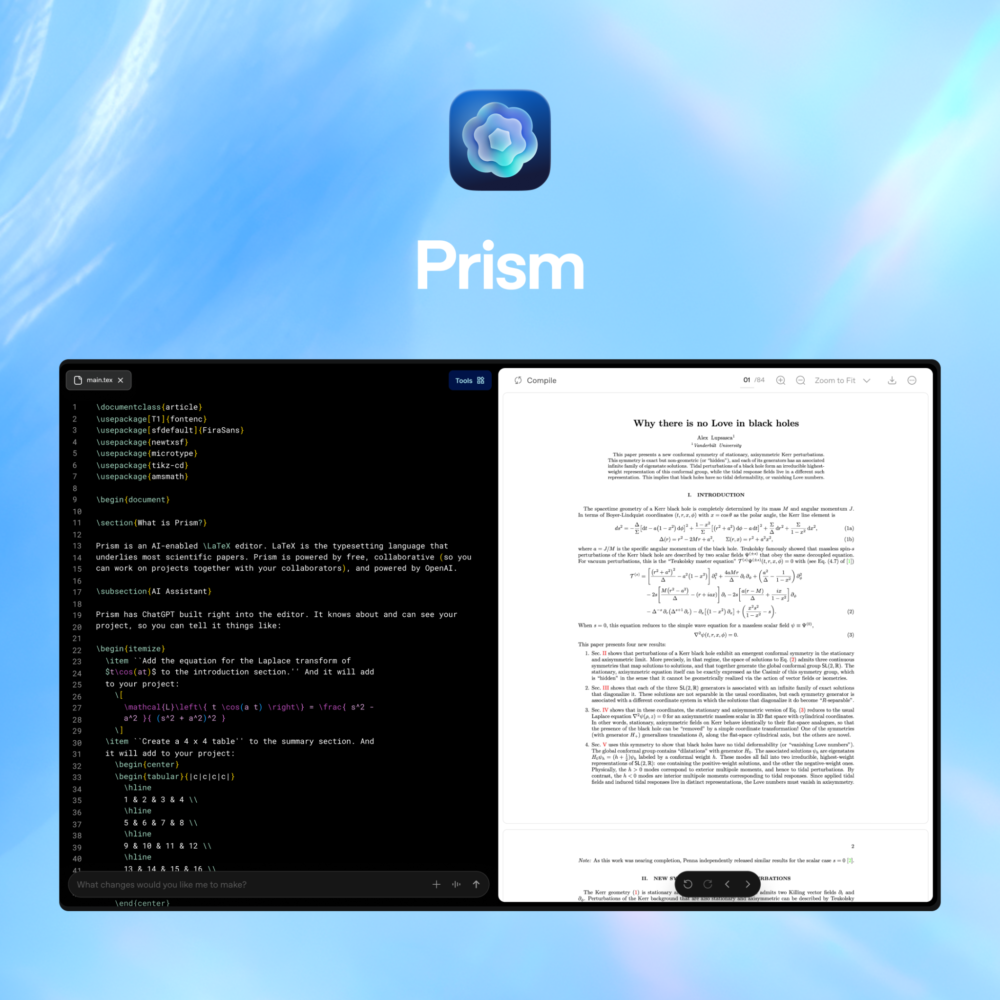
OpenAI has introduced a new product called Prism, a browser-based scientific workspace aimed at researchers who already use AI tools as part of their writing and analysis workflows. The tool, which is available at no cost to anyone with a ChatGPT account, is positioned less as an autonomous research system and more as a structured environment for drafting, revising, and evaluating scientific papers with AI assistance.
Prism functions primarily as an AI-enhanced document editor built around GPT-5.2. Within the workspace, researchers can ask the model to review claims, suggest revisions, check logical consistency, and surface relevant prior work. OpenAI is explicit that Prism is not meant to replace scientific judgment or independently generate discoveries. Instead, the emphasis is on accelerating tasks that already consume significant time, such as literature review, technical editing, and contextual cross-checking.
The company frames Prism as a parallel to modern coding environments that combine large language models with workflow-aware interfaces. Kevin Weil, OpenAI’s vice president for science, described the product as part of a broader shift in how research is conducted, arguing that AI’s role in science may soon mirror the impact it has already had in software development. The comparison is not about automation of outcomes, but about reducing friction in complex, iterative work.
OpenAI’s interest in building a dedicated scientific workspace follows a rise in advanced technical usage across its consumer products. According to the company, ChatGPT now handles millions of weekly queries related to hard sciences, though OpenAI acknowledges that it is difficult to determine how many of those interactions come from professional researchers rather than students or hobbyists.
Prism also reflects wider trends in academic research, where AI tools are increasingly used in tightly scoped, human-directed roles. In mathematics and statistics, recent papers have explored AI-assisted proofs, with models generating candidate arguments that are then verified by experts. These efforts remain controversial, but they have contributed to ongoing discussions about how formal reasoning and large language models might coexist in theoretical work.
On a practical level, Prism builds on existing standards rather than replacing them. The workspace integrates directly with LaTeX, extending familiar typesetting workflows with AI-driven editing and visualization tools. One notable feature allows researchers to convert rough whiteboard sketches into structured diagrams, addressing a common bottleneck in technical writing. Another is expanded context handling: when users open a chat window inside Prism, the model can reference the entire project, rather than isolated prompts or pasted excerpts.
While experienced users could replicate some of these capabilities with careful prompt management, OpenAI is betting that a purpose-built interface will lower the barrier to entry for scientists who are curious but cautious about AI. Prism does not fundamentally change what models like GPT-5.2 can do, but it packages those capabilities in a way that aligns more closely with how research is actually conducted.