

OpenAI has introduced GPT-5.4, a new large language model positioned as the company’s most capable system for professional and technical work so far. The release expands the GPT-5 series with improvements in reasoning, coding assistance, and document generation, areas that have become increasingly important as AI tools move deeper into workplace software and developer workflows.
According to OpenAI, GPT-5.4 combines advances previously seen in its Codex-focused models with a broader general-purpose architecture. The goal is to allow the model to handle tasks such as writing reports, building spreadsheets, drafting presentations, and generating structured documents with fewer errors and stronger organization. The company says the system is designed to approach these tasks with more consistent reasoning and improved reliability compared with earlier GPT-5 models.
The new model is available across several OpenAI products, including ChatGPT, Codex, and the developer API. Within ChatGPT, users can access two versions: GPT-5.4 Thinking and GPT-5.4 Pro. The Thinking version is designed to show a structured outline of how the model approaches a request before producing a final answer. This approach gives users an opportunity to modify instructions or guide the process while the model is still working, a feature OpenAI says can improve accuracy for complex tasks.
OpenAI also states that GPT-5.4 performs better on deep web research queries than GPT-5.3 Instant, the faster but less analytical variant of the previous model generation. Improvements in information synthesis and reasoning appear to be a major focus of this release, particularly for professional environments where accuracy and clarity matter more than speed alone.
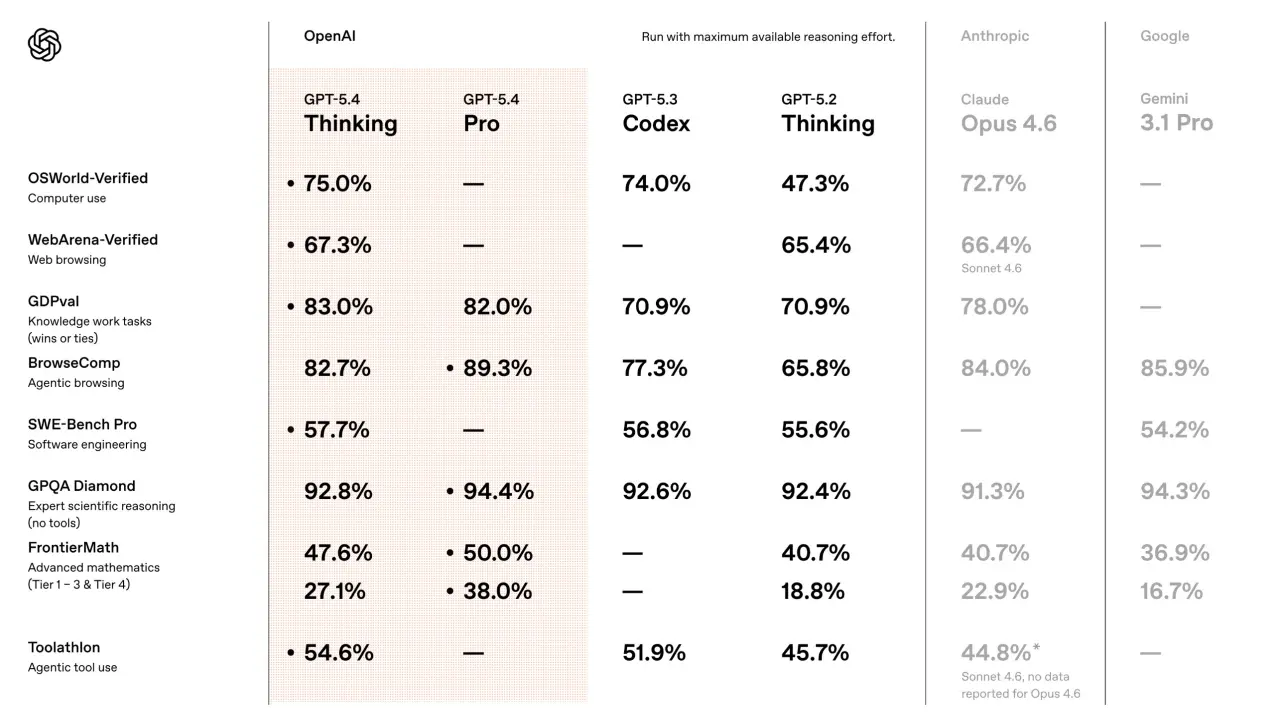
Another area highlighted by the company is computer-use capability. On the OSWorld-Verified benchmark, which measures how effectively AI systems interact with operating systems and software interfaces, GPT-5.4 reportedly achieves a score of 75 percent. The model also introduces support for up to one million tokens of context in preview, allowing it to process much longer documents, datasets, or codebases within a single session.
Benchmark results shared by OpenAI show GPT-5.4 reaching an 83 percent score on the GDPval evaluation and 81.2 percent on the MMMU-Pro benchmark without external tools. According to the company’s comparison data, those figures place the model slightly ahead of competing systems such as Gemini 3.1 Pro, which achieved an 80.5 percent score in the same test.
Document creation has also been a focus in this release. Earlier GPT models were sometimes criticized for producing text-heavy presentations or documents with limited visual structure. OpenAI says GPT-5.4 addresses this by improving layout awareness, visual variety, and integration with image generation tools. The company describes the model as capable of producing more polished documents and slides while maintaining clarity and readability.
For developers, the update introduces a new “fast mode” in Codex that increases token processing speed by up to 1.5 times while maintaining similar reasoning capability. The API also introduces a more efficient way to handle tools: instead of loading all tool definitions in the initial prompt, GPT-5.4 can receive a smaller list of available tools and dynamically search them as needed. This design is intended to reduce token usage and improve response speed.
GPT-5.4 Thinking is currently available to ChatGPT Plus, Team, and Pro subscribers, replacing the earlier GPT-5.2 Thinking model. OpenAI says GPT-5.2 Thinking will remain accessible in the legacy model list for approximately three months. The more advanced GPT-5.4 Pro version is limited to ChatGPT Pro and Enterprise users.
Developers accessing the model through the API will see different pricing tiers depending on the variant used. The standard GPT-5.4 model is priced at $2.50 per million input tokens and $15 per million output tokens. GPT-5.4 Pro is significantly more expensive, with pricing set at $30 per million input tokens and $180 per million output tokens, reflecting its higher capability and enterprise focus.
The release of GPT-5.4 reflects a broader shift in the AI industry toward models designed not just for conversation but for structured work tasks. As companies increasingly rely on AI for coding support, document production, and research workflows, models like GPT-5.4 are being positioned as tools that fit directly into professional environments rather than purely experimental technology.