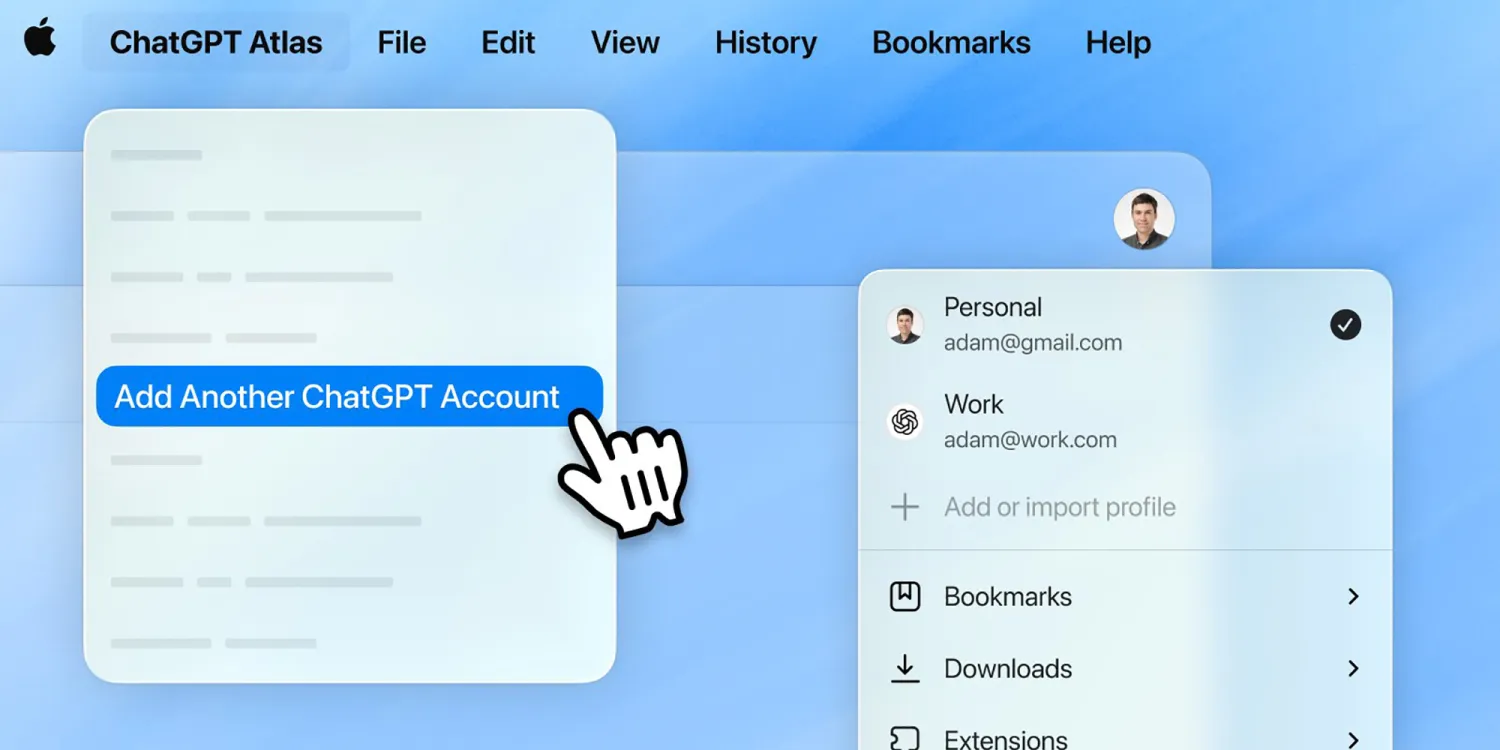
OpenAI has expanded the capabilities of its Atlas browser by introducing support for multiple ChatGPT accounts, addressing a limitation that users had raised since the browser’s early release. The update allows individuals to sign in to separate ChatGPT accounts across different browser profiles, making it easier to keep personal, professional, and academic activity distinct while using the same browsing environment.
The change builds on Atlas’s existing multi-profile system. Users could previously create separate profiles within the browser, but those profiles were tied to a single ChatGPT login. That restriction made it difficult for people who rely on multiple accounts—for example, a work account and a personal account—to fully adopt the browser across different parts of their daily workflow.
With the latest update, each Atlas profile can now be connected to a different ChatGPT account. This means users can maintain distinct environments for different types of tasks without repeatedly signing in and out. A work profile could remain connected to a company-managed ChatGPT account, while a personal profile might use an individual account for general browsing or experimentation with AI tools.
According to Adam Fry, product lead for ChatGPT Atlas, the lack of multi-account support had been a major obstacle for users who wanted to rely on the browser in all areas of their digital activity. The update is intended to remove that friction by allowing the browser to better reflect how people already separate their online identities.
The new capability is part of a broader effort by OpenAI to steadily expand the feature set of Atlas. When the company first introduced the agent-focused browser last year, early users noted that it lacked many functions commonly found in established browsers. In response, OpenAI adopted a frequent release cadence, introducing updates on a near-weekly basis.
Several features have been added over the past months to close that gap. These include improvements to tab organization, the ability to rename tabs, support for tab groups, and the option to import browser extensions. Together, these additions aim to make Atlas more competitive with traditional browsers while maintaining its focus on AI-assisted workflows.
Atlas is positioned as a browser designed around integrated AI assistance rather than simply adding AI features to an existing browsing model. The browser integrates ChatGPT directly into the browsing interface, allowing users to interact with AI tools while navigating websites, organizing information, or performing tasks that span multiple tabs.
The addition of multi-account support reflects a common requirement for productivity software as more people balance multiple digital roles. Professionals often maintain separate identities for work, personal use, and education, and switching between them efficiently is now considered a standard feature in most browsers and online services.
While the new update addresses one of the more visible usability issues, it also signals OpenAI’s broader strategy of refining Atlas incrementally rather than delivering large feature bundles all at once. As the browser continues to evolve, future updates are likely to focus on deeper integrations between browsing activity and AI-driven tools.