


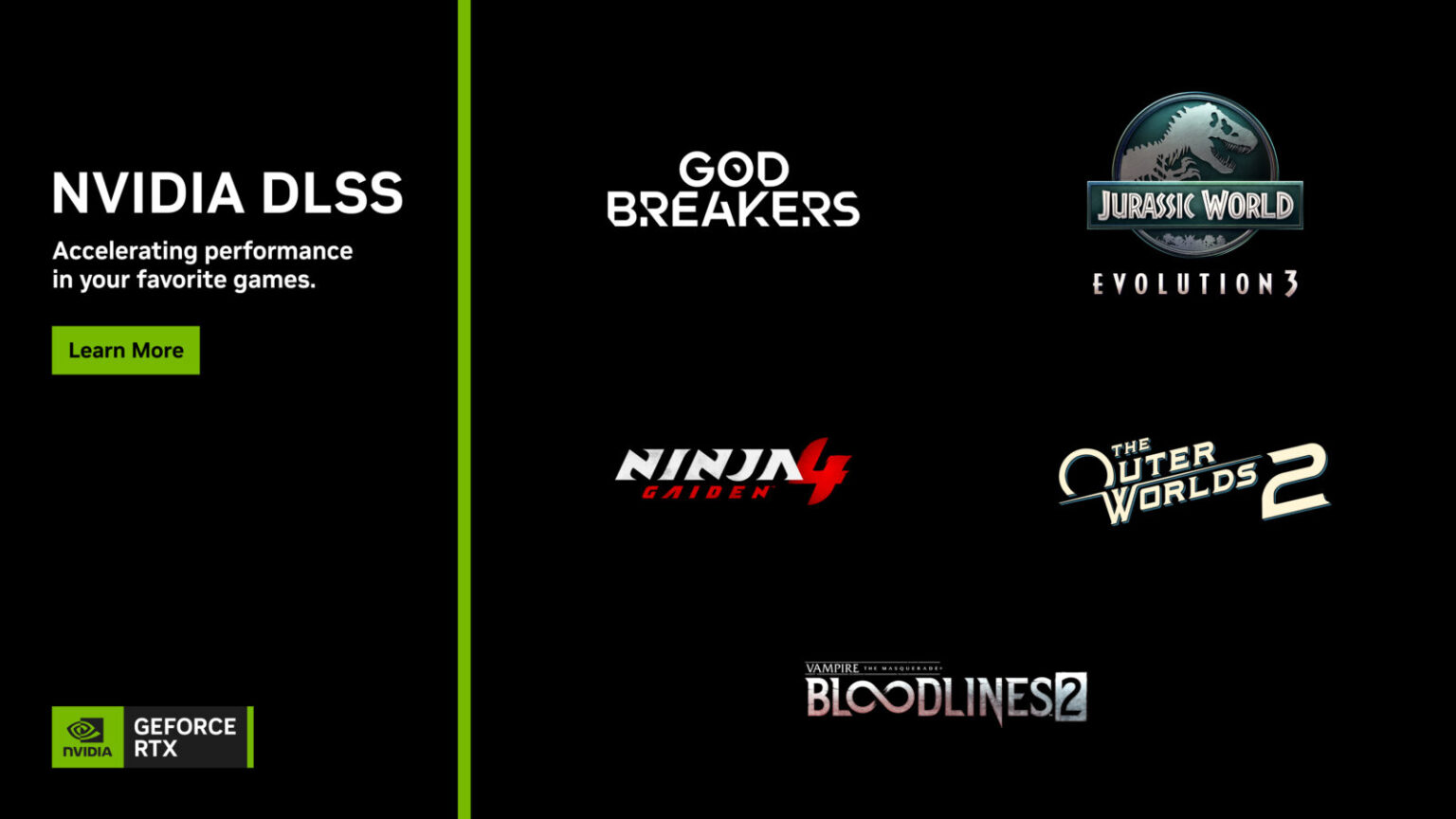
NVIDIA has expanded its DLSS 4 technology to several major upcoming titles, marking another step in the company’s ongoing integration of AI-driven performance tools across modern games. More than 800 titles now feature RTX technologies, and this week, The Outer Worlds 2, Vampire: The Masquerade – Bloodlines 2, and Jurassic World Evolution 3 are confirmed to include DLSS 4 support at launch. NINJA GAIDEN 4 also arrives with DLSS Super Resolution available from day one.
Obsidian Entertainment’s The Outer Worlds 2 enters Early Access on October 4 for Premium Edition buyers, with a wider release on October 29. The sequel takes players to a new colony where they serve as an Earth Directorate agent investigating mysterious rifts that endanger humanity. DLSS 4, including Multi Frame Generation and Super Resolution, offers performance scaling across GeForce RTX hardware, while ray-traced Lumen lighting adds greater depth and realism. NVIDIA recommends updating to the latest Game Ready Driver for optimal results.
In Vampire: The Masquerade – Bloodlines 2, from The Chinese Room and Paradox Interactive, players navigate a tense modern-day Seattle as an elder vampire balancing survival, secrecy, and influence. With DLSS 4 enabled, performance on the RTX 50 Series reportedly scales dramatically — NVIDIA cites a sixfold increase in average frame rates at 4K, with top-tier cards like the RTX 5090 exceeding 340 frames per second under maximum settings.
Jurassic World Evolution 3 from Frontier Developments extends the park-building formula, allowing players to manage dinosaur populations, attractions, and safety concerns across iconic and new landscapes. DLSS 4 with Multi Frame Generation and NVIDIA Reflex enhances both performance and input response, while ray-traced lighting and shadows bring additional visual detail to the simulation experience.
Meanwhile, Team NINJA and PlatinumGames’ NINJA GAIDEN 4 revives the action franchise with refined combat mechanics and a focus on fast, fluid gameplay. Players can enable DLSS Super Resolution to maintain smooth frame rates during visually intense fights. GODBREAKERS, a fast-paced action roguelite launching October 23, also incorporates DLSS Super Resolution to sustain performance during its dynamic, cooperative battles.
Alongside these game updates, NVIDIA announced enhancements to its AI ecosystem through NVIDIA ACE. The platform now supports the open-source Qwen3-8B small language model, enabling developers to integrate responsive, non-scripted NPCs that can process player input and generate context-aware dialogue in real time. Delivered as an In-game Inferencing (IGI) SDK plugin, Qwen3 simplifies implementation while optimizing simultaneous AI and graphics workloads.
NVIDIA also updated the RTX Branch of Unreal Engine (NvRTX) to version 5.6.1, featuring RTX Mega Geometry and improvements to ReSTIR PT performance and image quality. The accompanying Bonsai Diorama demo showcases these upgrades in action. Additional updates to the IGI SDK include Magpie Flow, which brings multilingual text-to-speech capabilities, and MultiLoRA adapters for more efficient model fine-tuning. Support for CUDA in Vulkan backends further improves synchronization between AI and graphical processes.
As NVIDIA continues to merge its AI initiatives with game development tools, the integration of models like Qwen3 and performance features such as DLSS 4 suggests a growing focus on both realism and computational efficiency in next-generation games.