


MediaTek has unveiled the Dimensity 9500, its most powerful mobile processor yet, designed to go head-to-head with Qualcomm’s Snapdragon 8 Elite Gen 5. The new flagship chipset pushes performance past the 4 GHz mark for the first time in MediaTek’s lineup, while also targeting major gains in efficiency, AI capability, and imaging. The first phones powered by the Dimensity 9500 are expected to launch by the end of 2025, with OPPO’s Find X9 Pro and Vivo’s X300 series among the first adopters.
The chip’s CPU configuration includes a single Arm C1-Ultra core clocked at 4.21 GHz, three performance cores at 3.5 GHz, and four efficiency cores at 2.7 GHz. MediaTek claims a 32% boost in single-core performance and 16% in multi-core compared to the Dimensity 9300. At the same time, efficiency has improved significantly, with reductions of up to 37% in peak power draw and 55% on the main core during sustained workloads. This balance should allow longer gaming sessions and heavy video editing without overheating or throttling.
Cameras are a central focus for the Dimensity 9500. The ISP supports up to 200-megapixel sensors and introduces 4K portrait video at 60 fps, alongside Dolby Vision 4K/120 fps video recording with stabilization—an industry first on Android. These specs even outpace the iPhone 17 Pro’s 4K/30 fps portrait video mode, underscoring MediaTek’s emphasis on cinematic mobile imaging.
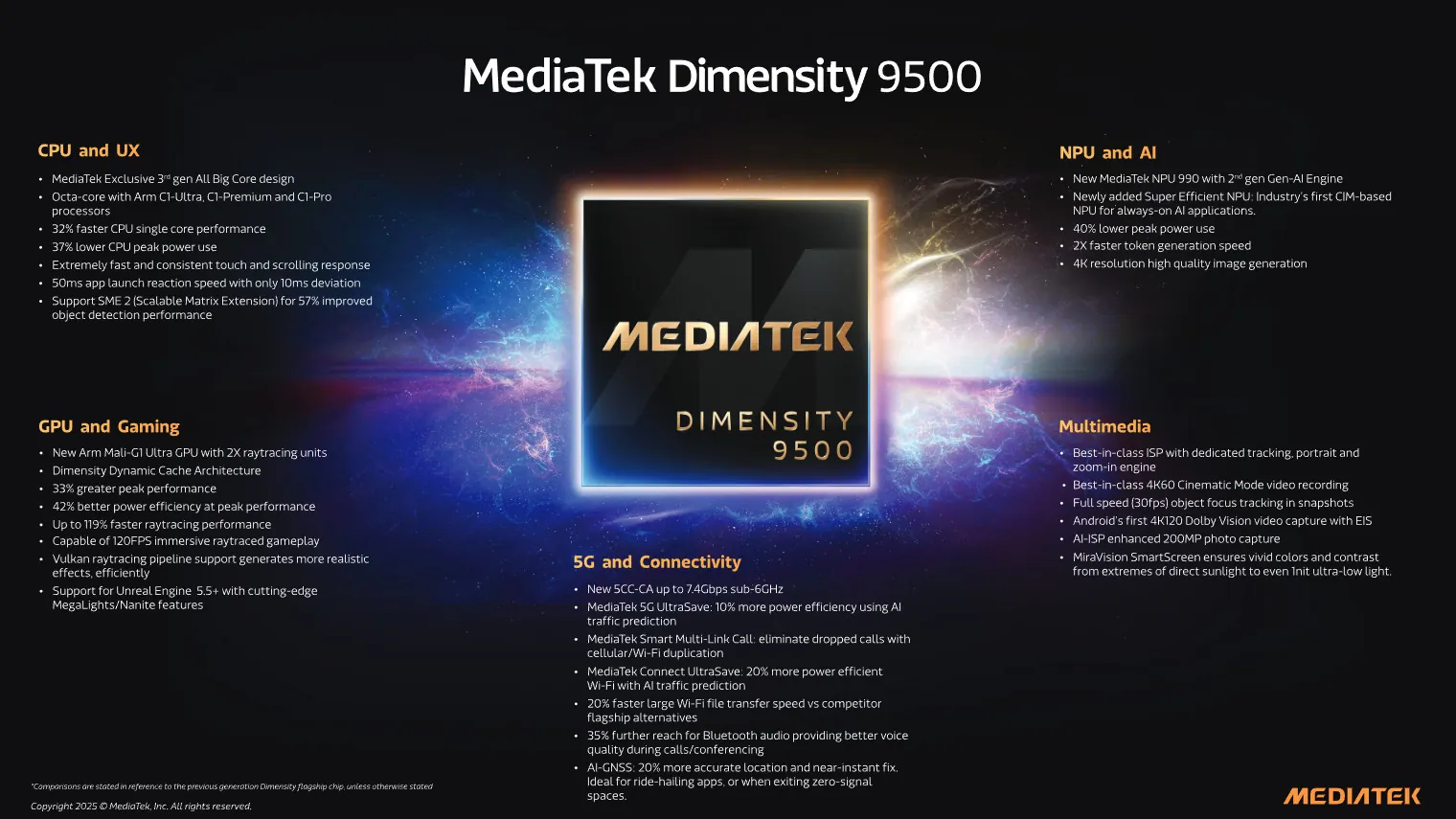
On the AI side, the chip debuts SME2 instructions for faster on-CPU machine learning, delivering 57% quicker object detection while cutting energy use by half for certain workloads. The upgraded NPU 990 handles up to 128,000 tokens and can generate 4K images, while using a CIM-based design to reduce energy demands by 42% for smaller models. With support for BitNet 1-bit quantization, the chip can run large-scale AI models with less storage and power overhead.
Graphics also see a step up with the Mali G1-Ultra MC12 GPU, which delivers 33% better performance and over double the ray tracing capability compared to its predecessor. Support for 120 fps ray tracing through interpolation, along with compatibility with Unreal Engine 5.5 and Vulkan 1.4, should bring console-level effects and smoother gameplay to Android flagships.
Other refinements include UFS 4.1 four-lane storage for faster data transfer, Bluetooth with 35% longer range, 5G speeds of up to 7.4 Gbps, and support for ultra-low screen brightness at just 1 nit.
With the Dimensity 9500, MediaTek is making a strong push into the premium tier, targeting not just raw speed but efficiency, AI processing, and camera performance as key differentiators. If the real-world results match the specifications, it could be the company’s strongest challenge yet to Qualcomm’s dominance in the high-end smartphone market.