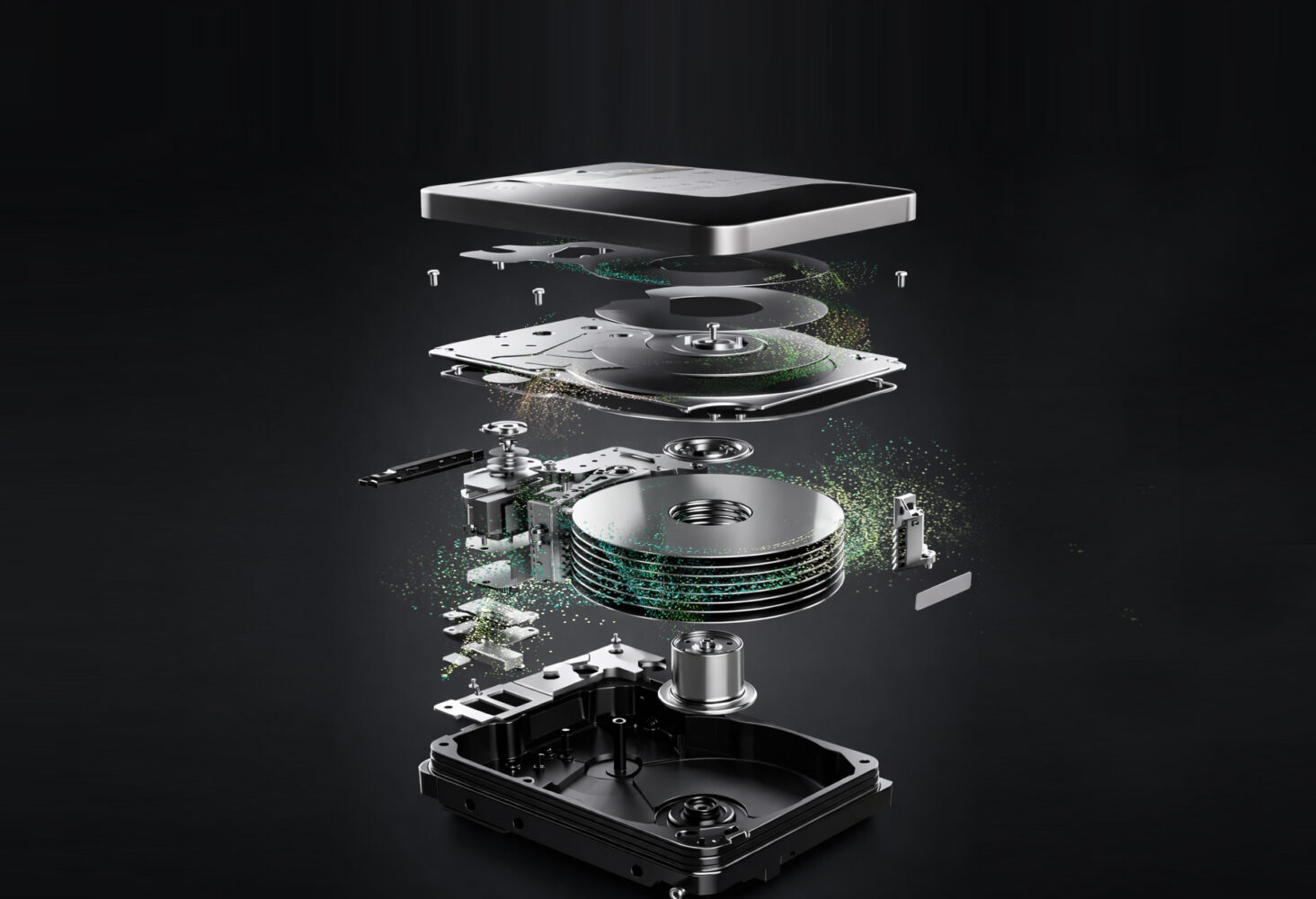
Seagate has introduced its latest high-capacity hard drive platform, positioning it as a response to sustained growth in cloud storage and AI infrastructure demand. The new Mozaic 4+ platform, built on heat-assisted magnetic recording (HAMR) technology, is now qualified and in production with two major hyperscale cloud providers. With capacities reaching up to 44TB per drive, the release marks one of the largest commercially deployed HAMR-based storage offerings to date.
The announcement reflects a broader shift in the data center storage market. As artificial intelligence workloads expand, hyperscale operators are managing increasingly large datasets that include training corpora, archival records, and AI-generated outputs such as high-resolution video and multimodal content. Mass-capacity hard drives remain central to this model because they offer lower cost per terabyte compared to flash storage for bulk and nearline data.
Seagate’s Mozaic 4+ platform builds on its existing HAMR roadmap. The company states that it is scaling from more than 4TB per disk today toward a long-term goal of 10TB per disk, which would enable hard drive capacities approaching 100TB in future generations. Rather than redesigning entire drive architectures with each step, the platform introduces incremental changes, including a new suspension architecture and an updated system-on-chip designed to support higher recording densities while maintaining enterprise reliability standards.
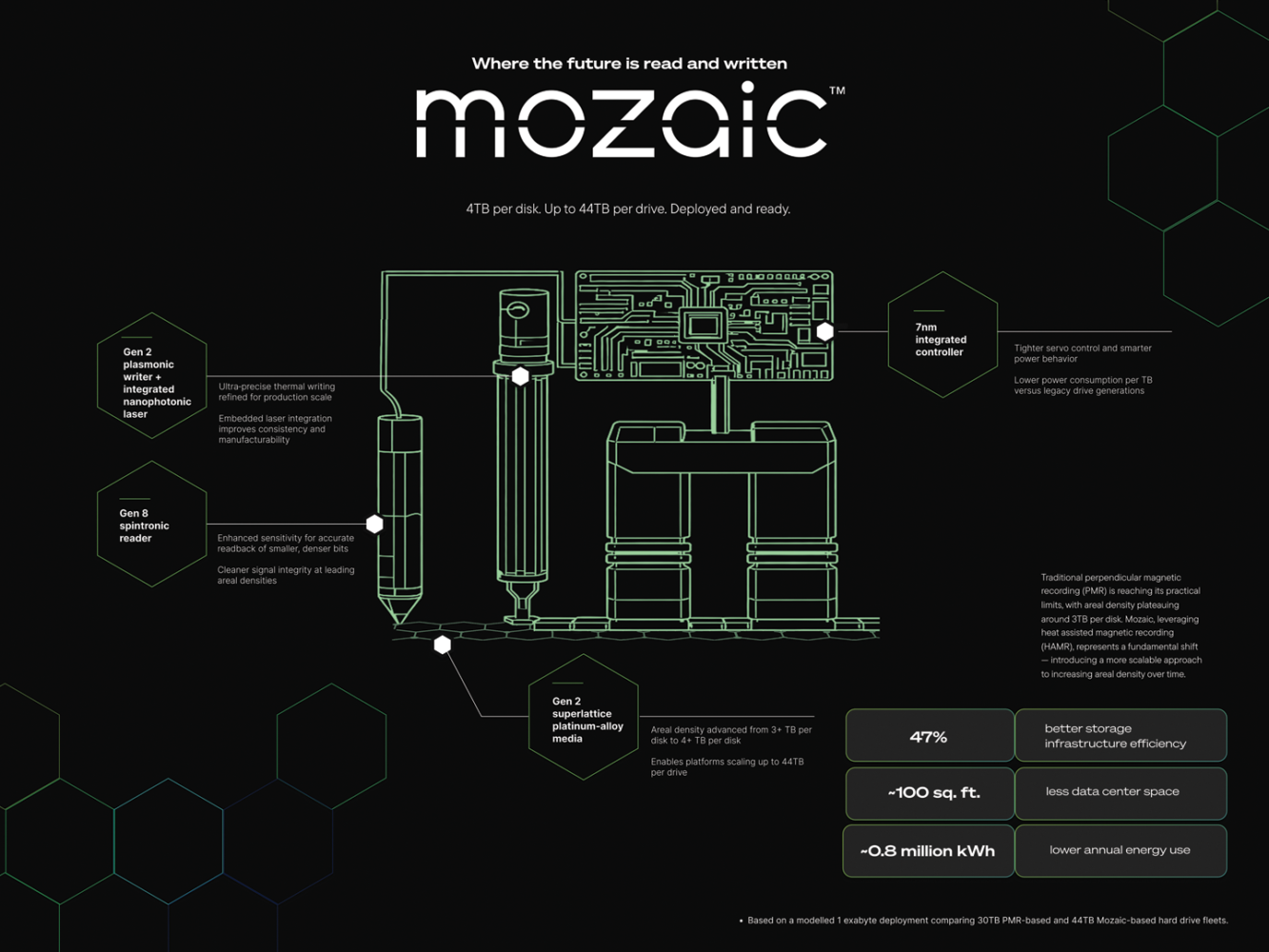
A notable aspect of the Mozaic platform is Seagate’s vertically integrated laser technology, which is central to HAMR. Heat-assisted magnetic recording uses a nanoscale laser to briefly heat the disk surface during writing, allowing for tighter bit density. By developing and manufacturing these photonic components internally, the company aims to maintain tighter control over supply chains, production yields, and qualification timelines—factors that have become increasingly important as hyperscale deployments grow in size and complexity.
From an infrastructure perspective, higher-capacity drives can affect rack-level economics. In a one-exabyte deployment scenario, Seagate estimates that replacing 30TB drives with Mozaic 4+ drives improves infrastructure efficiency by roughly 47 percent. The company projects a reduction of about 100 square feet in required data center space and annual energy savings of approximately 0.8 million kilowatt-hours. While actual results will vary by deployment model, these figures illustrate how incremental capacity gains can translate into measurable changes in footprint and operational cost at scale.
Industry analysts note that as generative AI systems mature, storage requirements are expanding rather than stabilizing. Larger model training runs, fine-tuning cycles, and the retention of synthetic data all contribute to long-term storage growth. In that context, high-capacity hard drives based on HAMR are increasingly seen as a practical component of AI data center infrastructure rather than an experimental technology.
Mozaic 4+ drives are currently shipping in volume to two hyperscale cloud providers, with broader availability expected as production ramps. As AI data growth continues, the commercial performance of HAMR-based storage will likely serve as a key indicator of how traditional hard disk technology adapts to next-generation workloads.