


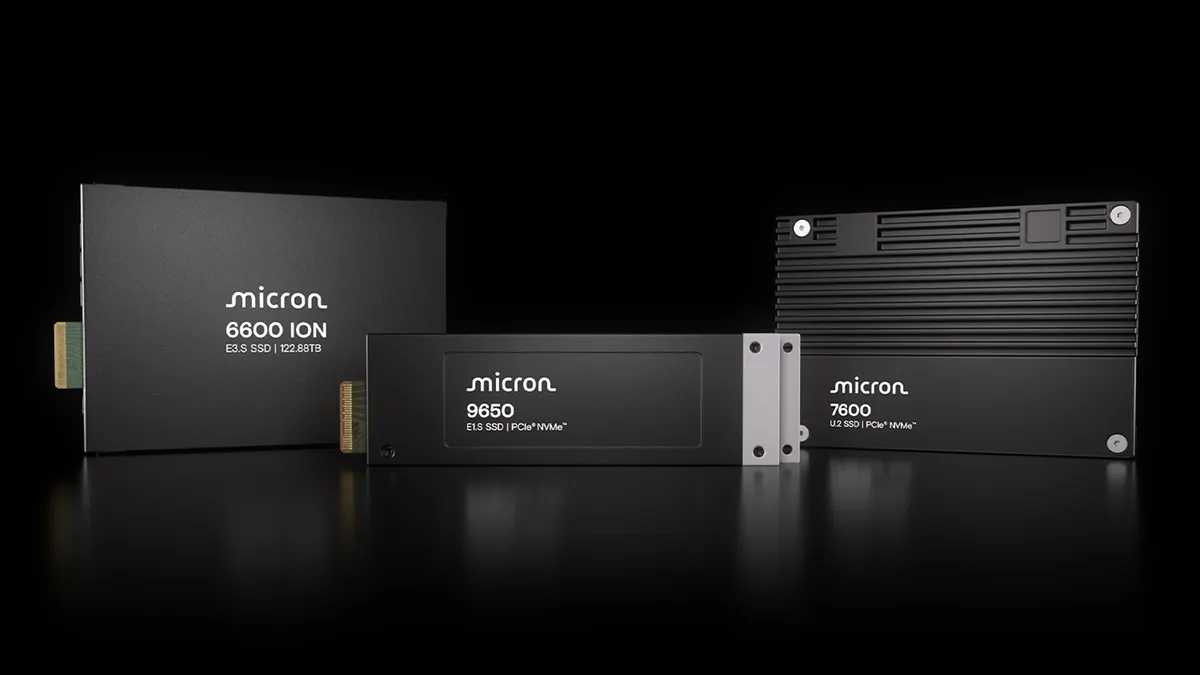
Micron has begun mass production of what it describes as the first PCIe 6.0 SSD to reach that stage, introducing the Micron 9650 series for data center and AI workloads. Built on a PCIe 6.0 x4 interface, the drive delivers sequential read speeds of up to 28GB/s and sequential write speeds of up to 14GB/s, effectively doubling peak read throughput compared to the fastest PCIe 5.0 enterprise SSDs currently on the market.
The Micron 9650 SSD is aimed squarely at AI servers and high-performance data center deployments rather than consumer systems. It is available in E1.S and E3.S enterprise form factors and will ship in two main variants: 9650 Pro and 9650 Max. The Pro model comes in capacities of 7.68TB, 15.36TB, and 30.72TB, while the Max version is offered in 6.4TB, 12.8TB, and 25.6TB configurations.
Performance metrics extend beyond raw sequential throughput. Micron rates the 9650 series at up to 5.4 million IOPS for random reads and 500,000 IOPS for random writes. In mixed 70/30 read/write workloads, the Pro version reaches up to 1.1 million IOPS, while the Max variant scales to 1.5 million IOPS. Endurance is another differentiator. For example, the 30.72TB 9650 Pro carries a random endurance rating of 56,064 terabytes written (TBW), while the 25.6TB 9650 Max is rated at 140,160 TBW, reflecting its positioning for heavier write-intensive environments.
Micron claims the 9650 delivers up to 40 percent faster write speeds and 67 percent faster random read performance compared to PCIe 5.0 SSDs, though it has not specified a direct model comparison. Most high-end PCIe 5.0 enterprise drives currently operate in the 10GB/s to 13GB/s sequential write range, making the jump to 14GB/s notable but consistent with the bandwidth improvements of PCIe 6.0.
Power consumption is rated at up to 25 watts, similar to the upper range of existing enterprise PCIe 5.0 SSDs. While that figure is higher than consumer PCIe 5.0 drives, which typically draw between 12 and 15 watts, it remains within expected limits for data center hardware. What has changed is the emphasis on cooling. The Micron 9650 is the company’s first SSD to support both air and liquid cooling configurations, with liquid cooling available for the E1.S variant. In dense server racks populated with multiple 25-watt drives, thermal management becomes more complex, making liquid cooling a practical option rather than an overstatement.
The introduction of a mass-produced PCIe 6.0 SSD reflects growing demand from AI infrastructure. Large language models and other AI workloads require high-throughput storage capable of moving large datasets quickly between accelerators and memory. As GPUs scale in capability, storage performance must keep pace, and PCIe 6.0 offers the bandwidth headroom to do so.
Consumers, however, should not expect PCIe 6.0 SSDs in desktops anytime soon. Mainstream platforms have yet to adopt PCIe 6.0, and widespread support is unlikely before the end of the decade. For now, the Micron 9650 series signals where enterprise storage is heading, driven largely by AI and data center requirements rather than traditional PC upgrades.