
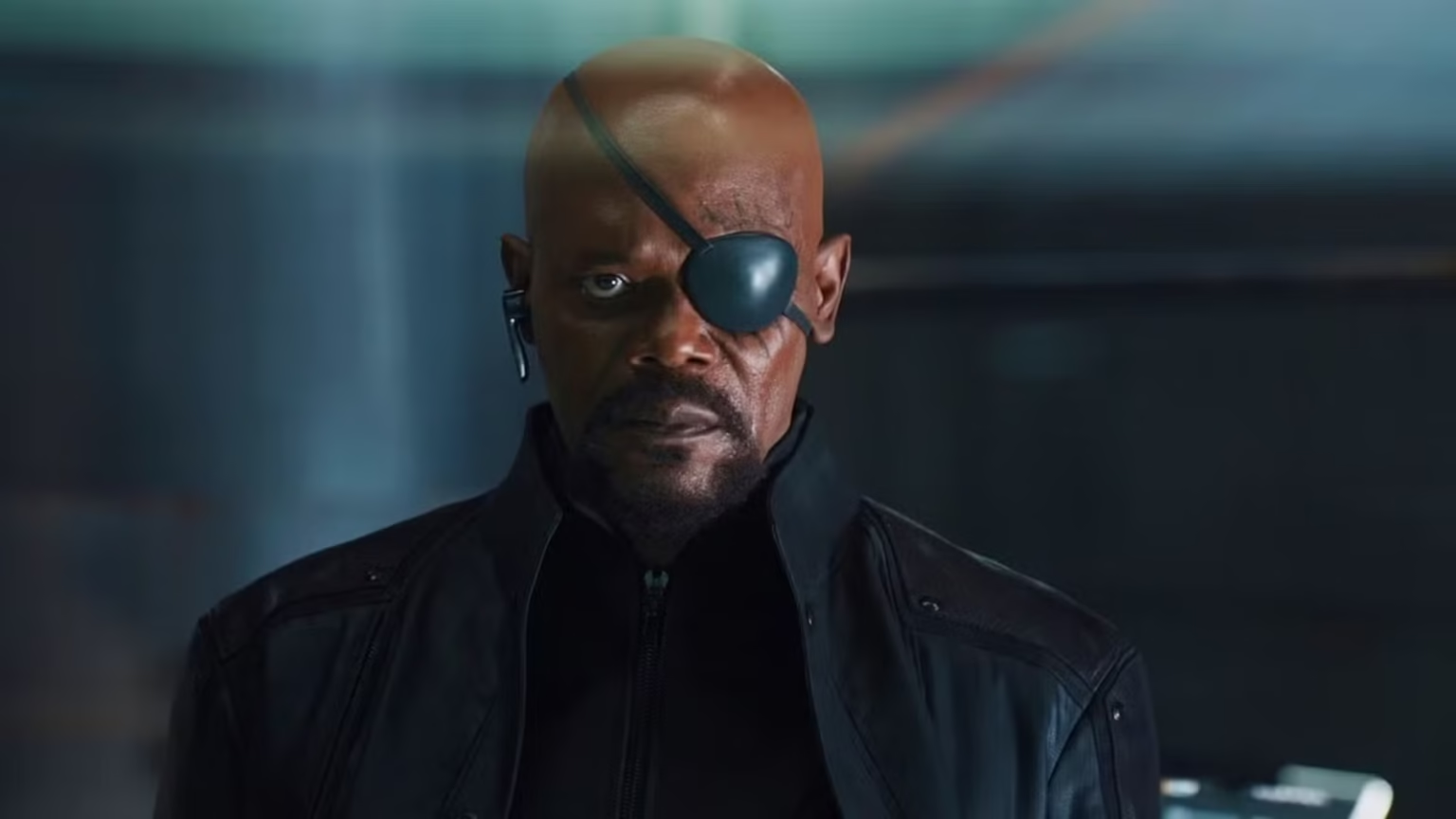
SHIELD’s return to Marvel continuity signals a shift in how global threats will be handled going forward, and the current Captain America series is positioning this comeback as a turning point for the larger Marvel Universe. Instead of restoring the organization to its former scale, the story frames Nick Fury Jr.’s effort as a controlled restart meant to avoid the excesses and failures long associated with earlier versions of SHIELD. This approach suggests that Marvel is steering the agency toward a more focused, less omnipresent role, which may influence how future conflicts are staged across the comics line.
The setup arrives in the wake of Doctor Doom’s death, an event that leaves Latveria vulnerable and volatile. Captain America is drawn into the mission as Fury Jr. assembles a leaner SHIELD team, emphasizing precision over breadth. Marvel appears to be using this plot point not only to reintroduce SHIELD but also to redefine its purpose after years of narrative absence. In past eras, SHIELD often acted as a catch-all authority in superhero affairs, sometimes overshadowing the heroes themselves. The current storyline gestures toward a more restrained version of the group, one that acknowledges past missteps baked into its history.
Chip Zdarsky, writer of Captain America #6, has indicated that this new SHIELD is intentionally modest in scope. Fury Jr. is depicted as trying to rebuild an organization without repeating the questionable decisions that shaped his father’s tenure, which included overreach, secrecy and ethically questionable initiatives. This reframing opens the door for Marvel to reexamine how institutional power functions within its universe, especially as the line prepares for what looks like a new cycle of political and geopolitical storytelling.
What makes SHIELD’s return noteworthy is the implication that its scaled-down structure may intensify rather than dilute future threats. A smaller team responding to international crises—in this case, the uncertainty surrounding Latveria after Doom’s fall—creates opportunities for more grounded espionage elements to complement superhero action. It also suggests that the next substantial adversary in Marvel’s comics may emerge from this unstable power landscape, possibly tied to the vacuum left by Doom. Marvel has often used SHIELD to frame incoming dangers, and the organization’s revival here signals that the political dimension of upcoming stories will carry significant weight.
Nick Fury Jr.’s measured approach hints at a shift in how Marvel intends to balance character-driven arcs with broader world-building. Captain America’s involvement places him at the center of this new direction, bridging superhero ideals with the strategic realities of global security. As this storyline unfolds, SHIELD’s reintroduction seems less like a nostalgic return and more like a narrative reset designed to set up the next major threat—one that grows out of geopolitical instability rather than cosmic or multiversal escalation.