

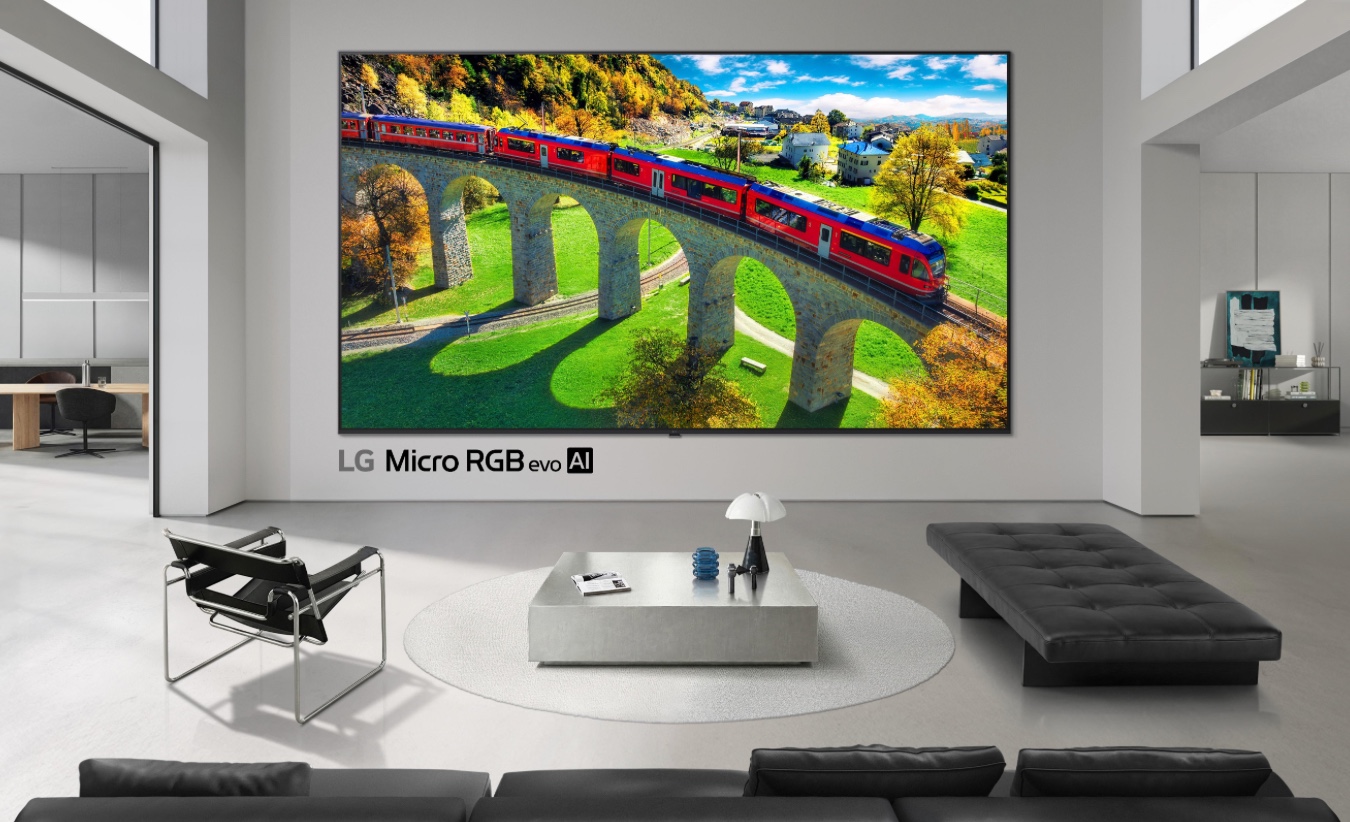
LG is preparing to introduce its first flagship RGB television, the LG Micro RGB evo, with a public debut planned for CES 2026. Positioned as the company’s most advanced LCD television to date, the Micro RGB evo reflects a broader industry push to extend LCD performance through more precise backlighting and processing, rather than relying solely on self-emissive OLED panels. While LG frames the launch as a milestone, the more practical significance lies in how the set blends established OLED processing techniques with a new RGB-based LCD architecture.
At the core of the LG Micro RGB evo is Micro RGB technology, which replaces conventional white LED backlights with individually controlled red, green, and blue LEDs at a much smaller scale than traditional MiniLED systems. According to LG, this allows for tighter control of color and luminance while remaining within the structural limits of LCD displays. The company says this design is intended to close the gap between high-end LCD TVs and OLED, particularly in color accuracy and contrast control.
Image processing is handled by the Alpha 11 AI Processor Gen 3, a dual-engine system designed to apply multiple AI-driven enhancements simultaneously. In practical terms, this processor manages upscaling, noise reduction, and color mapping across different content types. While AI-driven processing has become common across premium televisions, LG is emphasizing dual-path upscaling as a way to preserve detail without over-sharpening, an issue that has affected earlier AI-enhanced displays.
Color reproduction is a central selling point of the LG Micro RGB evo TV. The display has received Intertek certification for 100 percent coverage of BT.2020, DCI-P3, and Adobe RGB color spaces. These standards are typically associated with professional content creation and high-end HDR mastering, suggesting the panel is aimed not only at home cinema enthusiasts but also users concerned with color accuracy for editing and post-production workflows. Whether consumers will meaningfully perceive the difference outside controlled environments remains an open question, but the specifications place the set among the most color-capable LCD TVs announced so far.
Contrast performance is supported by what LG calls Micro Dimming Ultra, which manages over a thousand dimming zones. While this is not unprecedented in large-format LCD TVs, the company claims improved precision in how brightness and color are adjusted at the zone level. As with other full-array local dimming systems, real-world performance will depend on how effectively blooming and halo effects are minimized during high-contrast scenes.
The LG Micro RGB evo also incorporates the latest version of webOS, with personalization tools such as Voice ID, AI-assisted picture and sound tuning, and a customized home interface. Additional features like AI Search and an AI Chatbot are designed to streamline navigation, though their long-term usefulness will likely depend on accuracy and responsiveness rather than novelty.
The television will launch in 75-inch, 86-inch, and 100-inch sizes under the MRGB95 model line. LG plans to showcase the Micro RGB evo at CES 2026 in Las Vegas, where hands-on demonstrations will provide a clearer sense of how this new RGB LCD approach compares to existing MiniLED and OLED options in everyday viewing conditions.