

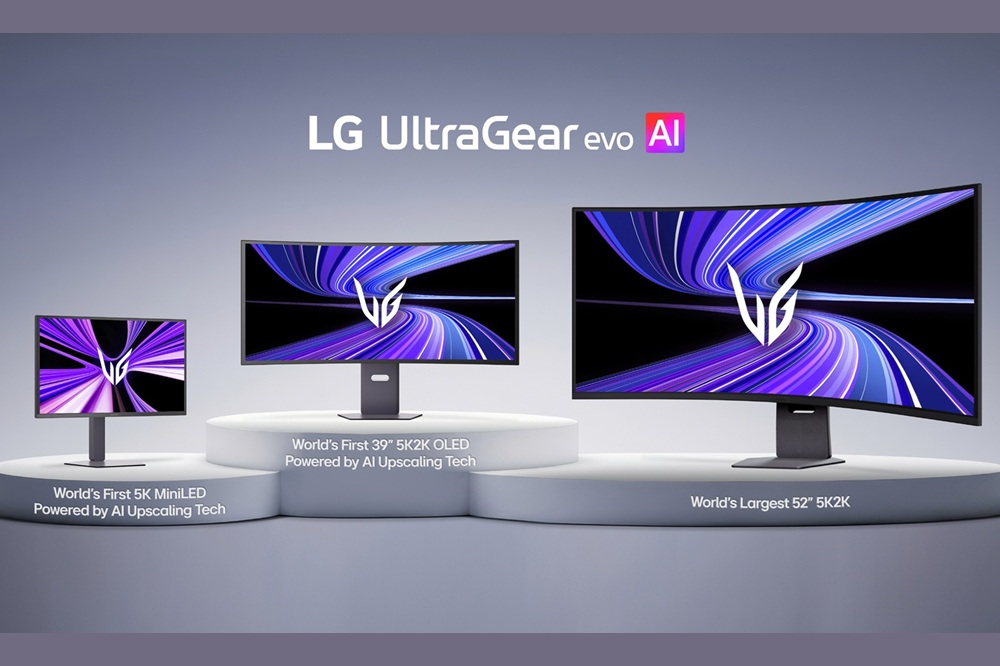
LG Electronics has announced a new premium gaming monitor line called UltraGear evo, which it plans to formally introduce at CES 2026. The lineup expands LG’s high-resolution gaming strategy with monitors that target 5K and 5K2K gaming across multiple panel technologies, including OLED, MiniLED, and ultra-wide formats. Rather than focusing on a single flagship, UltraGear evo is positioned as a range that prioritizes resolution consistency across different sizes and use cases.
A central feature of the UltraGear evo series is a new on-device image processing system that LG describes as the world’s first 5K AI upscaling solution. The technology is designed to upscale lower-resolution content to near-5K output without relying on additional GPU power. In practical terms, this approach is meant to reduce the hardware demands typically associated with ultra-high-resolution gaming, while broadening the range of games and media that can be displayed sharply on 5K-class panels. Alongside upscaling, the system also handles scene-based image adjustments and audio tuning directly on the monitor.
The initial UltraGear evo lineup includes three models. The 39-inch 39GX950B is a 5K2K OLED display built on LG’s Primary RGB Tandem OLED panel technology. It combines a 5120 x 2160 resolution with a 21:9 aspect ratio and a 1500R curve, offering the vertical space of a 32-inch display with additional horizontal width. The monitor supports dual refresh modes, allowing users to switch between 165Hz at full resolution or 330Hz at a lower resolution, depending on performance needs. A 0.03ms response time and DisplayHDR True Black 500 certification position it clearly toward high-end gaming and mixed-use scenarios.
The 27-inch 27GM950B takes a different approach, using a 5K MiniLED panel with 2,304 local dimming zones. LG is emphasizing improved blooming control through tighter panel-to-backlight integration, a known challenge for high-density MiniLED displays. The monitor supports the same dual-mode refresh strategy as the OLED model, offering 165Hz at 5K and 330Hz at QHD, alongside a 1ms response time and DisplayHDR 1000 certification.
At the largest end of the lineup, the 52-inch 52G930B is positioned as a large-format 5K2K gaming display with a 240Hz refresh rate. Its 12:9 aspect ratio delivers a wider workspace than standard UHD monitors, while a 1000R curve is intended to maintain immersion at close viewing distances. HDR 600 support and a screen height comparable to a 42-inch 16:9 display place it between traditional monitors and compact gaming TVs.
LG plans to showcase the UltraGear evo lineup at CES 2026 through themed demonstration zones, while also beginning global sales of the UltraGear GX7, a separate 27-inch QHD OLED monitor with refresh rates up to 540Hz. Taken together, the announcements suggest LG is continuing to push resolution and refresh rate boundaries simultaneously, while attempting to ease hardware requirements through monitor-side processing rather than relying entirely on GPU advances.