
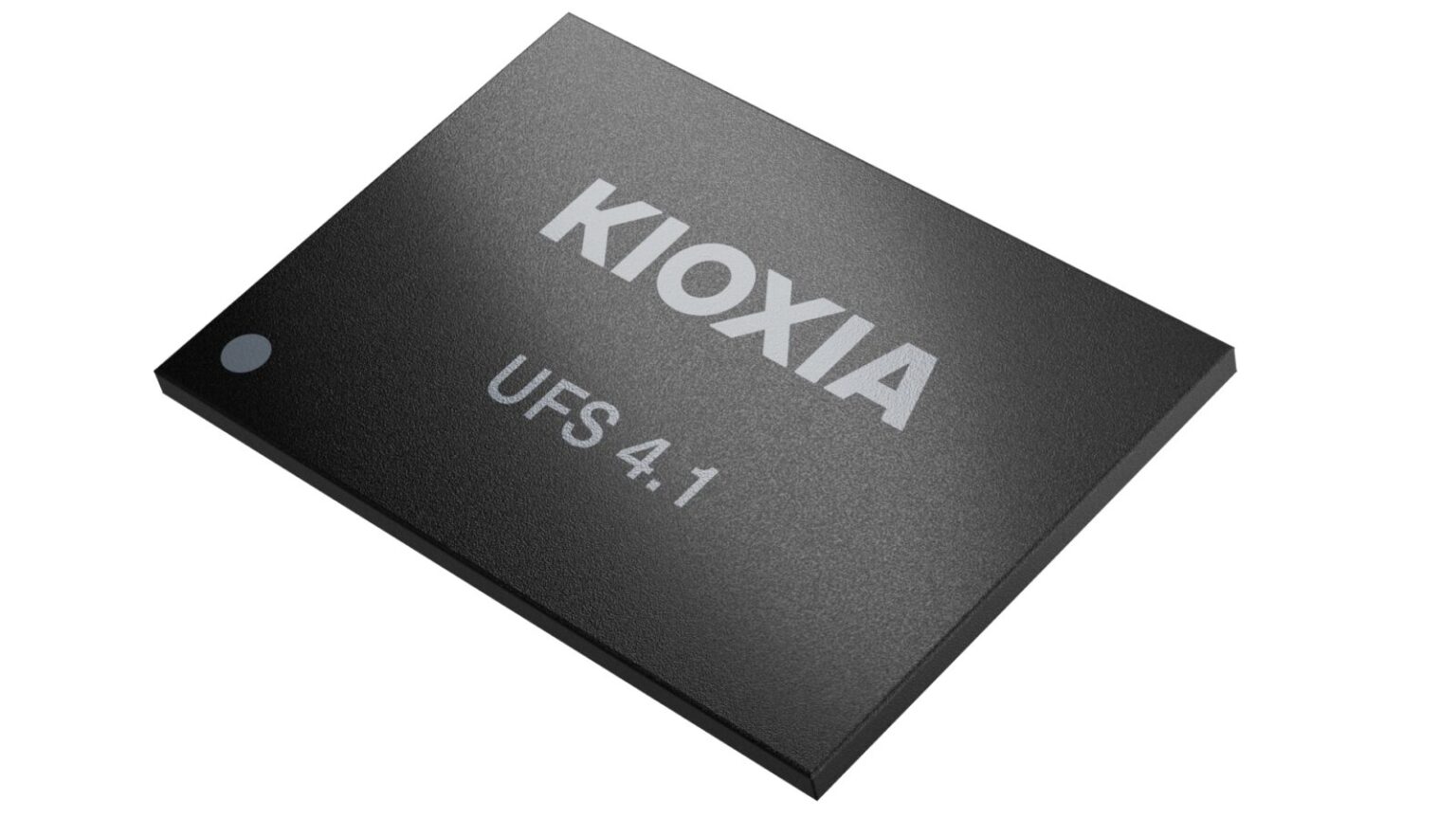
KIOXIA has begun sampling a new generation of embedded flash memory devices aimed at smartphones and other compact computing products that increasingly demand higher storage capacities. The company announced the availability of its QLC-based Universal Flash Storage devices compliant with the UFS 4.1 specification, positioning them as a higher-density alternative to existing TLC-based solutions.
The newly announced parts use quad-level cell, or QLC, technology, which stores four bits per cell and allows for greater storage density than triple-level cell designs. In practical terms, this makes QLC UFS more suitable for devices where capacity is a priority, such as premium smartphones, tablets, and emerging categories like AR and VR hardware. KIOXIA says recent improvements in controller design and error correction have narrowed the traditional performance gap associated with QLC memory, making it viable for read-intensive workloads common in mobile devices.
At the core of the new UFS 4.1 devices is KIOXIA’s eighth-generation BiCS FLASH 3D memory. This iteration introduces CMOS directly bonded to array technology, an architectural change that integrates peripheral circuitry more closely with the memory array. According to the company, this approach improves power efficiency and contributes to overall performance gains without increasing the physical footprint of the package.
Compared with the previous generation of KIOXIA QLC UFS based on UFS 4.0 and BiCS6 memory, the company reports notable improvements in several areas. Sequential write performance is said to be up by roughly 25 percent, while random read and random write speeds show much larger increases. Write efficiency has also been improved, with reductions in write amplification when certain acceleration features are disabled. As with most semiconductor announcements, these figures are based on internal testing and may vary depending on workload and system design.
The devices will initially be offered in 512GB and 1TB capacities, combining flash memory and controller in a single package built to standards defined by JEDEC. In addition to higher capacity, the physical package has been reduced in size compared with earlier QLC UFS products, which could make integration easier for device manufacturers working within tight space constraints.
While smartphones and tablets remain the primary target, KIOXIA is also positioning these parts for PCs, networking equipment, IoT hardware, and AI-enabled edge devices. As operating systems, applications, and on-device models continue to grow, storage capacity has become a more visible bottleneck, even in compact products.
Rather than introducing a dramatic shift in storage technology, KIOXIA’s QLC UFS 4.1 devices reflect an incremental approach: higher density, modest performance gains, and improved efficiency within an established standard. For device makers, the appeal lies less in headline speed numbers and more in the ability to ship higher-capacity products without a proportional increase in cost or power consumption.