

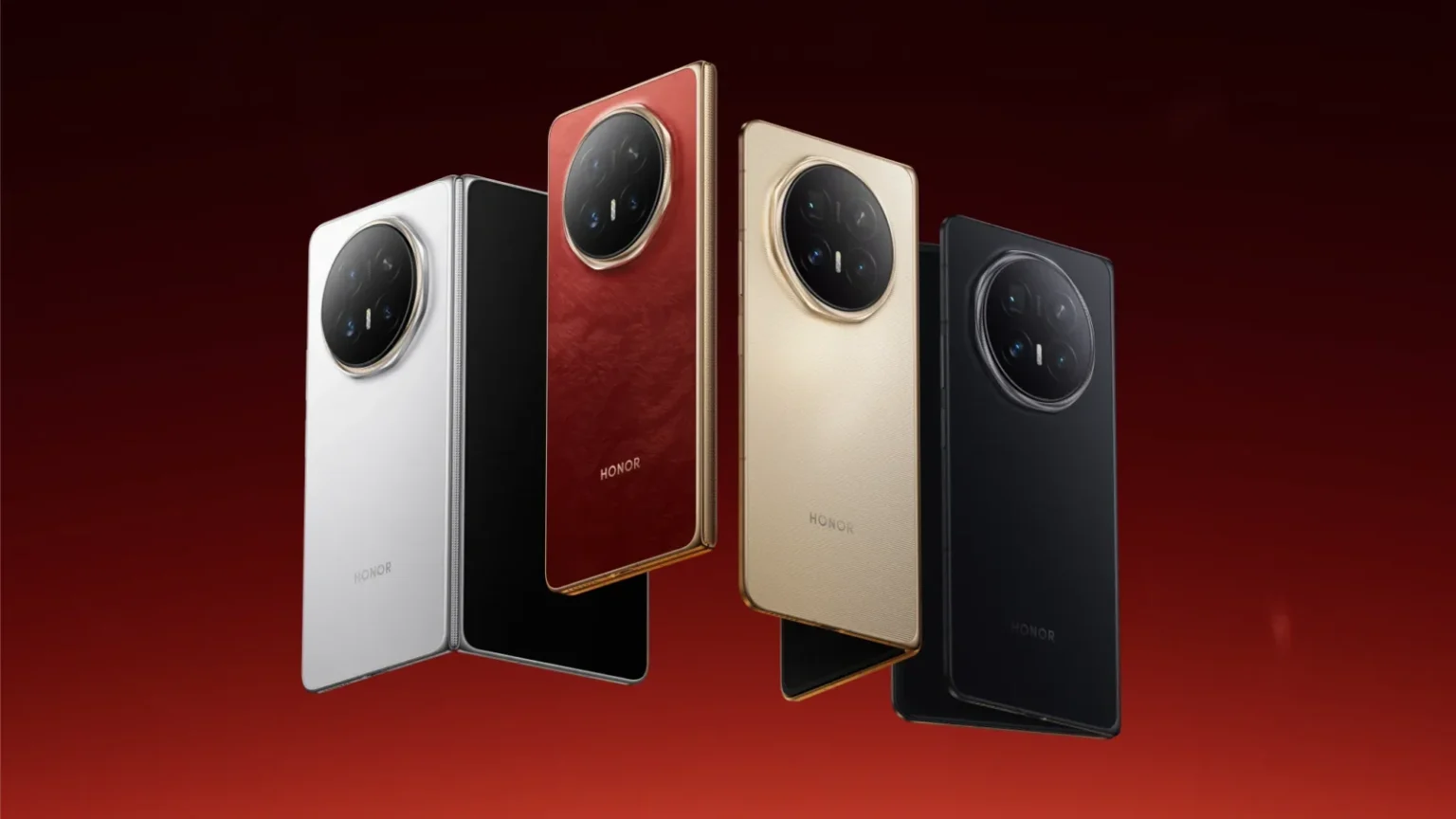
Honor has introduced the Honor Magic V6, its latest slim foldable phone, ahead of Mobile World Congress in Barcelona. The device continues the company’s focus on reducing thickness while increasing battery capacity, two areas that often work against each other in foldable design.
The Honor Magic V6 measures 4 mm when unfolded and 8.75 mm when folded, marginally slimmer than last year’s Magic V5, which came in at 4.1 mm and 8.8 mm respectively. The differences are small in practical terms, but in the competitive foldable market, even fractions of a millimeter are used to signal engineering progress. Thinness remains a key marketing point across brands, particularly as foldables attempt to match the everyday usability of conventional smartphones.
More consequential than the size reduction is the battery upgrade. The Magic V6 carries a 6,600 mAh battery, a notable increase from the 5,820 mAh cell in its predecessor. Battery life has long been a trade-off in foldable devices due to space constraints and dual-display power demands. If real-world performance aligns with the capacity bump, the Magic V6 could offer stronger endurance than many rivals in its class.
Charging speeds are also competitive. Using the company’s SuperCharge system, the device supports 80W wired charging and 66W wireless charging. While peak charging rates vary depending on conditions, these figures place the phone among the faster-charging foldables currently available.
Honor also previewed advances in silicon-carbon battery technology, citing a 32 percent silicon density that could potentially enable foldables to exceed 7,000 mAh in future iterations. Whether that translates into commercial devices soon remains to be seen, but it signals continued experimentation in battery chemistry to address one of the category’s structural limitations.
The device features a 7.95-inch main AMOLED display with a resolution of 2352 x 2172, alongside a 6.52-inch external screen at 2420 x 1080. Both panels use LTPO 2.0 technology, allowing variable refresh rates from 1 to 120Hz to balance smoothness and energy efficiency. Adaptive refresh rates have become standard in premium phones, but remain especially important in foldables where power consumption is amplified.
Durability is another focal point. Honor says it has developed a new “Super Steel Hinge” rated at 2,800 MPa tensile strength. The company also claims a 44 percent reduction in visible crease depth compared to the previous model. Foldable creases have improved across the industry in recent years, but they remain a point of scrutiny for buyers concerned about long-term wear. The external display includes an anti-reflective coating with a stated reflectivity rating of 1.5 percent, aimed at improving outdoor visibility.
Under the hood, the Magic V6 runs on Qualcomm’s Snapdragon 8 Elite Gen 5 processor, paired with 16GB of RAM and 512GB of storage. The rear camera system includes a 50-megapixel main sensor with an f/1.6 aperture, a 64-megapixel telephoto lens at f/2.5, and a 50-megapixel ultrawide at f/2.2. Dual 20-megapixel front-facing cameras handle selfies and video calls.
In an effort to broaden its appeal outside China, Honor is emphasizing cross-platform compatibility. The Magic V6 supports two-way notification syncing with an iPhone, can mirror notifications to an Apple Watch, and offers file-sharing and extended display functionality with Macs. These features reflect a broader strategy among Android manufacturers to reduce friction for users embedded in Apple’s ecosystem.
Honor has not disclosed pricing but says the Magic V6 will launch in select international markets in the second half of the year. As foldable smartphones continue to mature, improvements in battery capacity, hinge durability, and ecosystem compatibility may prove more meaningful than incremental gains in thinness. The Honor Magic V6 positions itself around those practical refinements, though its success will depend on pricing and long-term reliability once it reaches consumers.