

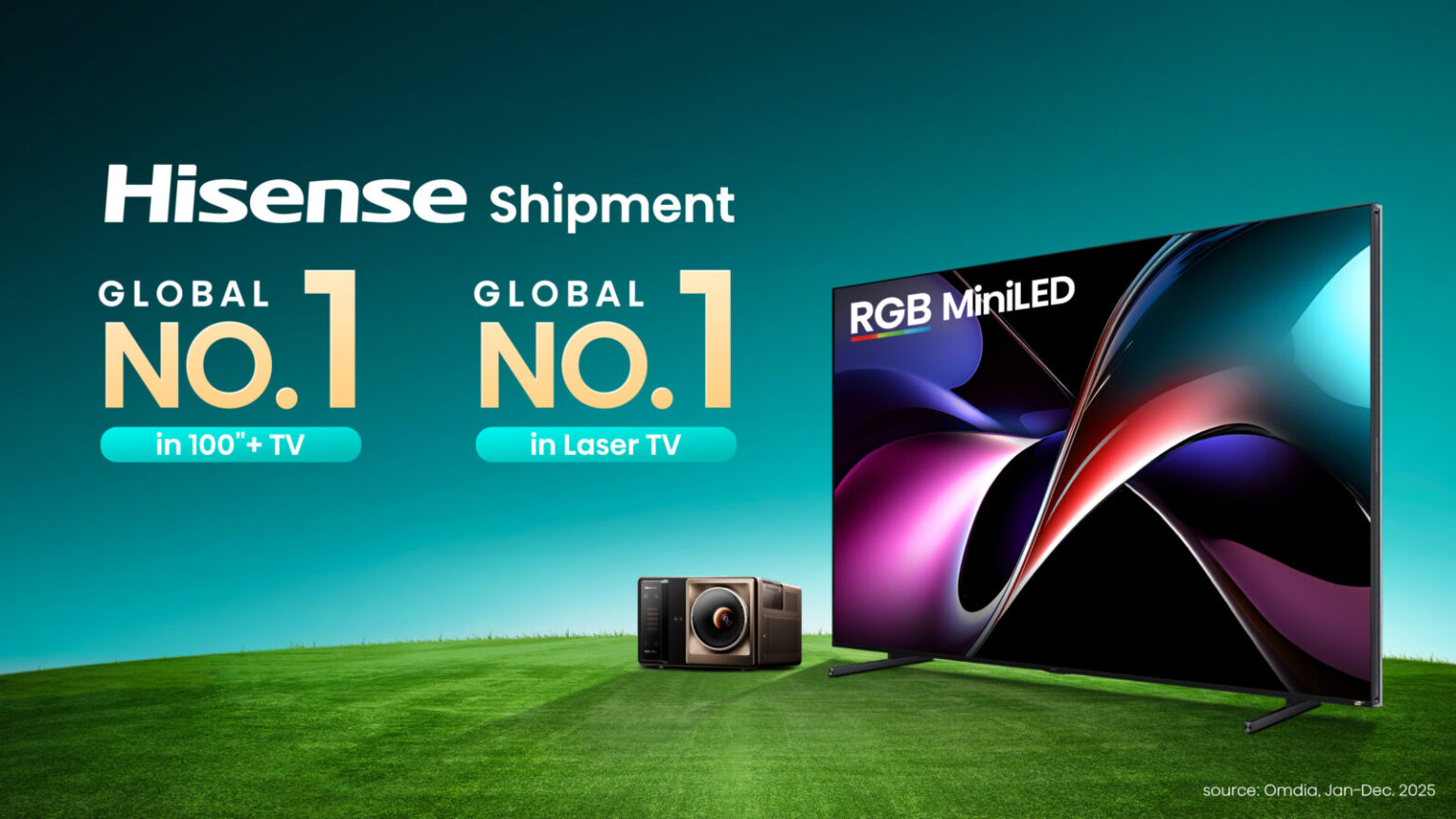
Hisense says it led global TV shipments in 2025 in two of the industry’s most closely watched large-format categories: 100-inch-and-above televisions and Laser TVs. According to full-year shipment data from Omdia, the company ranked first worldwide in the 100-inch-plus segment for the third consecutive year, covering 2023 through 2025. It also maintained the top position in Laser TV shipments in 2025, marking seven straight years leading that category.
In the 100-inch-and-over TV segment, Hisense accounted for 57.5 percent of shipments across the first three quarters of 2025 and 57.1 percent for the full year. The company ranked first globally in both Q3 and across 2025 as a whole. In Laser TVs, its reported share reached 69.7 percent for Q1 through Q3 and 70.3 percent for the full year, again placing it first in both Q3 and overall annual shipments. These figures underscore how concentrated the ultra-large-screen market remains, particularly as average screen sizes continue to grow in premium home entertainment setups.
The broader context is a television market that has shifted toward larger panels as prices fall and living spaces adapt to streaming, gaming, and sports viewing. Growth in 100-inch TVs reflects improvements in panel yields, MiniLED backlighting, and distribution logistics that make oversized displays more practical for residential installation. At the same time, Laser TV systems—which use ultra-short-throw projection paired with ambient light-rejecting screens—have carved out a niche for consumers seeking very large images without wall-dominating panels.
A key part of Hisense’s strategy centers on RGB MiniLED, a backlighting approach designed to improve color precision and brightness control compared to conventional MiniLED systems. Instead of relying on white LEDs with color filters, RGB MiniLED uses separate red, green, and blue light sources to enhance color volume and reduce light leakage. Industry analysts have noted that RGB MiniLED is expected to expand more rapidly from 2026 onward, particularly in premium segments where differentiation is increasingly technical rather than cosmetic.
At CES 2026, Hisense presented several new large-screen models, including the 116UXS powered by RGB MiniLED evo, as well as the UR8 and UR9 RGB MiniLED series and the Laser Projector XR10. These launches reflect a focus on scaling advanced backlighting and projection technologies across multiple price tiers rather than limiting them to concept products.
Hisense’s portfolio now spans RGB MiniLED, TriChroma Laser, and MicroLED technologies, positioning the company across several competing approaches to high-end display performance. While shipment leadership does not necessarily equate to overall market dominance across all TV sizes, the data suggests that the company has secured a strong position in categories where margins and brand perception are typically higher.
Founded in 1969, Hisense operates in more than 160 countries and produces a range of home appliances and consumer electronics. As global TV makers compete for share in a market defined by incremental hardware advances and intense pricing pressure, large-format and specialized display technologies are likely to remain a central battleground in 2026 and beyond.