

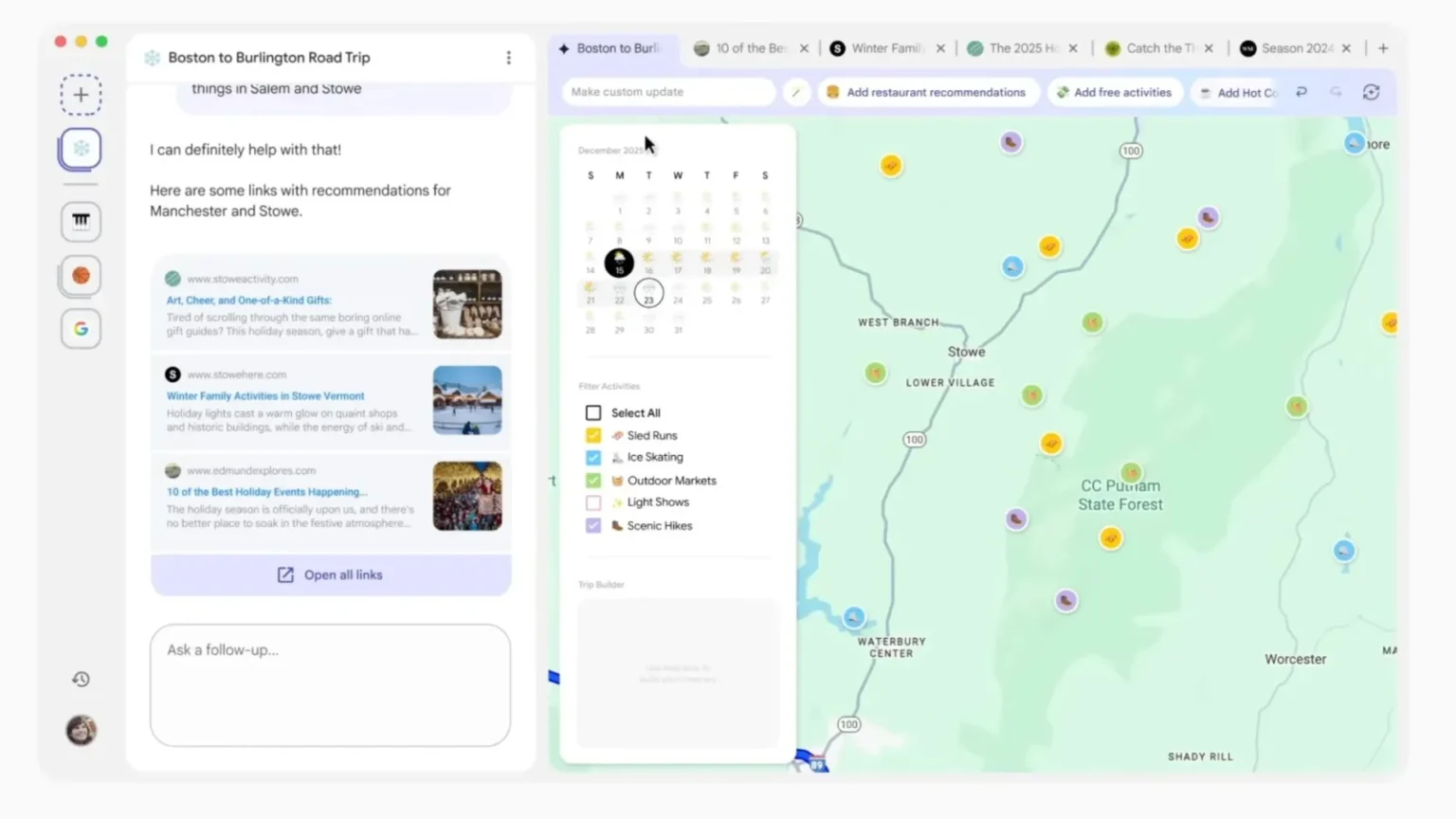
Google is testing a different idea of what a web browser could be, one that moves beyond passive tab management and into something closer to task-oriented software creation. The experiment, called Disco, is being developed within Google Labs and centers on a feature known as GenTabs, which uses Google’s Gemini 3 model to transform active browsing sessions into small, purpose-built web apps.
At its core, Disco is designed to address a familiar problem: modern browsing often involves juggling dozens of tabs, notes, and documents while trying to complete a single task. Instead of expecting users to manually organize that chaos, GenTabs observes the pages you have open, the context of your activity, and your interactions across tabs. Based on that information, it attempts to infer your goal and generate an interactive tool inside the browser to help you complete it.
Rather than asking users to learn a new interface or write code, GenTabs relies on natural language input. A user can describe what they want to accomplish, and the system responds by assembling a lightweight web application. These generated apps might consolidate relevant links, extract key information from open pages, or present data in a more structured way. Importantly, Google emphasizes that the content remains tied to its original sources, with clear links back to the web pages being referenced, rather than replacing them entirely.
This approach reflects a broader shift in how Google is experimenting with AI inside its products. Instead of focusing only on search results or chat-based answers, Disco treats AI as an organizational layer that sits on top of existing web content. The browser is no longer just a window to the internet, but a workspace that adapts dynamically to what the user is trying to do. In practice, this could mean automatically creating comparison views when shopping across multiple sites, or assembling a budgeting interface while researching financial tools.
However, Disco is very much an early-stage experiment. Access is currently limited to a small group of macOS users in the United States, and participation requires joining a waitlist and signing in with a personal Google account. The application process itself suggests that Google is being selective, asking applicants about their prior experience using AI tools in creative or experimental ways. There is no confirmation yet on when or if Disco will expand to Windows, ChromeOS, or other platforms.
Google has also been careful to frame Disco as a testing ground rather than a finished product. The company has stated that features from Disco and GenTabs could eventually influence larger products, potentially including Google Chrome, but no timeline has been shared. This cautious positioning reflects the uncertainty around how much automation users actually want inside their browsers, especially when it involves monitoring browsing behavior to infer intent.
If elements of Disco do make their way into Chrome, it would mark a meaningful shift in how browsers function. Instead of serving primarily as navigation tools, they could become adaptive systems that build temporary software tailored to specific tasks. Whether that vision proves practical, intrusive, or genuinely helpful will depend on how well Google balances automation, transparency, and user control as the experiment evolves.