
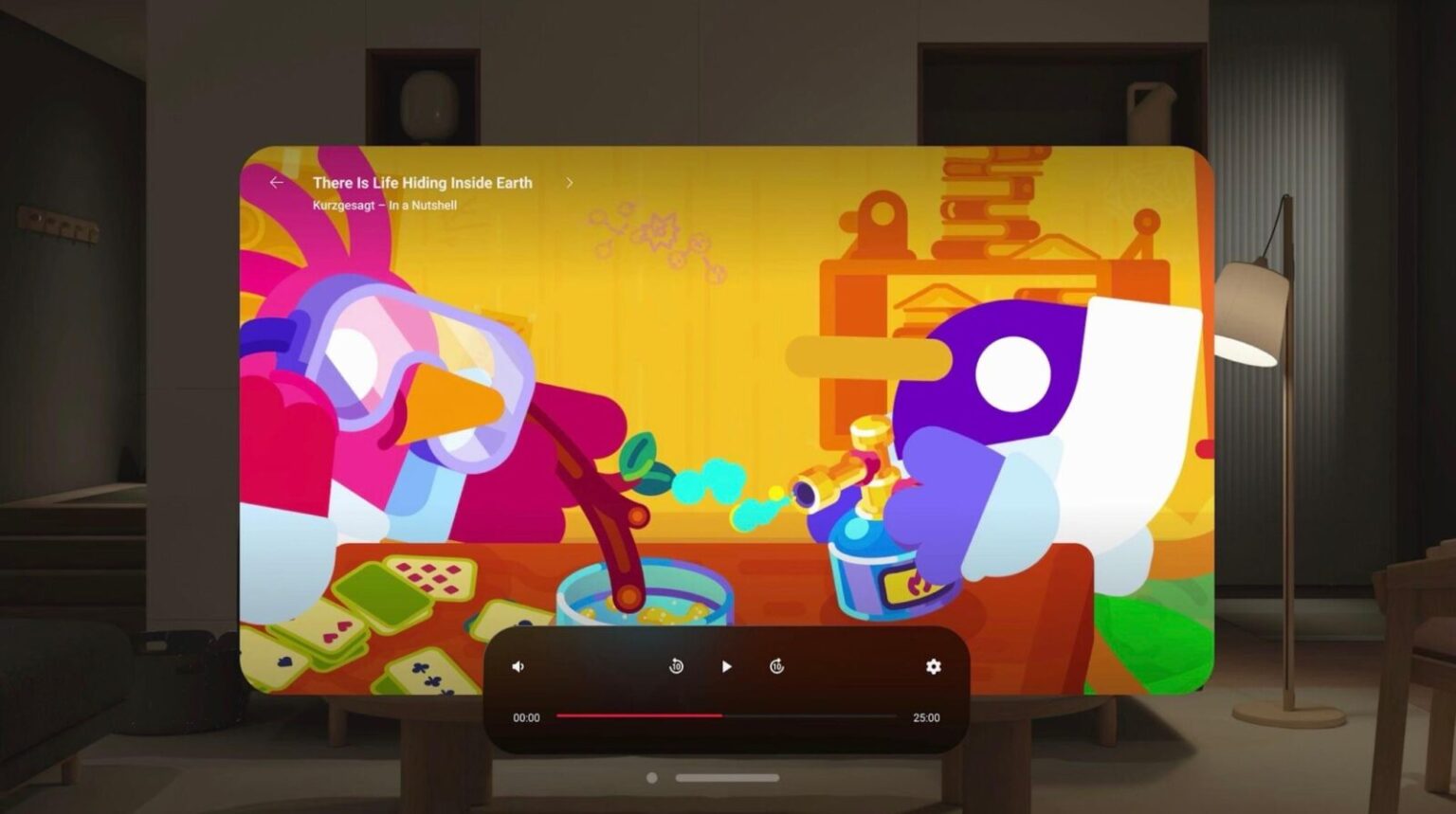
Google has released an official YouTube app for visionOS, bringing a native viewing experience to Apple Vision Pro nearly two years after the headset first launched. The arrival of a dedicated YouTube app addresses a notable gap in the platform’s media offerings and marks a practical step forward for video consumption on spatial computing devices.
The new app allows users to sign in with their Google accounts to access subscriptions, Watch Later queues, and playlists. It supports standard video playback, Shorts, and immersive formats such as 3D, 180-degree, and 360-degree content. On the newer M5 Vision Pro model, YouTube playback extends to 8K resolution, aligning with the headset’s high-resolution displays and positioning the device as a capable platform for premium video experiences.
Since the Vision Pro debuted, users have relied on browser-based viewing or third-party applications to access YouTube. Apps such as Tubular Pro, along with the now-defunct Juno, attempted to fill the void. Apple also improved web video playback in visionOS 2 to make streaming services function more smoothly within Safari. Still, the absence of a native YouTube app stood out, particularly given YouTube’s central role in online video.
For Vision Pro owners, video remains one of the headset’s most practical and consistent use cases. Watching long-form content, immersive travel videos, or 360-degree footage aligns naturally with spatial displays. A native YouTube app removes friction compared to browser workarounds, potentially improving stability, playback quality, and account integration.
From a platform perspective, the launch signals a more measured expansion of major third-party support for visionOS. While Apple positioned the Vision Pro as a high-end mixed reality device, broader adoption has been gradual, partly due to price and hardware constraints. As the ecosystem matures, participation from major media platforms becomes increasingly important. YouTube’s arrival suggests that larger content providers are beginning to see enough long-term value in supporting spatial computing directly.
The move may also reflect practical demand. YouTube remains one of the largest video platforms globally, spanning entertainment, education, gaming, and user-generated content. Ensuring native compatibility with devices like the Vision Pro strengthens its distribution footprint as new form factors emerge.
Attention now turns to other major streaming services. With YouTube now available natively on visionOS, industry observers will likely watch to see whether additional platforms expand their presence in Apple’s mixed reality ecosystem. For Vision Pro users, at least one of the most requested apps is no longer missing.