
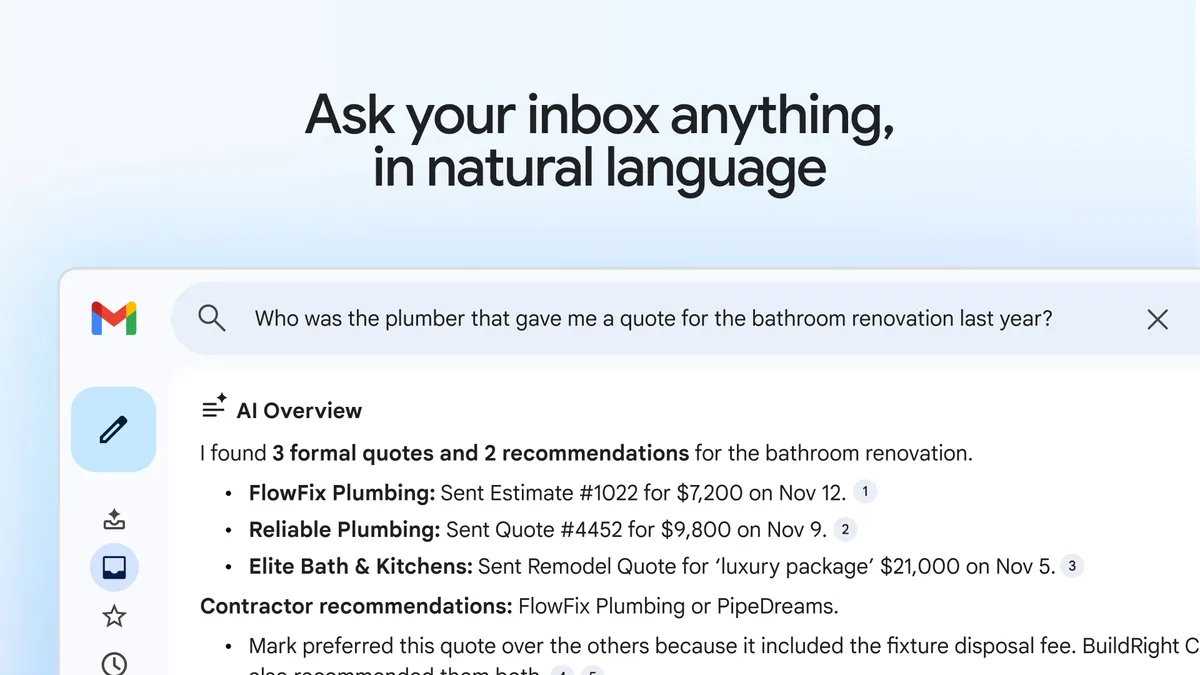
Google is expanding its push into AI-powered productivity tools with a new Gmail feature designed to reorganize how users interact with their inbox. The update, known as AI Inbox, introduces automated prioritization and summarization tools, but its rollout also highlights the growing cost of accessing advanced AI features.
As detailed in recent coverage , AI Inbox is currently limited to subscribers of Google’s AI Ultra plan in the United States, which is priced at around $250 per month. That positioning makes it less of a mainstream feature and more of a premium tool aimed at users who rely heavily on Google’s broader AI ecosystem.
At its core, AI Inbox integrates Google’s Gemini models directly into Gmail to surface what the system considers important messages. This includes highlighting upcoming bills, appointments, and emails from frequent or high-priority contacts. The idea is to reduce the time spent manually sorting through cluttered inboxes by presenting a curated overview of tasks and communications.
While this approach aligns with ongoing efforts to automate digital workflows, it also raises questions about how much control users are willing to hand over to AI systems. Email has long been a highly personal space, and giving an algorithm deeper access to interpret and prioritize messages introduces both convenience and potential unease. Even with assurances around privacy, the level of data processing required for such features may not appeal to everyone.
The pricing is another point of friction. At $250 per month, AI Inbox is bundled with a broader set of services, including expanded cloud storage, higher usage limits for AI tools, and access to premium tiers across other Google products. Still, the cost places it well above typical consumer subscription levels, especially for a feature that primarily reorganizes email rather than introducing entirely new capabilities.
This pricing strategy suggests that Google is treating AI Inbox less as a standalone upgrade and more as part of a larger enterprise or power-user offering. Over time, the company is expected to bring similar functionality to more affordable tiers, potentially including mid-range subscriptions or even free users in a limited form. That staggered rollout mirrors how other AI features have been introduced across Google’s ecosystem.
From a broader perspective, AI Inbox reflects a shift in how email platforms are evolving. Instead of simply filtering spam or categorizing messages, newer systems aim to interpret intent and surface actionable insights. Whether that shift proves useful will depend on accuracy and user trust. If the system consistently highlights relevant information without overstepping, it could reduce friction in daily workflows. If not, it risks becoming another layer of automation that users ignore or disable.
For now, AI Inbox serves as an early example of how far companies are willing to go in embedding AI into core communication tools—and how much they expect users to pay for that convenience.