
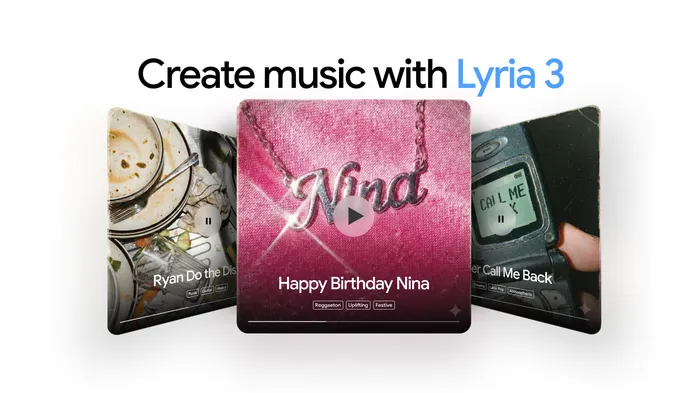
Google Gemini has gained a new capability: generating short music tracks directly from user prompts. The feature, now rolling out in beta, allows Gemini to create up to 30-second songs using text descriptions, images, or videos as inspiration.
The music generation tool is powered by Lyria 3, the latest generative music model from Google DeepMind. According to Google, the aim is not to produce fully polished commercial tracks but to offer users a creative way to experiment with music. The company frames the tool as a lightweight expression feature rather than a replacement for professional music production.
Users can describe a genre, mood, theme, memory, or even an inside joke. Gemini can then generate either instrumental pieces or tracks with automatically written lyrics. If a user uploads a photo or short video clip, the system will attempt to create music that reflects the tone or atmosphere of the visual input. Cover art is also generated automatically using Google’s Nano Banana image model.
The feature is available to users aged 18 and over in multiple languages, including English, German, Spanish, French, Hindi, Japanese, Korean, and Portuguese. While access is open broadly, subscribers to Google AI Plus, Pro, and Ultra tiers receive higher usage limits compared to free users.
To address concerns around originality and copyright, Google says the tool is designed to create new compositions rather than replicate specific artists. If a prompt references a musician by name, Gemini is intended to draw only broad stylistic inspiration rather than produce a direct imitation. The company also states that outputs are checked against existing content and that users can report potential rights violations.
Each generated track is embedded with SynthID, Google’s imperceptible watermarking technology, which helps identify content created using its AI systems. This aligns with broader efforts across the industry to label AI-generated media more transparently.
The addition of music generation expands Gemini’s growing list of multimodal capabilities, which already includes text, image, and video-related tasks. As AI tools increasingly move into creative domains, companies are positioning them as collaborative aids rather than autonomous creators. Whether short-form AI music becomes a widely adopted social feature remains to be seen, but Google’s latest update signals continued investment in generative media beyond text.