
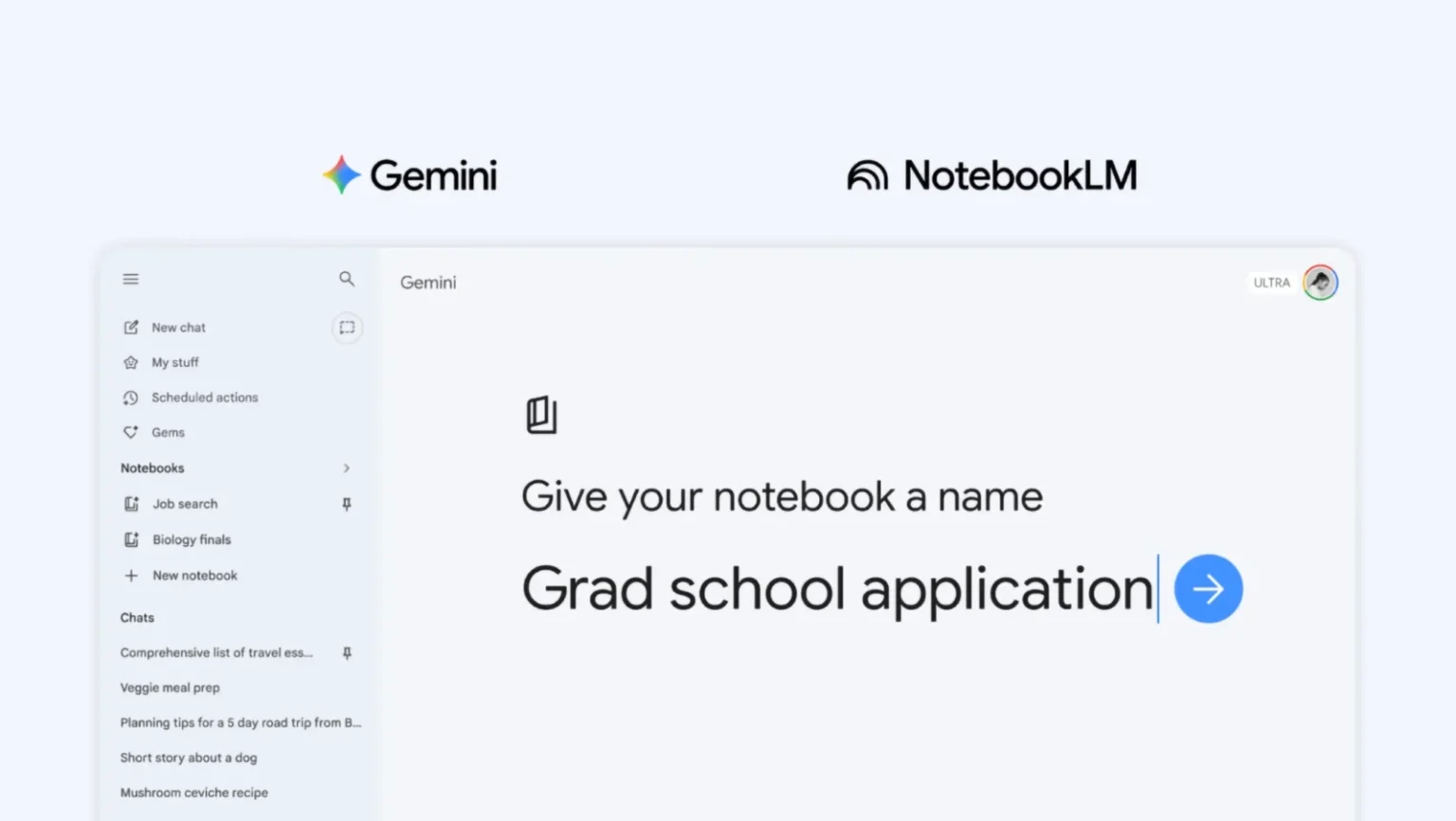
Google is adding a feature called notebooks to its gemini AI chatbot, allowing users to group files, past conversations, and custom instructions around specific topics or projects in one dedicated space. The update, announced this week, aims to make ongoing work with the ai more structured by providing consistent context across chats.
The notebooks function in a way that echoes openai’s projects tool, introduced in 2024, which similarly lets users collect materials related to a single subject for easier reference and continuity. Google describes notebooks as personal knowledge bases that can extend across its products, beginning with gemini. They also integrate directly with notebooklm, google’s separate ai research assistant. Materials added in one tool appear in the other, creating a basic level of cross-app continuity that could appeal to users already working within google’s ecosystem.
This kind of organization has become a practical need as people rely more on ai chatbots for extended tasks—research papers, work reports, creative projects, or long-term planning. Without such containers, conversations tend to scatter, forcing users to repeatedly paste context or start from scratch. Notebooks address that friction by keeping everything in one place that the model can draw from naturally.
The rollout started this week on the web for subscribers to google’s paid ai plans: ultra, pro, and plus. Free users and mobile access are expected in the coming weeks, according to the company. How quickly the feature matures and whether it delivers meaningful improvements over scattered chats will depend on real-world testing.
In the broader competitive landscape, google’s move reflects a shared direction among major ai developers. Openai, anthropic, and others have introduced similar workspace or project-style features to reduce the chaos of long threads and improve reliability for serious use. Yet these tools remain works in progress; context windows have limits, retrieval can falter, and switching between apps still adds overhead. Notebooklm’s involvement is convenient for google users but may feel less seamless for those outside its ecosystem.
Overall, notebooks represent a measured step toward making gemini more usable for sustained work rather than one-off queries. It does not reinvent ai interaction, but it tackles a common pain point in a straightforward manner. As these organizational features proliferate across platforms, the real test will be how well they scale with complex, multi-month projects and how much they reduce the mental load of managing ai-assisted workflows.