
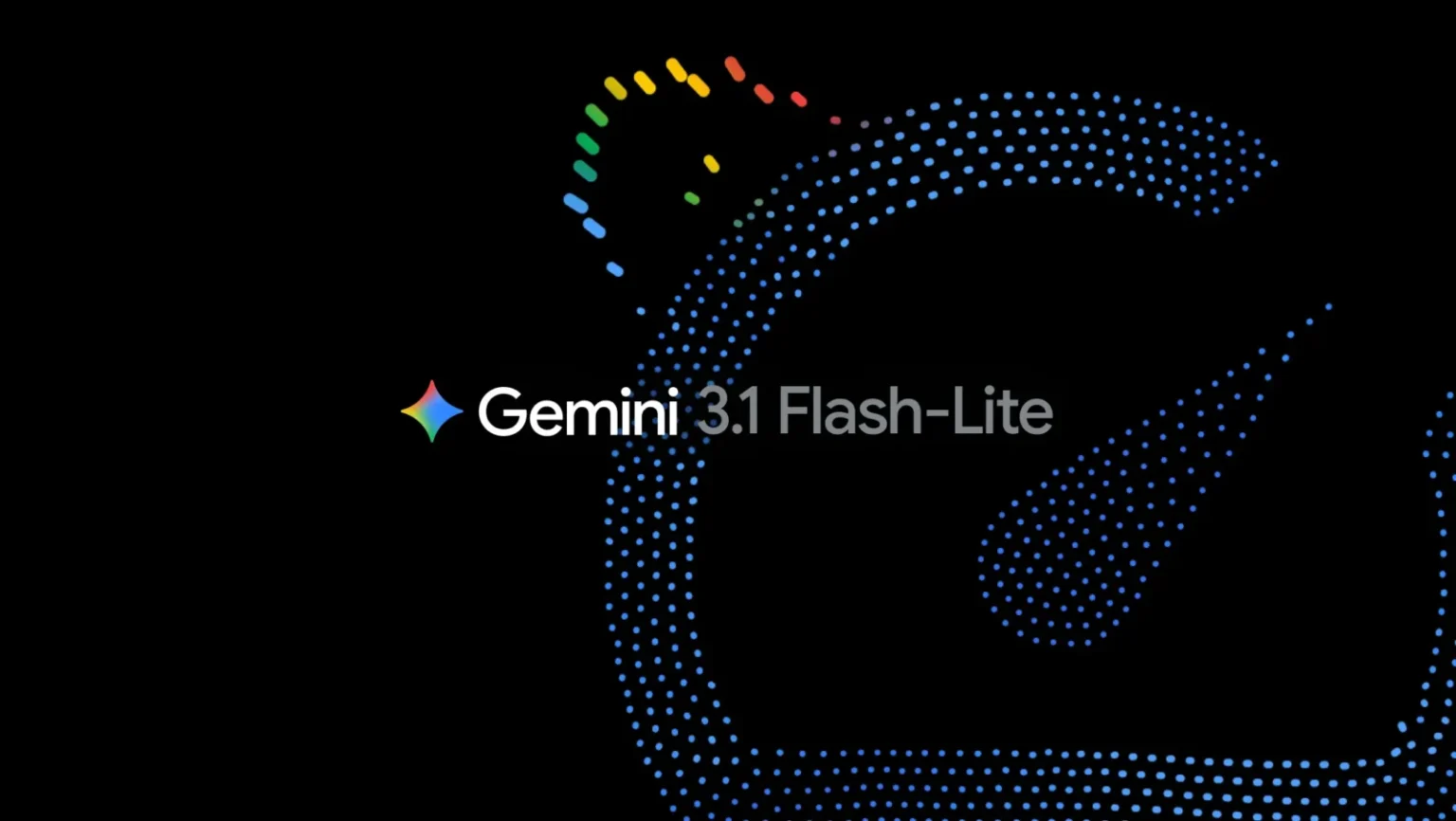
Google has introduced Gemini 3.1 Flash-Lite, a new addition to the Gemini 3 series aimed squarely at high-volume AI workloads where speed and cost control matter as much as model quality. Positioned as the fastest and most cost-efficient model in the current lineup, Gemini 3.1 Flash-Lite is rolling out in preview through the Gemini API in Google AI Studio and for enterprise customers via Vertex AI.
The headline pitch behind Gemini 3.1 Flash-Lite is scale. At a listed price of $0.25 per million input tokens and $1.50 per million output tokens, the model targets developers building applications that process large volumes of requests, such as translation pipelines, content moderation systems, customer support automation, and real-time UI generation. In these scenarios, marginal cost per request and latency are often more important than squeezing out incremental gains in top-tier benchmark performance.
According to benchmark data shared by Google, Gemini 3.1 Flash-Lite improves on the earlier 2.5 Flash tier with a reported 2.5x faster time to first answer token and a 45 percent increase in output speed. In practical terms, faster time to first token reduces perceived lag in chat interfaces and streaming applications, while higher output throughput can lower infrastructure bottlenecks in high-frequency systems.
On quality metrics, Google cites an Elo score of 1432 on the Arena.ai leaderboard and benchmark results including 86.9 percent on GPQA Diamond and 76.8 percent on MMMU Pro. The company says the model matches or exceeds similar-tier competitors across reasoning and multimodal understanding tasks. As with all vendor-reported benchmarks, real-world performance will vary depending on prompt design, system constraints, and integration choices, but the data suggests Google is aiming to close the gap between “lite” models and larger, more compute-intensive systems.
One of the more practical features for developers is adjustable “thinking levels” in AI Studio and Vertex AI. This allows teams to control how much reasoning depth the model applies to a task. For high-volume workloads where speed and cost are the priority, developers can dial back deeper reasoning. For more complex instructions—such as generating dashboards, simulations, or structured UI layouts—the model can allocate more reasoning capacity. That kind of flexibility is increasingly important as companies try to balance responsiveness with output reliability.
Google also points to early enterprise adoption, with companies using Gemini 3.1 Flash-Lite to handle complex inputs at scale while maintaining instruction adherence. The underlying strategy is clear: rather than focusing solely on flagship, large-scale models, Google is investing in mid-tier systems that can be deployed widely across production environments without driving up inference costs.
As AI deployment shifts from experimentation to operational infrastructure, models like Gemini 3.1 Flash-Lite are likely to play a central role. For many organizations, the question is no longer whether an AI model can reason at a high level, but whether it can do so quickly, predictably, and affordably across millions of interactions per day. Gemini 3.1 Flash-Lite appears designed to address that reality.