

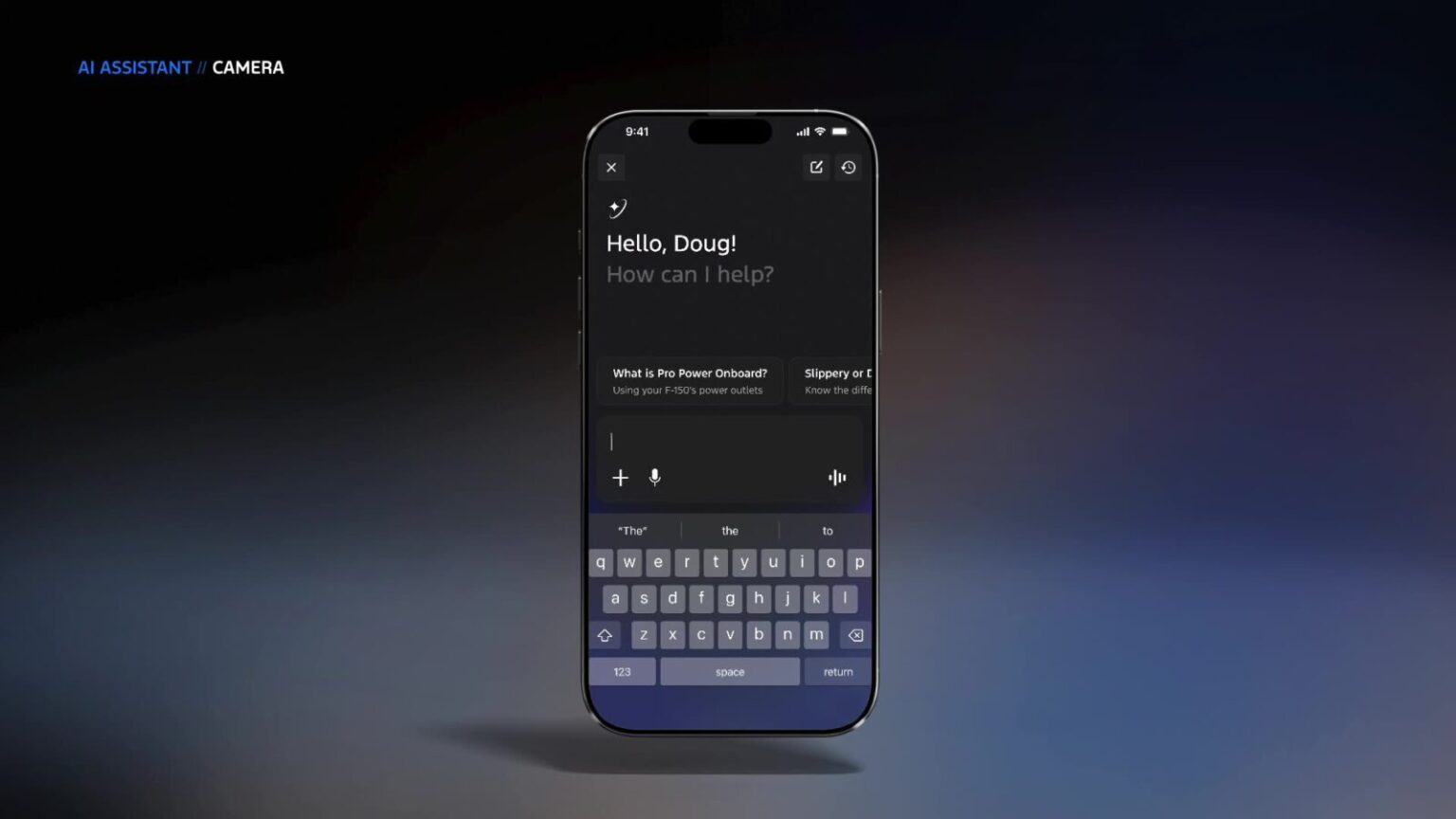
At CES 2026, Ford quietly joined the growing list of carmakers building their own AI assistants, announcing a new feature simply called Ford AI Assistant. The tool is designed to act as a vehicle-aware digital assistant, drawing directly from a car’s onboard data rather than operating as a general-purpose chatbot.
The rollout will happen in stages. Ford plans to introduce the AI assistant first through an updated version of the Ford mobile app in early 2026, with deeper, built-in vehicle integration scheduled to arrive in new Ford models sometime in 2027. For now, that means drivers will encounter the assistant on their phones before ever speaking to it from behind the wheel. Functionally, it positions Ford alongside companies offering branded alternatives to tools like ChatGPT or Gemini, but with a narrower and more vehicle-specific focus.
Ford’s pitch centers on context. Unlike general AI assistants, Ford AI Assistant is tied directly to an individual vehicle and can pull real-time data from its sensors. During its CES presentation, the company outlined scenarios where the assistant could answer practical questions that depend on knowing the car’s exact configuration and current state. One example involved estimating how many bags of mulch could fit in the bed of a truck by combining a photo with vehicle dimensions, load capacity, and passenger count.
This kind of calculation isn’t beyond what existing AI tools can do, but Ford argues the advantage lies in access. Because the assistant is connected to the vehicle, it can factor in information such as tire pressure, cargo weight limits, and occupancy without the user needing to manually provide details. According to Doug Field, Ford’s chief officer for EVs, digital, and design, the goal is to provide answers that external assistants simply cannot, because they lack direct access to the car itself.
From a technical standpoint, Ford is not developing its AI models entirely in-house. The company confirmed that the assistant is hosted on Google Cloud and built using existing large language models rather than proprietary systems. This approach reflects a broader industry trend, where automakers focus on integration and data access while relying on established AI infrastructure providers to handle the underlying intelligence.
Whether Ford AI Assistant proves useful will likely depend on how often drivers actually want remote access to detailed vehicle information. Features like checking tire pressure, mileage, or vehicle status without starting the car could appeal to some users, particularly those who already rely heavily on mobile apps to manage their vehicles. For others, it may feel like an extra layer of complexity rather than a necessity.
There is also an unavoidable privacy dimension. Modern connected vehicles already collect and transmit large amounts of data, and adding an AI assistant that can interpret and summarize that information raises additional questions about transparency and data use. Ford has not positioned the assistant as a listening device or conversational companion in the traditional sense, but its ability to access “everything about the car” may still make some drivers uneasy.
For now, Ford AI Assistant represents an incremental step rather than a radical shift. It reflects how automakers are increasingly treating software and data as core parts of the ownership experience, not just add-ons. Whether drivers embrace it or ignore it will become clearer once the feature lands in the Ford app later this year.