

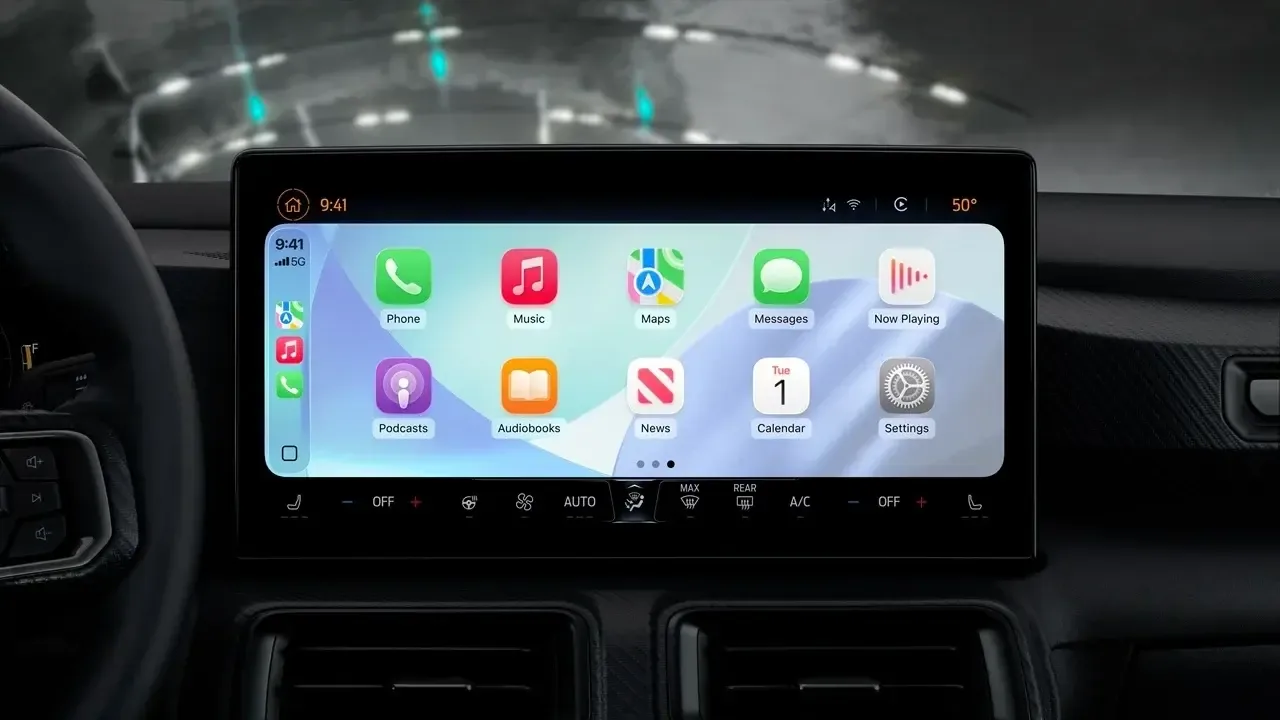
Ford has confirmed it will continue offering Apple CarPlay in its vehicles, even as several competitors move away from third-party infotainment platforms. The position was outlined by Ford chief financial officer Sherry House during remarks at the Barclays Global Auto and Mobility Tech Conference, where she emphasized that CarPlay remains important to a large portion of Ford’s customer base.
House described CarPlay as a feature many drivers actively use and expect, framing its continued support as a response to consumer behavior rather than a philosophical stance on software control. Her comments arrive amid a broader industry debate over whether automakers should rely on external platforms or build tightly controlled in-house systems. According to a 2024 study by McKinsey, 35 percent of new car buyers consider the absence of Apple CarPlay or Android Auto a deal-breaker, a statistic that helps explain why some manufacturers are reluctant to fully abandon those systems.
In contrast, several of Ford’s rivals have taken a different approach. Rivian has opted to exclude CarPlay and Android Auto entirely, arguing that tighter control over software enables a more cohesive user experience. General Motors has also stepped back from third-party infotainment, citing concerns about driver distraction and long-term platform ownership. Even so, the industry remains unsettled; Tesla, long resistant to external infotainment systems, has reportedly explored limited testing of CarPlay functionality.
Rather than choosing one side, Ford appears to be pursuing a hybrid strategy. The company plans to keep CarPlay available while continuing to invest in its own Sync infotainment platform and native applications. House noted that engagement with Ford’s internally developed features has increased significantly in recent iterations of Sync, suggesting the company sees value in blending familiar third-party tools with proprietary services. This approach allows Ford to maintain direct relationships with customers without forcing them to give up interfaces they already prefer.
Notably absent from House’s comments was any mention of CarPlay Ultra, Apple’s more deeply integrated version of the platform that extends into instrument clusters and additional vehicle screens. Industry observers have reported that some automakers are hesitant to adopt Ultra due to concerns about ceding too much control over the in-car experience, and Ford has not indicated plans to embrace that deeper level of integration.
Looking ahead, Ford has also confirmed plans to introduce Google Gemini in its vehicles starting in 2026. Gemini recently began rolling out within Android Auto, enabling voice-based interactions for navigation, messaging, translations, and media playback without requiring drivers to look at the screen. Ford’s adoption of Gemini signals a willingness to incorporate emerging AI tools alongside established platforms like CarPlay, reinforcing its broader strategy of flexibility rather than exclusivity.