



Dubai has ranked among the top five cities worldwide for artificial intelligence adoption, overtaking San Francisco in a new global study by Counterpoint Research. The 2025 Global AI Cities Index evaluated 100 of the world’s largest metropolitan areas based on their readiness and use of AI, with Singapore taking the top spot, followed by Seoul, Beijing, Dubai, and San Francisco.
Abu Dhabi also made the top 10, placing eighth, making the UAE the only Middle Eastern nation with multiple cities in the global top tier for AI. The rankings were based on more than 5,000 AI-related initiatives across public and private sectors, along with infrastructure strength, supercomputing capacity, academic output, and startup activity.
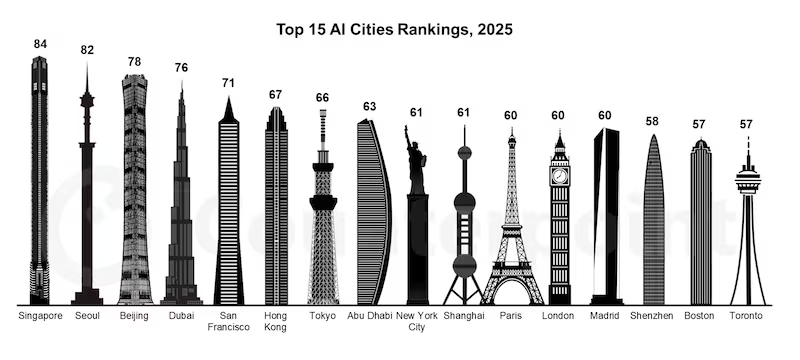
According to Counterpoint, Dubai’s high ranking reflects the city’s strategic integration of AI across government and industry. Every government department reportedly has a designated AI strategist, and the city has launched a program to train one million AI engineers. Teachers are also receiving AI training as part of broader education reforms. Abu Dhabi, researchers noted, is “not far behind” in its AI efforts.
The UAE’s AI investments span partnerships with global technology leaders such as Microsoft, Nvidia, and OpenAI. Microsoft has expanded its AI data center footprint in the country, established innovation hubs, and run training programs, while Nvidia’s collaborations with Emirates Integrated Telecommunications Company (du) have further strengthened Dubai’s position.
The nation has also developed homegrown AI capabilities, including the Falcon Arabic language model, aimed at ensuring Arabic-language representation in large-scale AI systems. In 2019, the UAE opened the Mohamed bin Zayed University of Artificial Intelligence, and in 2017 it became one of the first countries in the world to appoint a dedicated AI minister, Omar Al Olama.
Sheikh Hamdan bin Mohammed, Crown Prince of Dubai, recently announced a new classification system using “icons” to signal when AI has been used in research and publications — part of a broader effort to promote transparency and trust in the technology.
Counterpoint’s findings align with recent International Monetary Fund projections, which estimate that AI could boost the UAE’s GDP by up to 35% by 2030, with Saudi Arabia potentially seeing AI contribute 12% of its economy. While North America continues to lead in overall AI capability, the report notes that China is closing the gap, and the Middle East — led by the UAE — is rapidly emerging as a region to watch in the global AI race.