
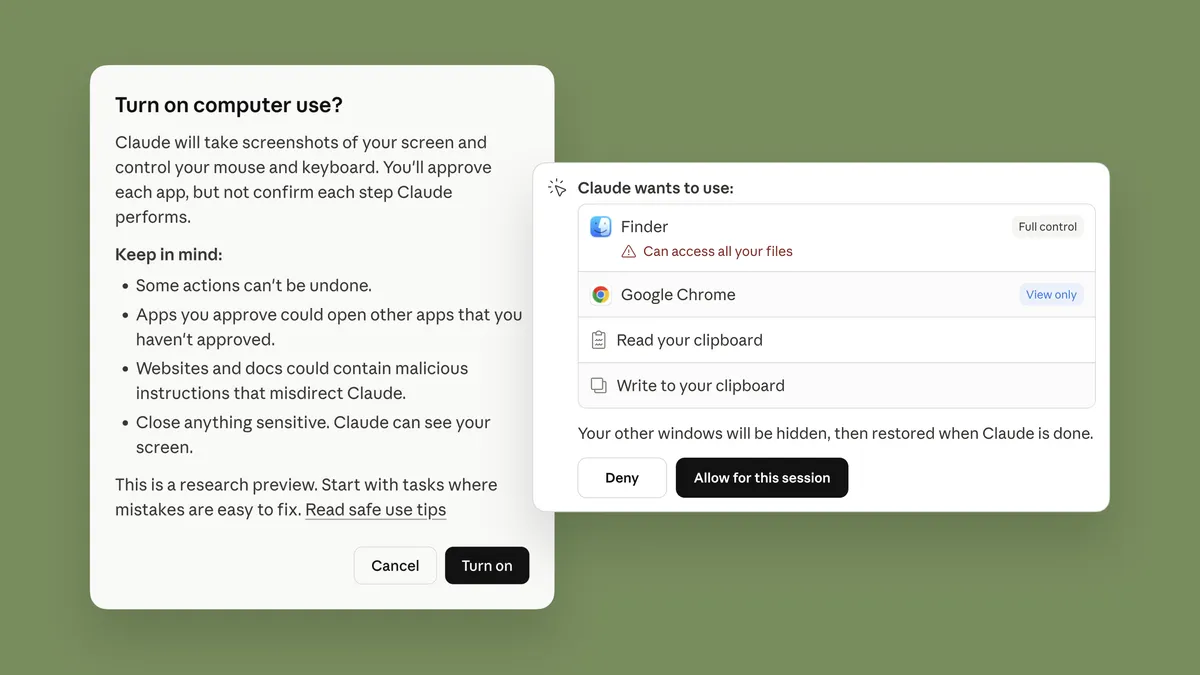
Anthropic is expanding the scope of its AI assistant Claude with a new feature that allows the system to operate a user’s computer directly. The update, currently available as a research preview, reflects a broader shift toward “agentic” AI tools that move beyond responding to prompts and instead carry out tasks on a user’s behalf.
The feature enables Claude to perform actions such as retrieving files, navigating applications, or interacting with software like web browsers and development tools. Through integrations with services including Google Calendar and Slack, Claude can identify relevant tools to complete a request. If no direct integration is available, it can simulate user input by moving a cursor, typing, and clicking through interfaces much like a human would. Anthropic says the assistant will request permission before taking control and can be stopped at any time.
This development comes amid growing interest in systems that can automate everyday workflows. The rise of the open-source OpenClaw framework earlier this year accelerated that trend, leading to a wave of similar tools designed to execute tasks autonomously across different environments. Nvidia’s recent introduction of NemoClaw, a framework aimed at simplifying deployment while adding security controls, highlights how quickly the space is evolving.
Claude’s computer-use capability positions Anthropic within this emerging category, but it also introduces familiar concerns around security and reliability. Systems that can act independently on a device inherently carry more risk than those limited to text-based responses. Experts have pointed out that agentic AI can make rapid decisions with limited oversight, which increases the potential for unintended actions. There is also the possibility that such systems could be exploited by malicious actors, particularly if they gain access to sensitive files or connected services.
Anthropic says it has implemented safeguards to address some of these risks, including protections against prompt injection attacks and restrictions on certain applications by default. Even so, the company advises users to avoid using the feature with sensitive data for now, acknowledging that the system may still produce errors.
The feature is currently limited to MacOS devices and requires a Claude Pro or Claude Max subscription. It also works alongside another tool called Dispatch, which allows users to assign tasks remotely, such as scheduling daily email summaries or initiating development sessions. Together, these tools point toward a more hands-off model of computing, where AI handles routine actions in the background.
While the potential for convenience is clear, the long-term value of this approach will depend on how well these systems balance autonomy with control. For now, Anthropic appears to be using this early release to gather feedback and refine how Claude interacts with real-world computing environments.