

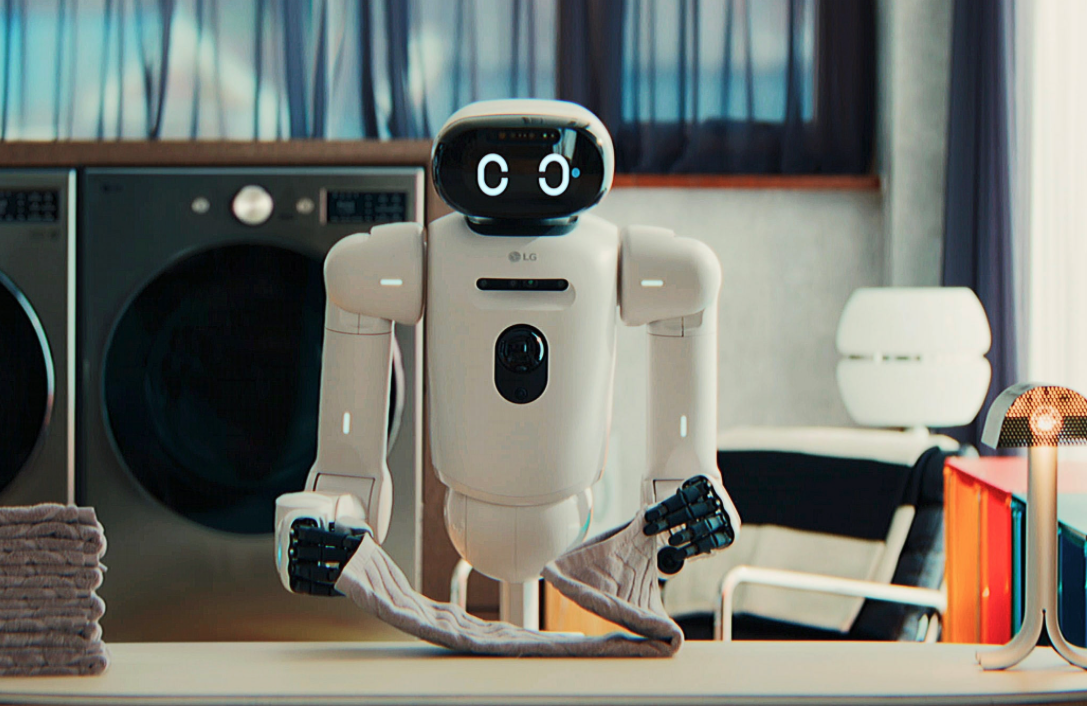
At CES 2026, LG Electronics is presenting a new prototype that illustrates how the company sees the future of domestic automation. The LG CLOiD home robot is positioned as a practical demonstration of what LG calls a “zero labor home,” an environment where routine household tasks are increasingly handled by connected machines rather than by people. Rather than framing the robot as a replacement for human involvement altogether, the concept focuses on reducing time spent on repetitive chores through coordination between robotics, appliances, and software.
LG CLOiD is designed to operate as both a physical assistant and a mobile control hub within the home. In demonstrations planned for CES 2026, the robot performs a series of familiar tasks such as retrieving items from a refrigerator, loading food into an oven, starting laundry cycles, and handling clothing after drying. These examples are meant to show how the robot can interact with multiple appliances in sequence, using contextual awareness rather than isolated commands. The emphasis is less on speed or spectacle and more on consistency and accuracy in everyday environments.
From a hardware perspective, the robot uses a wheeled base for stability and indoor navigation, combined with a torso and two articulated arms. Each arm offers seven degrees of freedom, while the hands include five independently controlled fingers. This configuration allows CLOiD to manipulate common household objects across kitchens, laundry rooms, and living spaces. The torso can adjust its height, enabling the robot to reach items placed at different levels without relying on fixed installations. LG notes that the low center of gravity is intended to reduce the risk of tipping, particularly in homes with children or pets.
The robot’s head serves as its primary interface and processing unit. It houses cameras, sensors, a display, a speaker, and onboard computing hardware that supports voice interaction and visual recognition. Acting as a mobile AI hub, this unit allows CLOiD to learn household layouts and usage patterns over time, adjusting how it manages connected devices through LG’s ThinQ platform and ThinQ ON hub.
At the software level, LG is highlighting its approach to what it calls physical AI, combining vision-language models that interpret visual input with action models that translate those interpretations into physical movement. These systems have been trained using extensive household task data, enabling the robot to recognize appliances, understand user intent, and carry out appropriate actions such as opening doors or transferring objects.
Alongside the robot, LG is also introducing AXIUM, a new actuator platform intended for service robots and related applications. Actuators are a critical component in robotics, affecting cost, efficiency, and performance. LG’s experience in appliance manufacturing is being applied here to develop compact, modular designs suitable for varied robotic functions.
While LG CLOiD remains a demonstration rather than a consumer-ready product, it offers a clearer view of how robotics, appliances, and AI may converge in future homes. The broader goal is not to eliminate human involvement, but to offload routine work so that household technology operates more quietly in the background of daily life.