


Apple is expanding its Apple silicon lineup with the M5 Pro and M5 Max, two new chips designed for the latest MacBook Pro models and aimed at users who run heavy creative, engineering, and AI workloads. The company says the main goal is to raise CPU and GPU throughput while keeping power use low, a balance that matters for laptops that need to deliver strong performance without relying on loud cooling or short battery life. For buyers comparing Apple silicon generations, the big themes here are higher peak compute for on-device AI, faster graphics features like ray tracing, and more memory bandwidth to keep large projects moving.
The headline change is a new packaging approach Apple calls Fusion Architecture. In Apple’s description, it links two dies together into a single system on a chip. That matters because modern pro workflows often hit limits that are not just about raw CPU speed, but about how quickly data can move between compute blocks, memory, and media engines. Apple says this combined design integrates the CPU, GPU, Media Engine, unified memory controller, Neural Engine, and Thunderbolt 5 capabilities. If the implementation works as advertised, the benefit for MacBook Pro users is less waiting for data transfers during large renders, AI inference, and multi-stream video timelines.
On the CPU side, Apple is moving to an 18-core layout for both M5 Pro and M5 Max. It includes six “super cores” for high single-thread performance and 12 additional cores tuned for power-efficient, multithreaded workloads. Apple claims up to a 30 percent boost for pro workloads versus the prior generation. As always with vendor benchmarks, the real-world outcome will depend on the app, the thermal envelope of the system, and the specific configuration, but the direction is clear: these M5 Pro and M5 Max chips are built to keep performance high when a workload scales across many threads.
GPU scaling is where Apple is putting a lot of its AI messaging. The company says the next-generation GPU includes a Neural Accelerator in each GPU core and that, paired with higher unified memory bandwidth, it can deliver more than four times the peak GPU compute for AI compared to the previous generation. Apple also ties the GPU update to ray tracing performance, claiming up to a 35 percent uplift in apps that use ray tracing compared to M4 Pro and M4 Max. For many creators, this matters less for gaming and more for preview speed in 3D tools, motion graphics, and visual effects work where lighting and reflections can be expensive to compute.
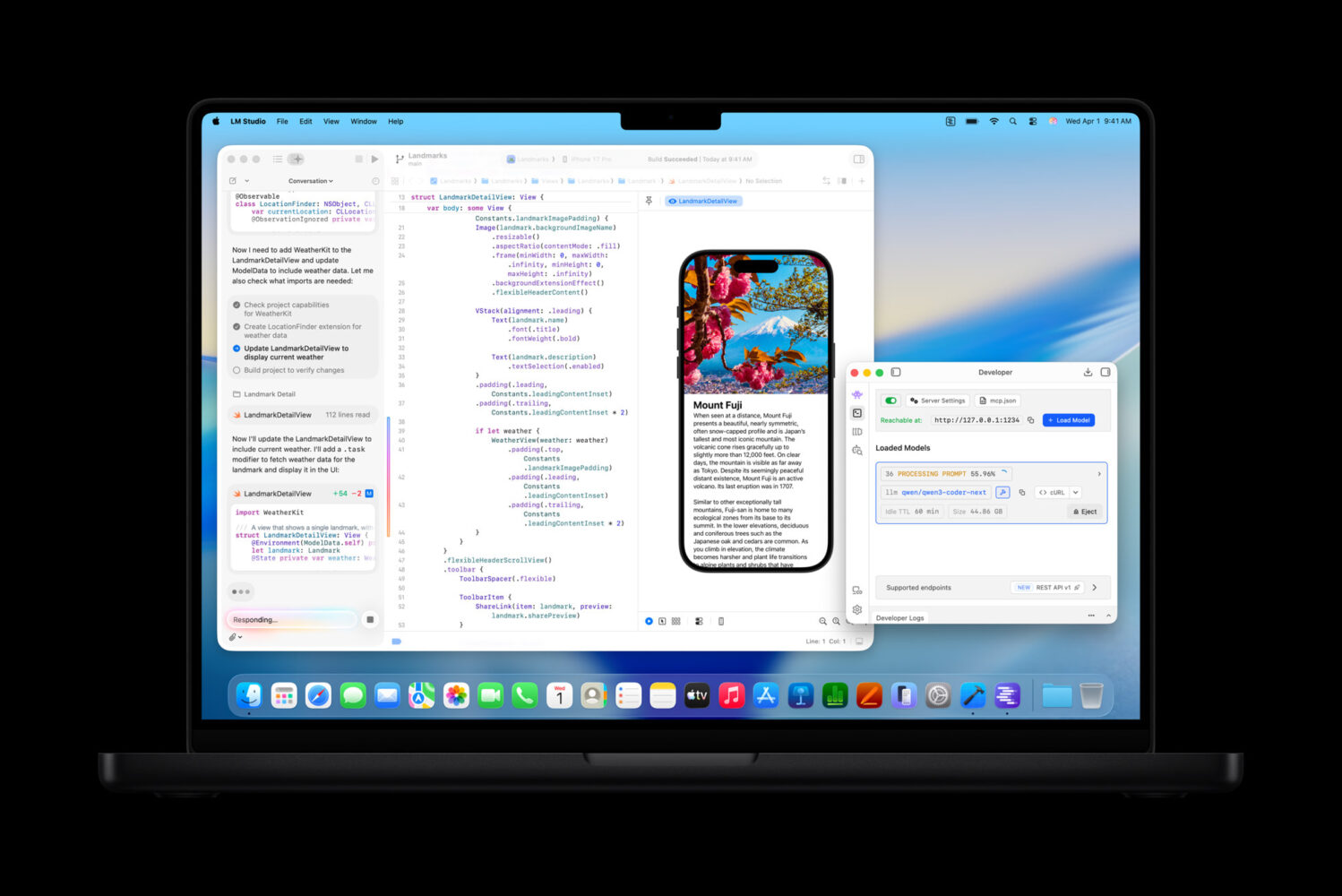
M5 Pro and M5 Max are also separated by the scale they target. The M5 Pro is positioned as the “balanced” pro chip, scaling up from the base M5 with up to a 20-core GPU. Apple says it supports up to 64GB of unified memory and up to 307GB/s of memory bandwidth. In plain terms, that’s aimed at people doing large photo libraries, audio sessions with heavy plug-ins, software builds, and hybrid creative work that benefits from both CPU and GPU strength without going to the top tier.
M5 Max is built for users who are more likely to be GPU- or memory-bandwidth bound: 3D artists working with complex scenes, developers building and testing large projects, and AI researchers running bigger models locally. Apple says M5 Max scales the GPU up to 40 cores, supports up to 128GB of unified memory, and reaches up to 614GB/s of memory bandwidth. Those numbers are relevant because local AI workloads, including large language model inference, often run into memory capacity and bandwidth limits long before they max out compute. If you can’t keep the model and context in memory efficiently, performance gains can flatten out.
Across both chips, Apple highlights a faster 16-core Neural Engine with a higher bandwidth connection to memory, plus an updated Media Engine with hardware support for common codecs, including H.264, HEVC, AV1 decode, and ProRes encode/decode. For pro users, the Media Engine is often the quiet workhorse behind smooth editing and export times in video pipelines. Apple also calls out Memory Integrity Enforcement as an always-on memory safety feature that does not reduce performance, and it emphasizes that each Thunderbolt 5 port is supported by its own controller on-chip.