


Google has clarified that Android 17 Beta 1 is “coming soon” rather than launching today. No revised release date has been provided.
Google is accelerating its Android release cycle, and Android 17 marks the first version to fully follow the company’s revised development roadmap. Instead of traditional Developer Previews, the process now leans on the Android Canary channel, allowing earlier and more continuous access to in-progress platform changes. With Android 17, Google is moving more quickly toward platform stability, which it says could arrive as soon as next month. The final stable release is expected several months later, roughly in line with Android 16’s June rollout.
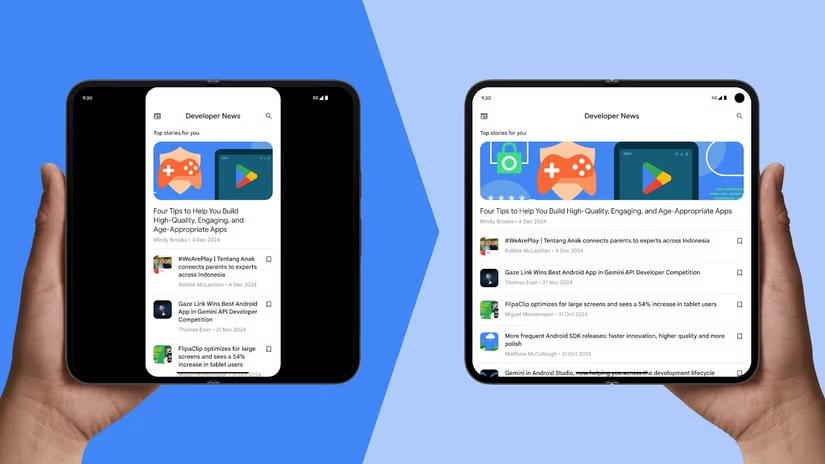
The most consequential change in Android 17 affects how apps behave on large-screen devices. Developers will no longer be able to opt out of resizability and orientation support on tablets, foldables, and desktop-style environments. In previous Android versions, some apps could restrict themselves to fixed orientations or limited layouts, often resulting in awkward black bars or stretched interfaces on larger displays. With Android 17, those limitations are being phased out as a requirement tied to newer API levels.
For users, this should translate into fewer poorly scaled apps on foldables and tablets. Applications will be expected to adapt dynamically to different screen sizes and window states. The move also aligns with Google’s broader push toward a desktop-style Android experience, sometimes referred to as Aluminium OS, where windowed apps and flexible layouts are essential.
Beyond large-screen enforcement, Android 17 introduces several under-the-hood improvements. Minor UI changes—such as toggling the navigation bar or opening the keyboard—will no longer force apps to restart their active state. That adjustment is intended to reduce interruptions, especially during tasks like video playback. Camera transitions between lenses and modes are also being refined to reduce stutter and memory issues, which should improve the experience on devices with multiple sensors.
Audio management is another focus. Android 17 introduces a system-wide volume standard designed to make sound levels more consistent across apps, addressing long-standing complaints about unpredictable volume differences between media sources.
There are also targeted updates for connected devices. Fitness trackers and medical devices will receive dedicated device profiles, separating them more clearly from smartwatches. Printing workflows are being updated as well, allowing users to configure printers directly from the system print dialog rather than navigating deeper settings menus.
As with any early beta, Android 17 is currently best suited for developers and enthusiasts using secondary devices. Supported Pixel models, starting from the Pixel 6 and later, will be eligible once the beta becomes available. With faster platform stabilization and mandatory large-screen compliance, Android 17 signals a continued shift toward a more adaptive, desktop-capable Android ecosystem.