
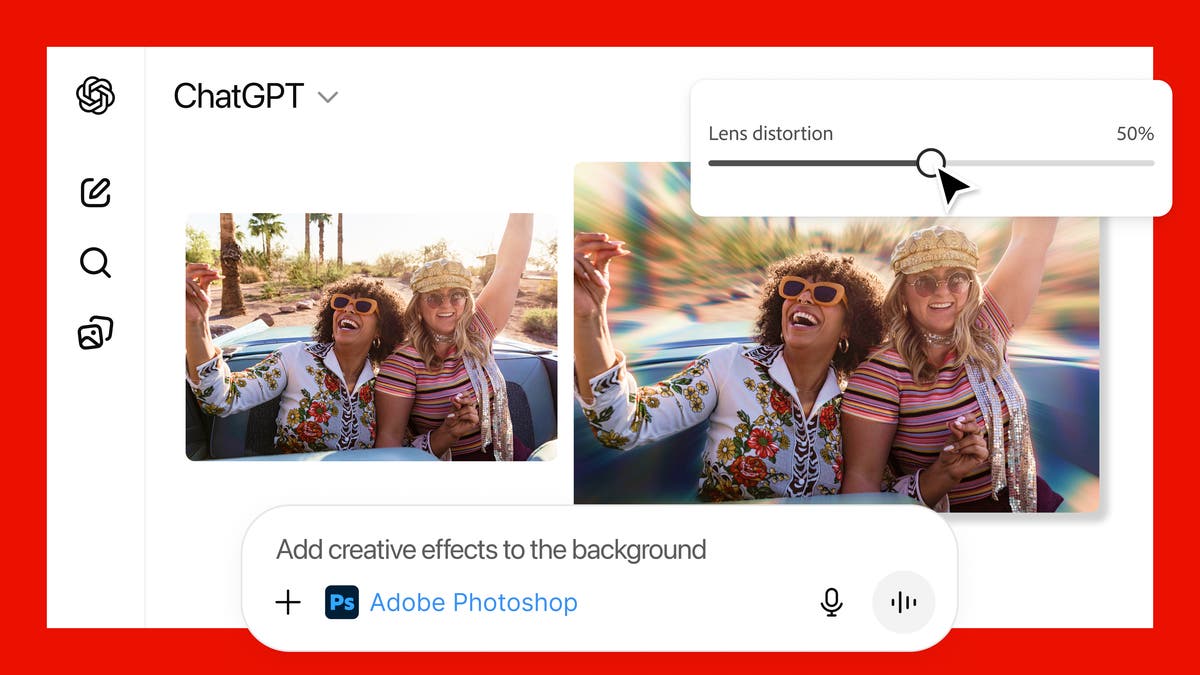
Adobe’s latest move brings scaled-down versions of Photoshop, Acrobat, and Express into ChatGPT, offering a way to edit photos, adjust PDFs, and handle basic design tasks without leaving the chatbot. The rollout is available to all ChatGPT users and doesn’t require separate installation—just mention the tool you want to use in your prompt. Ask ChatGPT to apply Photoshop to brighten an attached image, for example, and the system will show you the range of edits it can perform.
Once selected, the same Adobe tool remains active throughout the conversation unless you switch to another. When automatic suggestions fall short, the integrations surface simplified manual controls—brightness, exposure, contrast, and similar sliders—mirroring what many lightweight mobile editors already provide. These pared-back interfaces make it possible to adjust files quickly, though they stop well short of what the full apps offer. Adobe emphasizes that users who need deeper control can transfer their work to the company’s dedicated desktop or mobile software and continue editing there.
Express inside ChatGPT can help reshape basic layouts, swap images, adjust text, or generate alternative design ideas. It also supports simple animation options, aiming to help people create more polished social posts and presentations without formal design training. PDF handling through Acrobat includes data extraction, merging files, and converting documents, though again within a narrower feature set than the standalone product. The three tools are already accessible on desktop, the web, and iOS, with Express available on Android and Acrobat and Photoshop planned for Google’s platform later.
These additions follow OpenAI’s earlier effort to fold third-party services into ChatGPT, a process that started with commerce-focused partners in October and expanded to everyday utilities like grocery delivery tools. The company recently removed some recommendation features after users noted they felt too similar to advertising.
As AI assistants increasingly absorb lightweight editing features, the line between full applications and chatbot-based utilities continues to blur. The Adobe-ChatGPT pairing shows how companies are experimenting with smaller, integrated versions of their software to reach people who may not open a dedicated app for quick tasks. How widely these trimmed-down tools will be adopted depends on whether users see them as genuinely helpful or just another step in a growing trend of cross-platform bundling.