
A new iPhone app called Acme Weather is entering a crowded market with a specific goal: addressing forecast uncertainty in a way most weather apps do not. Developed by the team behind Dark Sky, Acme Weather builds on the group’s experience with hyper-local forecasting while taking a different approach to how predictions are presented.
Dark Sky was acquired by Apple in 2020 and discontinued in early 2023, with several of its features integrated into Apple’s built-in Weather app. After their time at Apple, members of the original Dark Sky team decided to return to the independent app space. According to co-creator Adam Grossman, the decision stemmed from dissatisfaction with the current weather app landscape and a desire to experiment with new ideas outside a larger corporate structure.
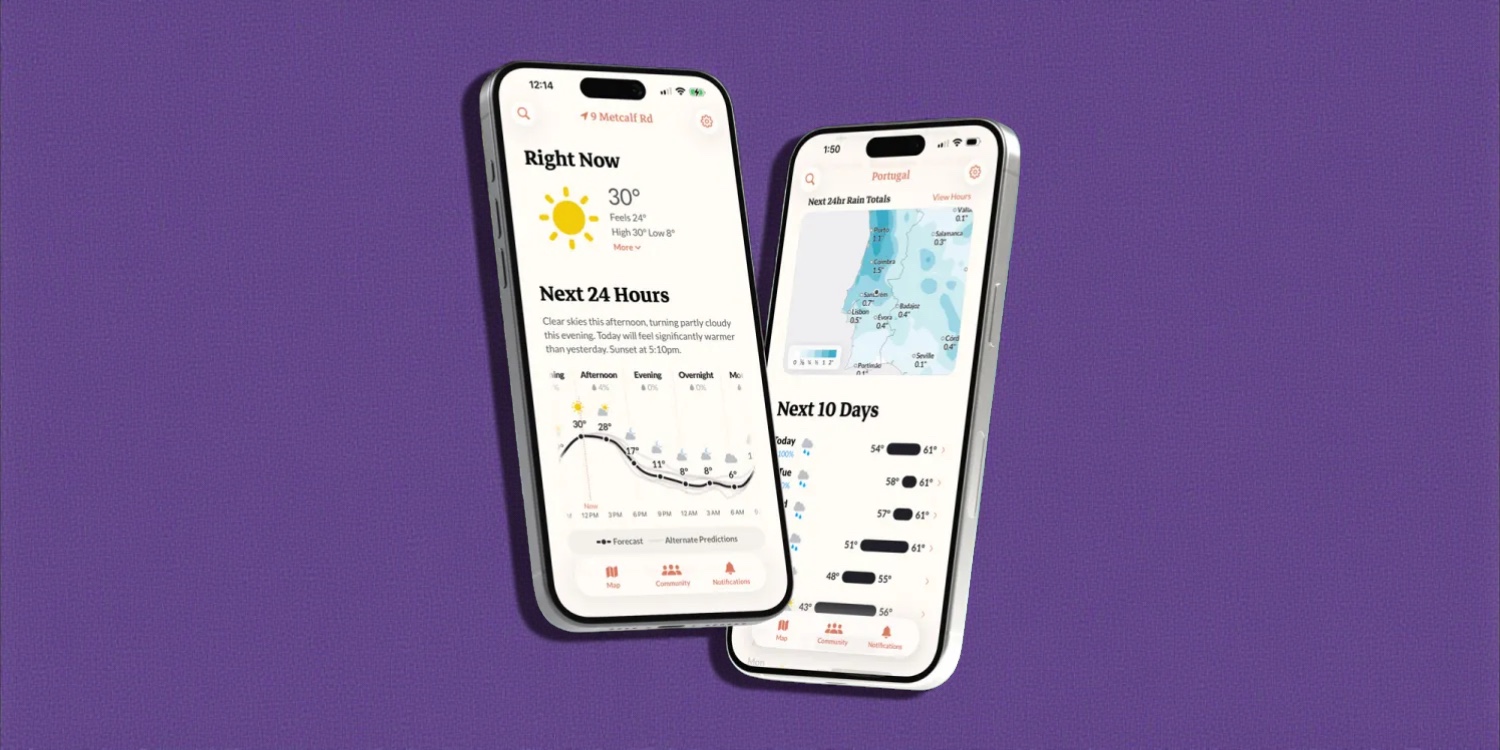
The central concept behind Acme Weather is what the team calls Alternative Forecasts. Instead of presenting a single predicted outcome, the app displays a primary forecast alongside multiple plausible alternatives. The premise is straightforward: weather systems are complex and inherently uncertain, and a single forecast can give a misleading sense of precision. By visualizing a range of potential outcomes, the app attempts to give users a clearer sense of how stable—or unstable—a forecast might be.
The spread between forecast lines acts as a visual indicator of reliability. When projections cluster tightly, the outlook is likely more dependable. When they diverge, it signals variability and the possibility of rapid changes. In practical terms, this could help users gauge whether to check conditions more frequently or prepare for different scenarios, such as a storm arriving earlier than expected or precipitation shifting from snow to rain.
Acme Weather says its primary forecast model draws from multiple inputs, including numerical weather prediction systems, radar data, satellite imagery, and ground station observations. The company claims the model improves upon what was previously used in Dark Sky, though real-world performance over time will be the meaningful test.
Beyond forecasting models, the app includes community reporting, allowing users to submit local condition updates. It also offers dedicated maps for radar, lightning strikes, snowfall totals, rainfall, temperature, and cloud cover. Notifications are another focus, ranging from minute-by-minute rain alerts to government-issued severe weather warnings and nearby lightning activity. There are even alerts tied to atmospheric conditions that might produce visible rainbows.
Acme Weather is currently available for iPhone through the App Store, priced at $25 per year with a two-week free trial. An Android version is in development. In a market filled with polished but often similar weather apps, Acme Weather is betting that transparency about uncertainty—and clearer visualization of risk—can differentiate it from more conventional forecasting tools.