

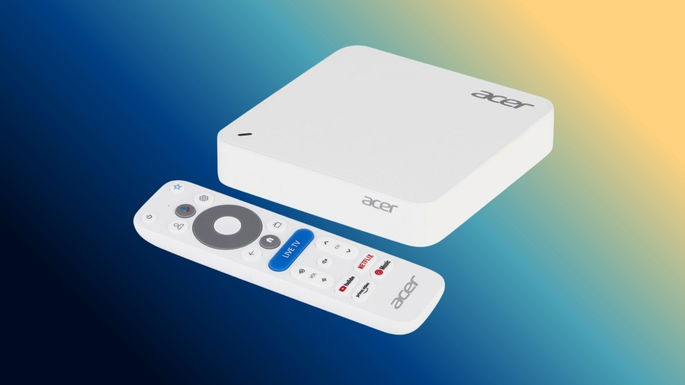
Acer, best known for its laptops, monitors, and Chromebooks, is stepping into an unfamiliar category with the launch of its first Google TV streaming box. The Acer 4K UHD Google TV Box has appeared for pre-order in South Africa, marking the company’s debut in a segment long dominated by players like Google, Amazon, and Xiaomi.
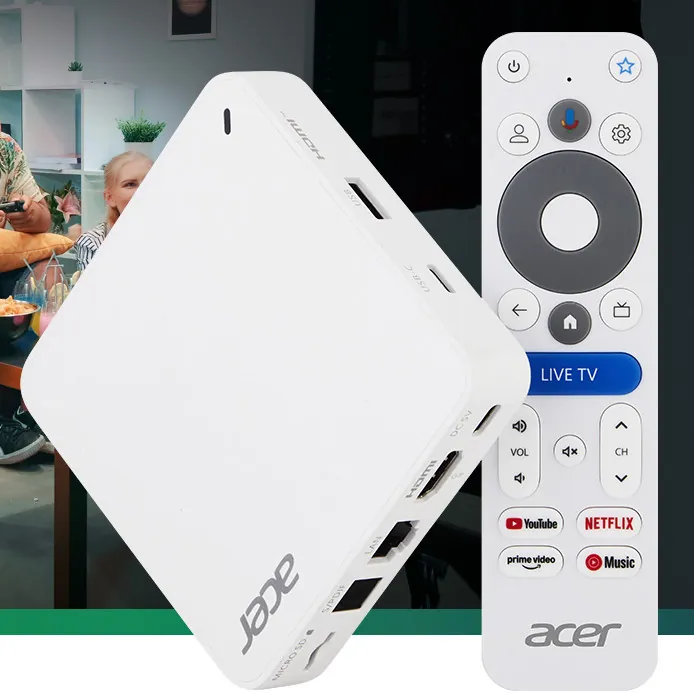
The device is designed to bring 4K smart TV features to standard televisions, effectively turning any screen with an HDMI port into a streaming hub. Its design is understated: a compact square box in white, paired with a matching remote. The remote includes expected navigation and volume controls along with direct access buttons for YouTube, YouTube Music, Netflix, and Prime Video, suggesting Acer is positioning this as a straightforward plug-and-play option for households already invested in mainstream services.
Where Acer attempts to stand apart is in connectivity. The box offers seven ports—unusually high for this category—including two USB-C ports (one reserved for power), USB-A, HDMI, Ethernet, microSD, and S/PDIF Optical Audio. The inclusion of optical audio stands out, as few budget-friendly streaming devices provide this option, potentially appealing to users who want to connect the box to existing sound systems without relying solely on HDMI ARC.
Internally, the device runs on a quad-core Amlogic S905X5 processor paired with a Mali-G310 GPU. Acer highlights support for super-resolution upscaling and Wi-Fi 6 compatibility, both of which should contribute to smoother streaming performance on modern networks. The RAM configuration, however, remains unclear—press materials list 3 GB, while Acer’s own South Korean website mentions 2 GB. Either way, the hardware specifications suggest a device positioned to compete in the entry-to-midrange tier rather than the premium streaming box space.
For now, the Acer 4K UHD Google TV Box is only available for pre-order in South Africa at around $79. The company has not announced whether it plans to roll the device out more broadly across Europe or North America. Still, the move indicates Acer’s willingness to broaden its portfolio beyond traditional PCs and displays into the smart home and entertainment ecosystem, where growth opportunities continue to attract established hardware brands.