
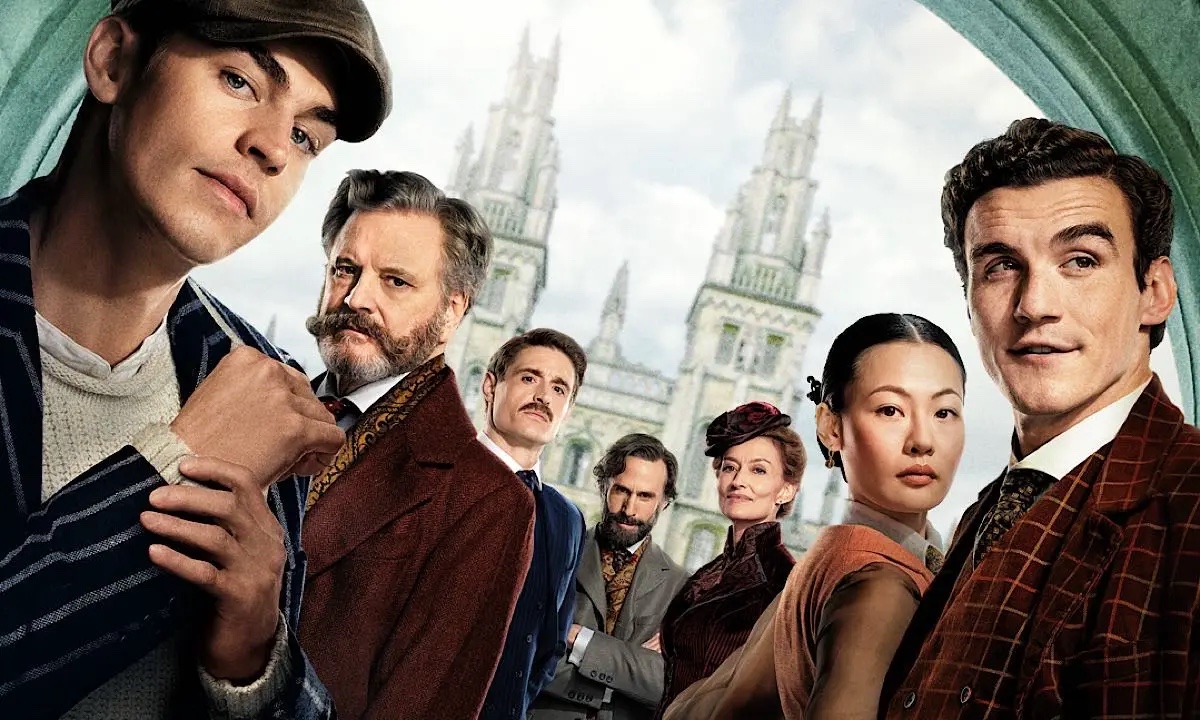
TL;DR: Young Sherlock on Prime Video reinvents the iconic detective as a flawed, emotional teenager navigating conspiracy and friendship with a charismatic young Moriarty. It’s stylish, serialized, and surprisingly heartfelt — a bold Sherlock Holmes adaptation that earns its risks.
Young Sherlock
There’s a sacred cow in detective fiction, and its name is John Watson.
Every time someone touches the Sherlock Holmes mythos, Watson is right there, notebook in hand, ready to narrate the genius of the world’s most insufferably brilliant man. So when I pressed play on Young Sherlock on Prime Video and realized Watson wasn’t just sidelined but completely erased from the board, I braced myself.
Turns out, that was the point.
Young Sherlock, directed by Guy Ritchie and created by Matthew Parkhill, isn’t interested in polishing the deerstalker. It wants to rip it off entirely and ask a far more chaotic question: what if Sherlock Holmes wasn’t a fully formed machine of deduction yet? What if he was nineteen, emotionally messy, grieving, brilliant, and just arrogant enough to think he could outsmart the universe?
The result is one of the boldest Sherlock Holmes adaptations in years. And yeah, I’m including everything from Sherlock to Enola Holmes in that statement.
This Isn’t Your Canonical Holmes — And That’s the Fun of It
Based on the novels by Andrew Lane, Young Sherlock plants its flag at Oxford University and builds a coming-of-age conspiracy thriller around a version of Holmes who hasn’t yet calcified into legend.
Hero Fiennes Tiffin plays Sherlock like a live wire. He’s still hyper-intelligent, still obsessively detail-oriented, still capable of reading a room like it’s an open book. But he’s also impulsive. Emotional. Reckless in that uniquely teenage way where you think being right is the same thing as being wise.
And I loved that.
We’ve had icy Sherlock. We’ve had sociopathic Sherlock. We’ve had action-hero Sherlock. What we haven’t really had is vulnerable Sherlock. This version doesn’t glide through mysteries like a chess grandmaster ten moves ahead. He stumbles. He miscalculates. He feels things too loudly.
It makes the eventual myth feel earned instead of assumed.
The show doesn’t cling to Arthur Conan Doyle canon like it’s sacred scripture. It borrows the bones and builds new muscle. That freedom allows the narrative to breathe in ways traditional adaptations rarely do.
Moriarty: The Real Masterstroke
If Young Sherlock has a secret weapon, it’s Dónal Finn as James Moriarty.
Yes, that Moriarty.
But instead of introducing him as a shadowy mastermind stroking a metaphorical cat, the series does something much more dangerous: it makes him likable. Charismatic. Funny. Almost heroic.
Watching Sherlock and Moriarty bond over intellectual puzzles feels like witnessing two future tectonic plates slowly drifting toward inevitable collision. The show smartly positions them as equals, even visualizing their thought processes in shared “mind palace” sequences that crackle with competitive energy.
Those scenes are pure geek candy. Rapid-fire deductions. Spatial memory visualizations. The kind of stylized mental gymnastics that make you want to pause and rewind just to catch every clue.
The tragedy is baked in from the start. We know what Moriarty becomes. That inevitability hangs over every grin and every shared revelation. When the fractures start to show, they hurt more because we’ve seen the friendship first.
It’s an origin story for both hero and villain, and the symmetry is delicious.
The Mystery Is Big, Bold, and Surprisingly Dark
The central mystery begins with a murder at Oxford, but it doesn’t stay small for long. The plot expands into political intrigue, buried family secrets, international conspiracies, and a visiting Chinese princess named Shou’an, played with razor-sharp intelligence by Zine Tseng.
What starts as a campus whodunit escalates into something far more ambitious. The writing avoids episodic case-of-the-week comfort. Instead, it builds a serialized narrative that tightens like a noose across eight episodes.
And yes, there’s a twist. A big one. The kind that makes you sit back and mutter, “Oh, that’s what you were doing.”
The pacing rarely sags. Even when exposition creeps in, Ritchie’s visual dynamism keeps things moving.
Guy Ritchie Turns Down the Dial — Just Enough
Here’s the thing about Guy Ritchie: subtlety is not typically his brand.
But in Young Sherlock, he shows surprising restraint. The kinetic editing, whip-smart dialogue, and punchy action sequences are all present, but they’re calibrated for character rather than spectacle.
When fights break out, they feel messy and human, not superheroic. Sherlock isn’t a seasoned brawler. He gets hit. He panics. He improvises.
The camera often stays close, almost claustrophobic, amplifying the sense that we’re inside Sherlock’s spiraling mind. It’s stylish without being obnoxious. Which, coming from a lifelong Ritchie skeptic, is high praise.
The Holmes Family Drama Hits Hard
If you think this is just a mystery thriller, think again. Young Sherlock is also a family drama wrapped in Victorian gothic aesthetics.
Natascha McElhone’s Cordelia Holmes is the emotional anchor of the series. Introduced as fragile and withdrawn, she gradually reveals warmth and strength that reframes Sherlock’s emotional DNA. Their shared grief over the death of Beatrice, Sherlock’s younger sister, shapes everything.
Joseph Fiennes plays Silas Holmes with distant ambiguity, while Max Irons’ Mycroft feels intentionally grounded, though perhaps less brilliant than lore traditionally suggests. It’s one of the few creative risks that doesn’t entirely land. Mycroft should feel terrifyingly sharp. Here, he feels merely competent.
Still, the family dynamic adds stakes beyond the central mystery. Sherlock isn’t just solving a crime. He’s navigating loss, identity, and legacy.
That emotional layer elevates the entire series.
A Sherlock Holmes Adaptation That Dares to Evolve
We’ve been living in a golden age of Sherlock reinventions for over a decade. From the high-tech London of Sherlock to the feminist spin of Enola Holmes, the IP has proven remarkably elastic.
Young Sherlock continues that trend but skews younger, darker, and more serialized. It feels engineered for binge-watching, but it doesn’t insult the audience’s intelligence.
For longtime Holmes fans, the departures from canon may initially sting. No Watson. A sympathetic Moriarty. A deeply involved Holmes family. But by the end of Season 1, it’s clear this isn’t sacrilege. It’s recalibration.
The show respects the spirit of Sherlock Holmes even when it discards the letter.
Technical Craft: Production, Score, and Atmosphere
The production design deserves its own applause. Oxford feels lived-in rather than stagey. Candlelit halls, damp cobblestone streets, and looming European landscapes create a textured world that feels tactile.
The score leans into tension without overwhelming scenes. It pulses rather than blares, giving dialogue room to breathe.
From a technical standpoint, Young Sherlock understands modern streaming expectations. Clean cinematography. Tight episode runtimes. Minimal filler. It’s built for 2026 viewing habits without sacrificing period authenticity.
Verdict
Young Sherlock is not the most faithful Sherlock Holmes adaptation. It is, however, one of the most entertaining and emotionally layered in recent memory.
By stripping away Watson and focusing on youth, friendship, and moral divergence, the series carves out its own identity. Hero Fiennes Tiffin delivers a compelling, vulnerable Holmes. Dónal Finn’s Moriarty is the real showstopper. And Guy Ritchie proves he can channel his kinetic style into something character-driven.
This is Sherlock before the legend. Before the arrogance calcified into myth. Before Baker Street.
And honestly? I’m all in.