
TL;DR: Emerald Fennell’s Wuthering Heights is a visually lavish but spiritually empty adaptation that strips Emily Brontë’s novel of its cruelty, complexity, and generational weight in favor of a glossy, defanged romance. Gorgeous to look at, painful to think about, and utterly uninterested in what made the original endure.
Wuthering Heights (2026)
I walked into Emerald Fennell’s Wuthering Heights with a knot of dread and hope tangled together like barbed wire on the Yorkshire moors. On one hand, I love a director with a point of view. On the other, Emily Brontë’s novel isn’t just a dusty syllabus assignment you remix for vibes. It’s a vicious Gothic pressure cooker about class, cruelty, inheritance, and the kind of love that corrodes everything it touches. What Fennell delivers here is not an adaptation so much as a very expensive Tumblr mood board that mistakes obsession for depth and romance for meaning. Emily Brontë isn’t just rolling in her grave. She’s clawing her way out with righteous fury.
This is not a love story. The book never was. It’s a ghost story soaked in mud, blood, and generational trauma, one where love is the accelerant, not the cure. Fennell’s Wuthering Heights, however, desperately wants to be a doomed-romance epic, the kind where the camera swoons harder than the characters and every emotional beat is underlined in glitter pen. The result is a film that looks stunning, sounds expensive, and feels utterly hollow.
To be clear, I’m not allergic to bold reinterpretations. Baz Luhrmann took Shakespeare, slapped a handgun named “Sword” into Leonardo DiCaprio’s hands, and still respected the spine of the text. What Fennell has done here is remove the spine entirely and replace it with a Pinterest quote about soulmates.
At the most basic level, this film barely resembles Emily Brontë’s Wuthering Heights. Entire characters are erased, motivations are reassigned at random, and the novel’s carefully constructed generational structure is bulldozed in favor of a single, monotonous idea: Cathy and Heathcliff are destined lovers, and that’s all that matters. If you strip away the title cards and the moors, this could be any glossy tragic romance with a prestige budget and a playlist.
The most unforgivable sin is the removal of Hindley Earnshaw. In the novel, Hindley is the engine of Heathcliff’s transformation. His jealousy, abuse, and resentment are what forge Heathcliff into something monstrous. Without Hindley, Heathcliff’s cruelty loses its origin story. Fennell’s solution is to graft Hindley’s worst traits onto Mr. Earnshaw, turning a complicated, flawed father figure into a one-note abusive drunk. This not only flattens the story but robs Heathcliff of the one relationship that explains why his fall hurts so much.
By excising the second generation entirely, no Cathy Linton, no Hareton Earnshaw, no Linton Heathcliff, the film also deletes the novel’s ultimate thesis. Wuthering Heights is about cycles of violence and the faint, fragile hope that the next generation might escape them. Fennell’s version has no interest in cycles, consequences, or inheritance. It wants passion without aftermath, fire without ashes.
The supporting cast fares no better. Nelly Dean, once the moral spine and observer of the chaos, is rewritten into a bitter, antagonistic presence with motivations that feel imported from a different script. Joseph, a grotesque embodiment of religious cruelty in the novel, is reduced to an off-kilter background oddity. Isabella Linton, whose tragedy lies in her naïveté and suffering, is transformed into something aggressively modern and oddly mean-spirited. These aren’t reinterpretations that reveal new truths. They’re distortions that erase old ones.
Then there’s the central pairing, which should be the beating, diseased heart of the story. Margot Robbie as Catherine Earnshaw is, frankly, miscast. Cathy is supposed to be feral, selfish, impulsive, and young enough that her worst decisions feel tragically inevitable. Robbie brings star power and polish, but very little danger. This Cathy feels petulant rather than wild, entitled rather than untamed. When she throws tantrums, it plays less like a storm and more like a sulk.
Jacob Elordi’s Heathcliff is even more baffling. Heathcliff should be terrifying. He should radiate menace, bitterness, and emotional rot. Elordi’s version is soft, lovesick, and weirdly passive, like a sad boy who wandered in from a prestige YA adaptation. Their relationship is immediately framed as pure and mutual, with endless declarations of love and intimacy that completely defang the story. The toxicity is gone. The imbalance is gone. The danger is gone. What’s left is a melodramatic romance that mistakes intensity for complexity.
Watching these two circle each other, repeating “I love you” like it’s a contractual obligation, is exhausting. The sex scenes linger far too long, mistaking duration for depth, and by the halfway point I felt like the film was trying to convince me of their passion rather than letting it unsettle me. Heathcliff and Cathy aren’t supposed to be aspirational. They’re supposed to be a warning.
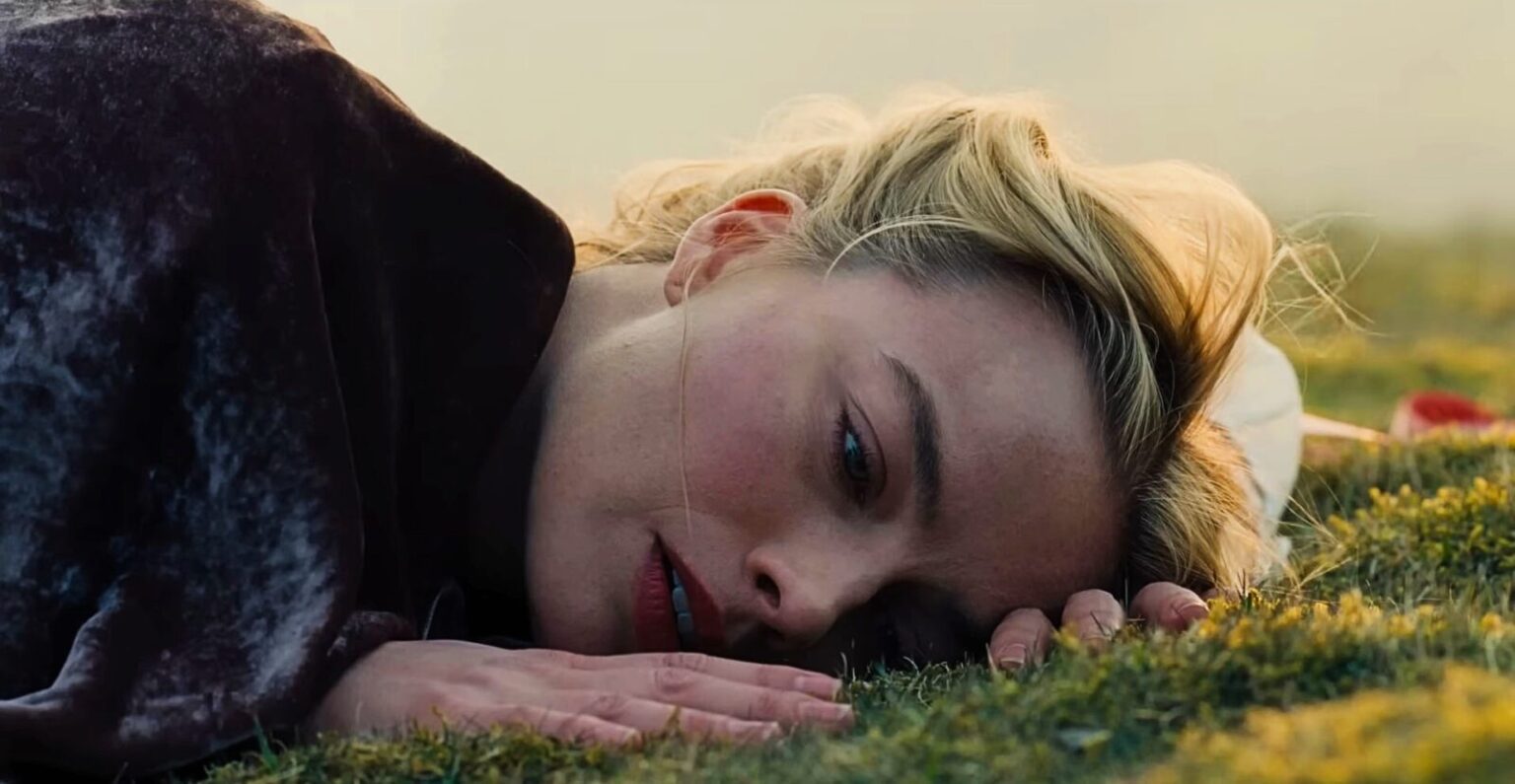
Visually, this is where Fennell reminds us why she keeps getting handed massive budgets. The film is gorgeous in individual frames. Linus Sandgren’s cinematography turns the moors into a painterly nightmare, and Anthony Willis’ score swells with operatic intensity. There are moments where the wind, the sky, and the land feel alive in a way that genuinely honors the Gothic tradition.
And then the costumes walk in and shatter the illusion.
The production design feels aggressively anachronistic, not in a clever, symbolic way but in a cheap, distracting one. Latex, polyester, and glossy fabrics clash violently with the period setting. Wuthering Heights looks like a ruin, Thrushcross Grange looks like a surreal carnival, and the whole thing feels less like 19th-century England and more like a haunted fashion editorial. Jacqueline Durran and Suzie Davies are wildly talented artists, which makes these choices even more confusing. This feels intentional, yes, but intention does not equal effectiveness.
Tonally, the film can’t decide whether it wants to be a fever dream, a parody, or a sincere melodrama. Absurdist humor rubs up against overwrought tragedy, and the shifts are so jarring they pull you out of the story entirely. One moment feels like a gothic soap opera, the next like a dark comedy that forgot to land its punchlines. The influence of Gone with the Wind is worn so heavily it borders on cosplay.
What ultimately sinks this film is its fundamental misunderstanding of what makes Wuthering Heights endure. Emily Brontë didn’t write a romance about overcoming obstacles. She wrote a brutal examination of how love, when fused with resentment and class resentment, becomes destructive. Heathcliff isn’t redeemed by love alone. He’s exposed by it. His cruelty forces us to confront how far sympathy can stretch before it snaps.
Fennell replaces that moral tension with a Harlequin fantasy dressed in prestige aesthetics. By ignoring the racial, social, and economic context that defines Heathcliff’s rage, the film drains the story of its teeth. It wants to be transgressive without understanding why the original was transgressive in the first place.
Analyzed on its own terms, divorced entirely from Emily Brontë’s novel, this Wuthering Heights is a shallow tragic romance that might work as original IP. As an adaptation, it’s an act of cinematic vandalism. It feels like the work of someone who loved the idea of the book at fourteen and never bothered to revisit it with adult eyes.
I left the theater frustrated not because the film was incompetent, but because it was so close to being something meaningful. The talent is there. The money is there. The visuals are there. What’s missing is respect for the source and an understanding that sometimes the point of a story is to make you uncomfortable, not to make you swoon.