
TL;DR: The Pitt season 2 episode 4 delivers a nerve-racking, deeply human hour of television that balances medical precision with emotional fallout. Whitaker shines, Ogilvie stumbles hard, and the show continues to prove it’s less interested in saviors than in systems. This is hospital drama that cuts deep and leaves the wound open on purpose.
The Pitt
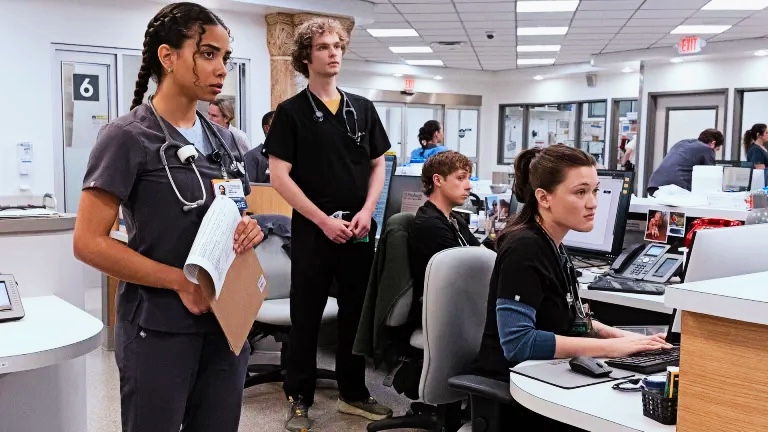
I’ve come to accept something fundamental about watching The Pitt at this point in season two: this show does not want me to feel comfortable, validated, or even particularly smart. It wants me alert, slightly stressed, and constantly aware that competence in a hospital setting is a moving target. The Pitt season 2 episode 4, titled “10:00 A.M.” but spiritually branded as First Week in July Syndrome, is the hour where that philosophy fully crystallizes. This is the episode where small mistakes metastasize into near-fatal disasters, where empathy saves a life while confidence nearly kills one, and where the most impressive win of the season arrives with a quiet warning label attached.
I watched this episode on my couch, coffee going cold, with the kind of clenched attention usually reserved for boss fights or watching someone defuse a bomb in a movie where you know the red wire is never actually the red wire. The Pitt doesn’t do spectacle medicine. It does procedural dread. And this hour weaponizes that dread like a scalpel.
Early on, the episode introduces Harlow Graham, a deaf patient played with disarming clarity by Jessica Flores. Watching nurse Donnie, portrayed by Brandon Mendez Homer, repeatedly address the ASL interpreter instead of Harlow herself made my spine tighten in recognition. Not because I’m some paragon of social grace, but because I’ve been mainlining classic medical TV lately and had literally just seen this exact mistake corrected on an episode of ER. Yes, that ER. The one starring ER, the series that taught an entire generation how to pronounce “stat” correctly.
That resonance isn’t accidental. The Pitt, starring Noah Wyle as the perpetually burdened Dr. Robby, exists in constant dialogue with its genre ancestors. And here’s the wild part: nearly three decades after ER tackled deaf accessibility with relative grace, modern doctors in-universe still need reminders. Harlow politely asking for eye contact lands harder than any shouted confrontation ever could. It’s a reminder that progress isn’t a straight line. It’s a spiral staircase you keep tripping on.
That theme of institutional knowledge failing under pressure runs through every corridor of this episode. The most overt example arrives courtesy of Ogilvie, played by Lucas Iverson, who finally stops being the golden boy long enough to screw up in a way that could have ended a life. He removes a shard of glass from Vince Cole, a 23-year-old parkour enthusiast who fell through a skylight, without realizing the glass is acting as a structural dam for his circulatory system. Blood pours out like the show has been waiting all season to remind us why you never pull foreign objects out of a trauma patient.
The save comes courtesy of a medical device that feels like something Bruce Wayne would prototype at 3 a.m.: microscopic sponges injected directly into the wound. It’s one of those moments where The Pitt flexes its commitment to near-future medical realism. This isn’t sci-fi, but it’s not your standard TV saline drip either. When Dr. Robby mutters “first week in July syndrome,” he’s not being flippant. He’s diagnosing a systemic issue. New residents, new rhythms, and just enough overconfidence to turn routine scans into missed time bombs.
Radiology missing the glass shard is almost worse than Ogilvie’s mistake, because it reinforces the episode’s central anxiety: everyone here is capable, and that still isn’t enough.
Elsewhere, Santos, portrayed by Isa Briones, continues her slow-motion academic implosion. She’s already skating on thin ice in her R2 year, and this episode makes it painfully clear that her problem isn’t intelligence. It’s distraction. Working alongside Mel King, played by Taylor Dearden, Santos fails to land on a diagnosis that Mel identifies with tired precision: bulimia in a Black female patient, a condition historically underdiagnosed due to medical bias. The show doesn’t grandstand about it. It doesn’t need to. The quiet frustration in Mel’s performance does all the heavy lifting, especially as she’s simultaneously counting down the hours to her own deposition like someone waiting for a root canal.
Dr. Langdon, played by Patrick Ball, gets his own slice of humiliation when he can’t unglue a patient’s eyelid. The solution arrives in the form of TikTok-famous “Dr. J,” who turns out to be Dr. Javadi, portrayed by Shabana Azeez. The fix works, but the cost is devastating in its own petty way: lost eyelashes mere hours before a Fourth of July party. The Pitt understands that trauma is relative, and sometimes it wears mascara.
Then there’s Joy Kwon. Irene Choi plays her like the human embodiment of Murphy’s Law. She’s already drowning in med school debt, already exhausted, and then she gets poked by glass sticking out of Vince Cole. Suddenly she’s a patient. A blood vial gets drawn. The vial gets dropped. The vial gets obliterated by a passing gurney. If this were a cartoon, there’d be a slide whistle sound effect. Instead, it’s just another reminder that hospitals are chaotic ecosystems where competence doesn’t immunize you against bad luck.
The episode is packed with patients stuck in diagnostic purgatory. A psychosis case goes unresolved. A diabetic ketoacidosis patient survives the medical crisis only to be crushed by the financial reality of having no insurance. His rejection of a GoFundMe page is one of the most quietly devastating moments of the hour. The Pitt doesn’t need monologues about the healthcare system. It just shows you the look on a father’s face when survival comes with a bill he can’t pay.
Amid all this entropy, one character actually gets a clean win. Dr. Whitaker, played by Gerran Howell, continues his ascent from promising resident to low-key MVP. When he refuses to write off Jean Samba’s condition as simple exhaustion and orders additional tests, the payoff is immediate and terrifying. A posterior STEMI. The worst kind of heart attack. Whitaker catches it seconds before Samba flatlines, saving his life through vigilance and intuition.
It’s the kind of moment medical dramas live for. The triumphant save. The earned praise from Dr. Robby. The sense that, for once, someone did everything right.
And The Pitt immediately undercuts it.
We learn that Whitaker has been spending time with the widow of a patient who died last year, helping on her farm, involving himself in her life far beyond professional boundaries. Santos clocks it instantly. Javadi raises an eyebrow. The implication is clear without being lurid: this isn’t healthy. It’s grief-adjacent codependence masquerading as kindness.
That’s what makes Whitaker such a compelling character. The same empathy that lets him see what others miss is the empathy that could destroy him. The Pitt isn’t asking whether Whitaker is good or bad. It’s asking whether the system even has room for someone like him without chewing him up.
By the time the episode ends, I’m left with the overwhelming sense that nobody wins here for long. Not the interns. Not the residents. Not the veterans. Whether you act too fast or hesitate too long, someone online, someone in administration, or someone in your own conscience is keeping score.
The Pitt season 2 episode 4 is one of the series’ strongest hours because it understands that medicine isn’t about heroics. It’s about margins. About eye contact. About knowing when not to pull the glass out.