


TL;DR: The Pitt season 2 episode 3 is a deceptively steamy, emotionally sharp hour that balances medical chaos with understated romance, proving once again that this show thrives when it lets human desire simmer beneath the scrubs.
The Pitt
I didn’t expect to start my morning with The Pitt season 2 episode 3 feeling like I’d accidentally tuned into a prestige medical drama that briefly moonlights as a low-simmer romance novel, but here we are. “9:00 A.M.” is one of those episodes that sneaks up on you. On paper, it’s another Fourth of July ER shift from hell, stacked with exposed brains, potassium crashes, rare diagnoses, and the kind of moral shortcuts that only feel justifiable when every second costs a life. In practice, it’s the horniest hour this show has ever produced, and I say that with deep respect.
There’s something almost mischievous about the way The Pitt deploys desire here. Not lust, not soap-opera melodrama, just that unmistakable static hum of attraction that happens when smart, exhausted people collide under fluorescent lights. The episode understands that romance in an ER isn’t about candlelight or swelling strings. It’s about jokes that land a second too late, eye contact that lasts a beat too long, and the thrill of realizing someone else in the room is just as fried and feral as you are.
That tonal sleight of hand is what makes “9:00 A.M.” such a standout. The Pitt doesn’t abandon its hardcore procedural bones. It simply lets a little blood rush somewhere unexpected.
The opening stretch sets the mood with the confidence of a show that knows exactly how weird its audience is willing to get. We go from a medically graphic emergency involving a dangerously persistent erection straight into banter that feels, frankly, illegal for morning television. This is where The Pitt really flexes its restraint. It never winks at the camera. It never underlines the joke. It just lets the situation exist, trusting that anyone who’s been online long enough already knows what kind of fan edits are coming.
Dr. Cassie McKay is the episode’s unexpected romantic epicenter, and watching the show realize in real time just how much gravitational pull she has is half the fun. Fiona Dourif has always had that quietly dangerous charisma, but here the writing leans into it like it’s finally accepted the obvious. A grandfatherly flirt becomes a warm reminder of human connection. A soccer-jersey-clad patient pushes things into rom-com territory without ever breaking the show’s grounded tone. It’s all very chaste, very professional, and somehow far more charged than anything explicit.
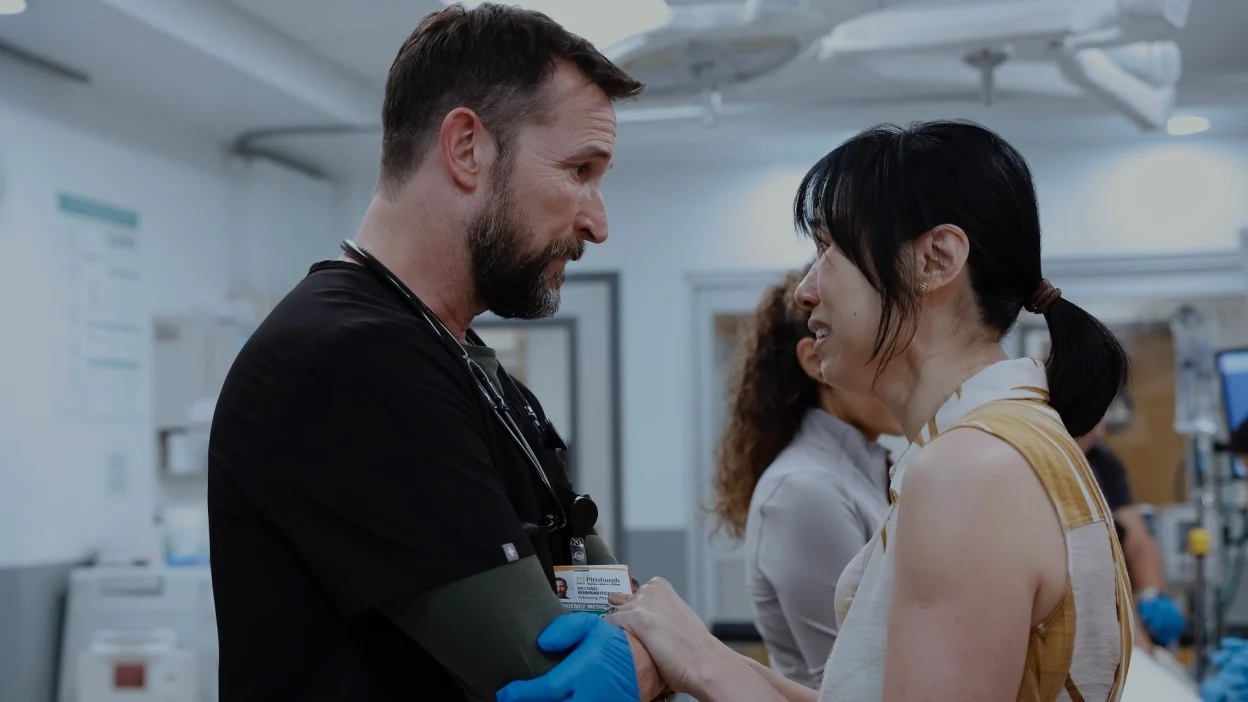
The real spark, though, lives in the quiet moments between the attendings. Noah Wyle’s Dr. Robby and Dr. Al-Hashimi share the kind of chemistry that only exists when two actors trust each other enough to do less. Their parting exchange about cooperation versus commitment is delivered like a throwaway joke, but it lands like a thesis statement. This episode isn’t about grand declarations. It’s about acknowledging desire without letting it derail the work. That’s a razor-thin line, and The Pitt walks it like it’s done this a hundred times before.
What makes that line resonate is how the patients mirror it. Mr. Williams’ diagnosis is devastating, the kind of reveal that usually sucks all the oxygen out of an episode. Instead, it becomes a bittersweet window into the way people retroactively rewrite their relationships when illness offers a narrative escape hatch. His ex-wife’s tentative hope that a tumor might explain years of pain is heartbreaking in a way that feels painfully human. The Pitt doesn’t judge her for wanting that absolution. It simply lets the idea hang in the air, unresolved and uncomfortable.
Then there are the Yees, whose storyline is the episode’s quiet emotional gut punch. Hypokalemia might be a medical zebra, but the real rarity here is the tenderness with which the show treats marital fear. Mark Yee’s filmed message to his wife is a small moment, almost procedural in execution, but it wrecked me. It’s the sound of a man realizing that love isn’t proven in grand gestures, but in making sure the words exist somewhere, just in case.
That tenderness makes the later revelation about Nancy Yee sting even more. Whether it’s a systemic blind spot or an unspoken prioritization of one patient over another, the show refuses to spoon-feed blame. It just presents the consequence and moves on, because that’s what an ER does. If you linger too long, someone else dies.
Even the chaos beats feel more purposeful this week. Jackson Davis’ storyline wraps quickly, but it leaves behind a residue of institutional unease. The negative tox screen doesn’t absolve anyone. It just shifts the discomfort from a medical mystery to an ethical one. Watching authority figures scramble when certainty evaporates is one of The Pitt’s most reliable pleasures, and this episode wastes no time cashing that check.
The same goes for the Hansens, whose introduction feels almost casual until you realize how much world-building is happening in the background. Drug sharing, familial mythology, and the normalization of risk all bleed together into a portrait of American excess that feels uncomfortably plausible. The Pitt never lectures. It just observes, scalpel-sharp.
And yes, we get our Louie check-in, because the universe is not cruel enough to deprive us of Ernest Harden Jr. for too long. Louie remains the soul of the show, a walking reminder that survival often looks messier than redemption arcs would have us believe. His ongoing health issues aren’t played for cheap suspense. They’re just part of the rhythm now, like a favorite NPC whose quest line you desperately hope doesn’t end.
The episode’s most affecting sequence, though, belongs to Yana Kovalenko. Her arrival brings the weight of Pittsburgh’s real history crashing into the procedural flow, and the show handles it with remarkable grace. The reference to the Tree of Life synagogue shooting isn’t sensationalized. It’s treated as lived trauma, folded into casual conversation the way real grief often is. Her scenes with Robby and the nursing staff are quiet, humane, and devastating in their simplicity.
This is where The Pitt’s setting truly earns its keep. By rooting its stories so specifically in Pittsburgh, the show sidesteps the glossy anonymity of coastal medical dramas. The pain feels local. The resilience feels earned. When characters talk about settling down or finding release, it’s not abstract. It’s happening in a city that remembers its scars.
“9:00 A.M.” works because it understands that desire and duty aren’t opposites. They’re parallel forces, both demanding attention, both capable of destruction if ignored. The episode doesn’t ask its characters to choose. It just asks them to keep going, to do the work, and maybe, if there’s time, to acknowledge the heat crackling beneath the surface.
By the end of the hour, I felt like I’d watched The Pitt level up. Not louder, not messier, just more confident in its ability to let human messiness coexist with clinical precision. It’s an episode that trusts its audience to feel the tension without needing it spelled out, and that trust is intoxicating.