

TL;DR: A gorgeous, clever, and mechanically rich RPG that occasionally trips over its own jokes. If Fallout: New Vegas and Mass Effect had a baby raised by Futurama, it would look a lot like this.
The Outer Worlds 2
Obsidian Entertainment has always been my favorite kind of chaos merchant. They’re that friend who insists on running a D&D campaign where half the group ends up debating ethics instead of rolling for initiative. Their games aren’t about perfection — they’re about personality. Fallout: New Vegas, Pillars of Eternity, even Alpha Protocol — they all carry the same DNA: beautiful disasters powered by conviction. Their code might creak like an old space freighter, but every line of dialogue hums with intent. You don’t play an Obsidian game expecting stability; you play it because you know it’ll ask questions most studios are too scared or too disinterested to even form.
So when The Outer Worlds 2 landed on my hard drive, I wasn’t waiting for a slick blockbuster. I was waiting for an argument. I wanted the studio’s trademark mix of wit, cynicism, and existential dread — the feeling that behind every corporate mascot and vending machine slogan, there’s someone quietly screaming. And, to its credit, I got that. But I also got something stranger: a game that feels like Obsidian is finally confident enough to strut, even if it occasionally forgets which dance it’s doing.
The Outer Worlds 2 is sharper than the first — sleeker combat, denser systems, and a better understanding of what makes its universe tick. Yet for all its polish, it’s still gloriously messy in spirit. It can’t decide whether it wants to be a biting satire or a straight-faced space drama, and the tension between those instincts gives it a kind of unpredictable electricity. Sometimes it soars, sometimes it stumbles, but it’s never boring. It’s the rare sequel that dares to improve and contradict its own identity — a cosmic contradiction I couldn’t stop orbiting for sixty hours.

The Setup: Betrayal Among the Stars
This time, you’re not a random colonist thawed from cryosleep. You’re an agent of the Earth Directorate — the bureaucratic heart of a decaying interstellar empire that’s part Starfleet, part IRS. What begins as a routine mission turns sideways faster than you can say “corporate espionage,” and before you know it, you’re knee-deep in a conspiracy involving a totalitarian faction called the Protectorate and a megacorp merger between Auntie Cleo and Spacer’s Choice, now reborn as Auntie’s Choice. Yes, that’s right — the future still belongs to branding.
The first thing you notice is how alive the writing feels. Obsidian’s world-building is still razor-sharp, filled with half-whispered political tension and the slow creep of consumerist decay. The factions are no longer cardboard caricatures of late-stage capitalism — they’re recognizable reflections of our own broken world. The Protectorate feels like a mashup of every well-meaning government gone authoritarian, while Auntie’s Choice represents the tech conglomerate future we’re already living in, where your boss is a hologram and your paycheck is a subscription.
The problem? The tone doesn’t always know what to do with all this richness. One moment you’re staring down the aftermath of a planetary genocide, the next someone makes a fart joke about nutritional paste. It’s like watching The Expanse suddenly cut to Futurama. There’s brilliance in the writing, but it keeps tripping over its own sense of humor.

Who You Are (and Who You Might Become)
Character creation remains the beating heart of the experience. Obsidian has always excelled at letting you build yourversion of the protagonist — the charismatic diplomat, the unhinged sociopath, the pacifist engineer who solves galactic crises with duct tape and sarcasm. In The Outer Worlds 2, every background, trait, and flaw feels like it was written by someone who actually thought through how they’d affect the story.
My first playthrough, I built a smooth-talking mechanic named Aria, a former corporate saboteur who used to work in planetary maintenance. I gave her the “Lucky” trait, which occasionally let her bypass locked doors or reroute circuits by sheer chance. The first time that trait triggered, she accidentally kicked a console and reactivated a life-support system that was supposed to be dead. It was absurd — and perfectly on brand for her. By the fifth time, I was convinced the universe itself was mocking me.
But the real magic comes from the flaws. Obsidian brought them back with more nuance — little psychological thorns that offer bonuses and curses in equal measure. My favorite was Foot-in-Mouth Syndrome, which grants extra XP but auto-selects a dialogue option if you take too long to answer. It’s brilliant. It forces you to roleplay impulsiveness, to live with the chaos you invited into your own story. I lost count of how many times I watched Aria ruin delicate negotiations because I got distracted petting my cat mid-dialogue.
Every choice ripples outward. Maybe you specialize in engineering and can repair old-world tech others overlook. Maybe your silver tongue talks you out of a boss fight entirely. Or maybe — as I learned the hard way — you spread your skill points too thin and end up half-good at everything, which is Obsidian’s polite way of saying: you’re mediocre and everyone knows it.

When Combat Finally Clicks
One of my biggest complaints about the first Outer Worlds was the combat. It always felt like a side project — the awkward cousin at the RPG family reunion. Guns lacked punch, AI enemies stood still waiting to be shot, and melee attacks landed with all the impact of a wet noodle. The sequel fixes that in spectacular fashion.
Weapons finally feel good. Each one hums with mechanical heft. Pistols snap, shotguns roar, and energy rifles crackle like they’re trying to melt the air itself. I became particularly obsessed with a gun called the Auto-Hacker 5000 — a ridiculous name for what is essentially a portable chaos generator. It shoots electric bursts that scramble enemy robots, occasionally making them switch sides mid-fight. There’s nothing more satisfying than watching a mech tear through its former allies while you reload behind cover, grinning like an idiot.
Enemy AI actually uses tactics now — flanking, taking cover, and forcing you to think. The time-slowing tactical system from the first game returns, but it’s rebalanced to reward precision instead of spamming. Combine that with more fluid movement, and the whole experience feels like someone finally taught Fallout’s gunplay how to dance.
And the companions! Six of them join your crew across the campaign, each with distinct personalities and missions that expand the lore in small, meaningful ways. One of my favorites, Valerie, is a hovering robot whose dry literalism could make Marvin the Paranoid Android blush. She’s funny — but sometimes too funny. Like when she breaks the tension of a tragic death scene with a probability joke. It’s cute the first time; by the tenth, it’s like watching someone crack memes at a funeral.

Humor as a Double-Edged Sword
Let’s talk about the elephant — or rather, the sarcastic AI — in the room. The Outer Worlds 2 can’t quite decide if it wants to be a biting satire or a serious sci-fi epic. Its humor is baked into its DNA; it’s what gave the original its charm. But this time, the jokes sometimes clash with the maturity of the themes.
Take, for example, the Abrasive flaw. Occasionally it unlocks new dialogue options where you can threaten or insult NPCs. In theory, that’s great — it adds role-playing depth. But most characters shrug it off like you just sneezed mid-sentence. “That’s rude,” they’ll say, then carry on like nothing happened. It’s jarring. If the game is going to let me play an asshole, then let the world react to it. Otherwise, it’s just empty flavor text.
This tonal schizophrenia runs throughout the story. You’ll get a quest about the ethics of cloning human consciousness, then immediately find yourself looting a corpse wearing a shirt that says “Taste the Flavor of Obedience.” I get it — satire. But sometimes the writing is too self-aware for its own good. It’s the same problem BioShock Infinite had: trying to critique capitalism while reveling in its aesthetics.
That said, when the humor lands, it’s devastatingly good. There’s one moment — without spoiling too much — where you’re forced to choose between two catastrophes in what is basically a cosmic trolley problem. If you pick the darker option, the NPC who orchestrated it just stares at you, horrified, muttering, “You’re not supposed to pick that.” It’s meta, it’s bold, and it’s the kind of joke that sticks because it reveals something about you, not just the game.

Space, Style, and Scope
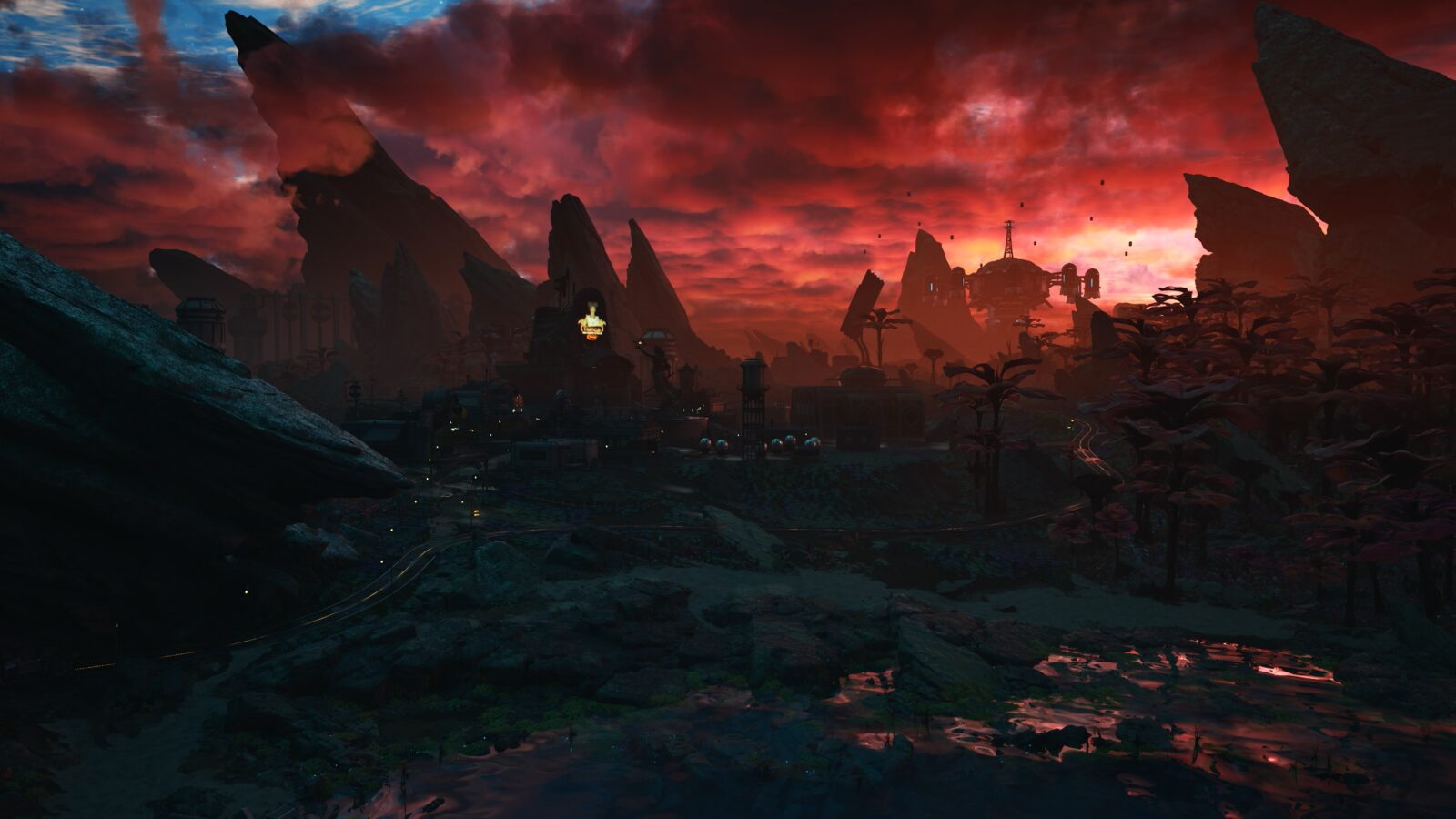
From a presentation standpoint, The Outer Worlds 2 is breathtaking. Obsidian’s art direction walks a tightrope between pulp sci-fi and dystopian absurdity. Planets are dense, colorful, and weirdly intimate — more curated than Starfield’s procedural sprawl, but better for it. Every location feels hand-built to tell a story, from the neon sprawl of New Halcyon to the fungal wastelands of Orison Prime. It’s a universe that begs to be explored, screenshot, and meme’d.
The soundtrack deserves special mention — it’s cinematic without losing that old-school RPG texture. Brass swells when you step into orbit, synths shimmer in the void, and quiet strings mourn the consequences of your choices. The sound design sells the illusion that you’re part of something grand, even when you’re just rifling through space dumpsters.
But the biggest compliment I can give is that The Outer Worlds 2 feels cohesive. Despite the tonal missteps, every system, every conversation, every environmental detail feeds into the game’s central question: what does freedom mean in a world where everything — even rebellion — can be monetized?

The Great Tonal Rift
This is where I struggle most with the game. It’s not that the humor is bad — it’s that it’s too safe. It undercuts moments that could have hit like gut punches. There’s a late-game scene where a beloved companion confronts you about a moral choice you made hours earlier. It’s raw, intimate, and beautifully acted — until Valerie interjects with a line about friendship protocols. The tension evaporates. It’s not that I don’t appreciate levity, but sometimes silence is the better punchline.
Obsidian is clearly aware of this push and pull. The game even mocks itself in the opening narration, admitting it’s a sequel that doesn’t know its own plot yet. That self-awareness is funny, but it also becomes a crutch. The Outer Worlds 2 constantly reminds you that it knows it’s a game — that it’s all part of the joke. But the best satire doesn’t have to wink at the audience every five minutes; it just lets the absurdity speak for itself.
In the Company of Better (and Worse) Games
Comparisons are inevitable. Where Starfield gave us an infinite universe with the emotional range of a beige wall, The Outer Worlds 2 gives us a smaller galaxy that actually means something. Where Mass Effect delivered grand melodrama, Obsidian gives us moral ambiguity wrapped in absurdity. It’s less about saving the universe and more about surviving it with your sense of humor intact.
And yet, I couldn’t shake the feeling that this game wanted to be both — the grand BioWare epic and the satirical indie darling. It almost pulls it off. Almost. But not quite. The dissonance is the price of ambition.
Verdict
Despite its tonal wobble, The Outer Worlds 2 is everything I wanted from a sequel: more depth, more consequence, and more reasons to replay. Its world is vibrant, its systems interlock beautifully, and its writing — when it’s not trying too hard — cuts sharper than ever. I just wish it trusted itself enough to pick a lane.
Obsidian has proven that they can do space opera as well as anyone — they just need to decide whether they want to make us laugh at the universe or cry for it.