
TL;DR: The Abandons is an over-serious, occasionally clunky, but undeniably compelling western powered by two killer performances from Gillian Anderson and Lena Headey. The script wobbles, the tone is heavier than a fully loaded covered wagon, and the melodrama can get goofy—but the mythmaking works, the frontier aesthetics hit hard, and the central feud is delicious. A flawed but engrossing binge for anyone who loves their westerns bold, dusty, and dramatically overcooked.
The Abandons
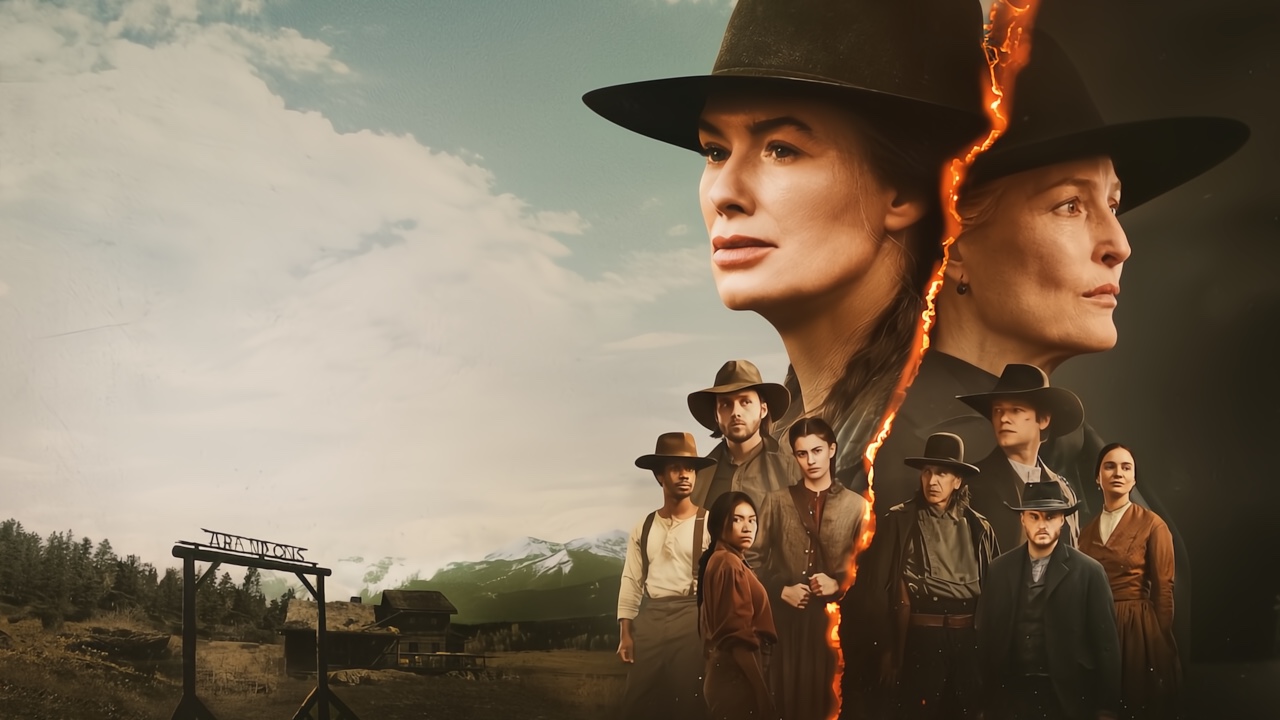
Angel’s Ridge, Washington Territory, 1854. Dust in the air thick enough to season fries, horses that look like they desperately need union representation, and a sepia palette so committed it may as well be under an exclusivity contract. That’s the frontier Kurt Sutter drags us back into with The Abandons, his moody, blood-stained Netflix western that pairs Gillian Anderson and Lena Headey for a showdown that feels one part operatic, one part mythic, and about six parts deadly serious.
As someone who grew up on a questionable rotation of Clint Eastwood marathons, Deadwood rewatches, and the kind of paperback westerns you’d find in your granddad’s spare room between a radio he swore he’d fix and an ashtray shaped like Texas, I went into The Abandons curious. And while the show occasionally hits the same narrative potholes as the Oregon Trail, it also barrels forward with such conviction that I couldn’t look away. It’s overripe, overwrought, sometimes overrun with exposition—but it’s also strangely hypnotic in its dedication to frontier mythmaking.
This is a western that wants to be a legend. And sometimes legends forget they don’t have to be poems written in capital letters.
The Ice Queen of Angel’s Ridge
Let’s talk about Gillian Anderson, because my god. As Constance Van Ness, the silver-mine magnate who rides into town with the kind of posture that could slice marble, she is an arctic front wrapped in black wool. Anderson’s performance is a masterclass in weaponized stillness—every glare could tan a hide, every sentence feels chiseled from glacier ice. It’s the kind of villainy that doesn’t chew scenery; it quietly repossesses it.
Constance is the engine of the plot, the woman whose hunger for Jasper Hollow’s silver pits her against the four families who’ve built actual lives on land she sees as nothing more than a mineral buffet. And while the writing sometimes gives her dialogue that feels a little on the nose—like the script equivalent of a piano chord labeled “MENACE”—Anderson elevates it with a terrifying restraint. Watching her stalk through the town is like watching a snow leopard walk into a saloon: you know something beautiful and fatal is about to happen.
Her best moments, ironically, are the quiet ones. The scenes where she isn’t threatening anyone, but you can feel the threat hovering above her like a halo dipped in kerosene. In another life, she could’ve been the villain of a Fallout game.
Lena Headey, Patron Saint of Found Families
Opposite her, Lena Headey’s Fiona Nolan is basically frontier-era Sarah Connor with an Irish rosary. She’s a devout, stubborn, fiercely protective rancher who has gathered around her a ragtag group of orphans, strays, and lost souls—think Oregon Trail but curated by the Fast & Furious franchise’s definition of family.
Headey is magnetic here. She plays Fiona with that signature blend of tenderness and coiled fury, the kind of performance that reminds you why Game of Thrones didn’t work whenever she wasn’t on screen. Fiona is the beating heart of the show, the righteous fist raised against Constance’s empire of exploitation.
And yes, the show milks this binary—good vs evil, family vs empire, justice vs corruption—like a cow that should frankly file a workplace grievance. But Headey sells it with such conviction that I felt myself getting swept along even when the writing drifted into melodrama.
There’s a scene where her cattle are driven off a cliff by masked saboteurs, and the only thing that saves her herd is a last-minute orphan rescue mission. It feels like something straight out of a pulp dime novel, and yet Headey grounds it emotionally. I didn’t believe the moment. I believed her belief in the moment.
This Script… It Sure Exists
Look, we need to talk about the dialogue.
Every so often, a character in The Abandons delivers a line that sounds like it escaped from a different show—specifically, a YA historical melodrama rejected by The CW for being too earnest. When orphan Elias declares, with full chest, Her tyranny’s getting worse!, it’s one of those lines that made me involuntarily glance at the camera that wasn’t there.
The writing often lands somewhere between Shakespearean gravitas and a very passionate community theater production. And while I admire the ambition, I sometimes wished the characters were allowed to sound like actual frontier people instead of characters who just finished reading a book called Themes of Power and Moral Order in Pre-Statehood America.
That seriousness is the show’s biggest liability. Westerns can be mythic, but mythology doesn’t need to be humorless. Deadwood understood that profanity could be poetry. The English understood that tragedy could be surreal. Even 1883 knew that bleakness worked best when it was filtered through human messiness, not solemnity at gunpoint.
The Abandons goes for operatic, and sometimes it accidentally lands on soap operatic.
Mythmaking on a Streaming Budget
To the show’s credit, it looks gorgeous. Netflix clearly invested more than what most westerns get these days, and the production design embraces that rustic, grimy authenticity that frontier stories thrive on. The sepia-washed palette, the lived-in interiors, the battered costumes—it all contributes to a sense of place that feels tactile, even when the dialogue floats away like a tumbleweed in search of a better metaphor.
The world-building is strong enough that I occasionally found myself wishing the camera would linger longer on the setting and less on yet another Very Serious Monologue about the future of the town.
There are also subplots—like outlaw Roache bonding over Schubert with Constance’s daughter—that feel like Sutter saw a Romeo and Juliet production and thought, I can westernify that. The forbidden romance vibes are strong, even if the pacing sometimes makes it feel like we’re skipping chapters.
And then there’s the priest. Timothy V Murphy plays Father Duffy, Fiona’s childhood friend turned spiritual ballast. As someone raised Catholic, I’ve learned that priests in westerns are about as trustworthy as rattlesnakes in gift boxes, so I spent the whole season waiting for him to do something catastrophic. Whether or not that happens… well, let’s just say the show has fun with expectations.
Why It Still Works
For all my grumbling, The Abandons has something essential: mythic momentum. Westerns aren’t about realism—they’re about the stories we tell ourselves about justice, survival, community, and power. And on that front, the show delivers.
Yes, it’s heavy. Yes, it’s earnest. Yes, sometimes the script sounds like a frontier-themed tabletop RPG run by a very enthusiastic dungeon master. But the emotional throughline lands. The conflict feels elemental. The performances are fierce. And the story has that classic American tension between empire and underdog that never stops being relevant.
You root for the Nolans because the world is unfair. You root against Constance because history is full of people like her who didn’t get punched enough. You keep watching because you want the frontier myth—family wins, corruption falls, justice triumphs—to come true at least somewhere, even if only on Netflix.
The Abandons may be flawed, but it has conviction. And sometimes that’s enough.