
TL;DR: Star Wars: Visions Season 3 is a masterclass in animated storytelling — bold, emotional, and visually breathtaking. From the return of the Ronin to the quiet heartbreak of The Lost Ones, this is Star Wars at its most creative and fearless. Forget canon — this is the Force unleashed.
Star Wars: Visions Season 3
At this point, the Star Wars fandom has been through more ups and downs than a podrace on Boonta Eve. For every Andor that sneaks up and rewires our idea of what Star Wars can be, there’s a Book of Boba Fett that feels like it was patched together in a Tatooine garage with spare speeder parts. But then there’s Star Wars: Visions — the one corner of the galaxy that doesn’t care about canon, continuity, or how many Skywalkers are in the family tree.
And thank the Force for that.
With its third season now streaming on Disney+, Visions continues to be the most thrilling, original, and visually audacious thing to happen to Star Wars since George Lucas said, “What if I made the prequels mostly about trade negotiations and glowing swords?”
From the start, Star Wars: Visions has been a love letter — not just to Star Wars, but to the art of animation itself. Season 1 brought in Japanese powerhouses like Studio Trigger and Production I.G., who treated lightsabers like brushstrokes and Jedi philosophy like abstract poetry. Season 2 went global, calling in studios from Spain to Ireland to give us claymation Jedi and cosmic folklore.
Season 3? It’s the perfect balance between reverence and rebellion — a return to form with a little narrative continuity and a whole lot of style.
This time, three of the series’ most beloved shorts get sequels: The Duel, The Ninth Jedi, and The Village Bride. And rather than feeling like a rehash, they make Visions feel even more alive — like we’re watching this incredible anthology evolve in real time.
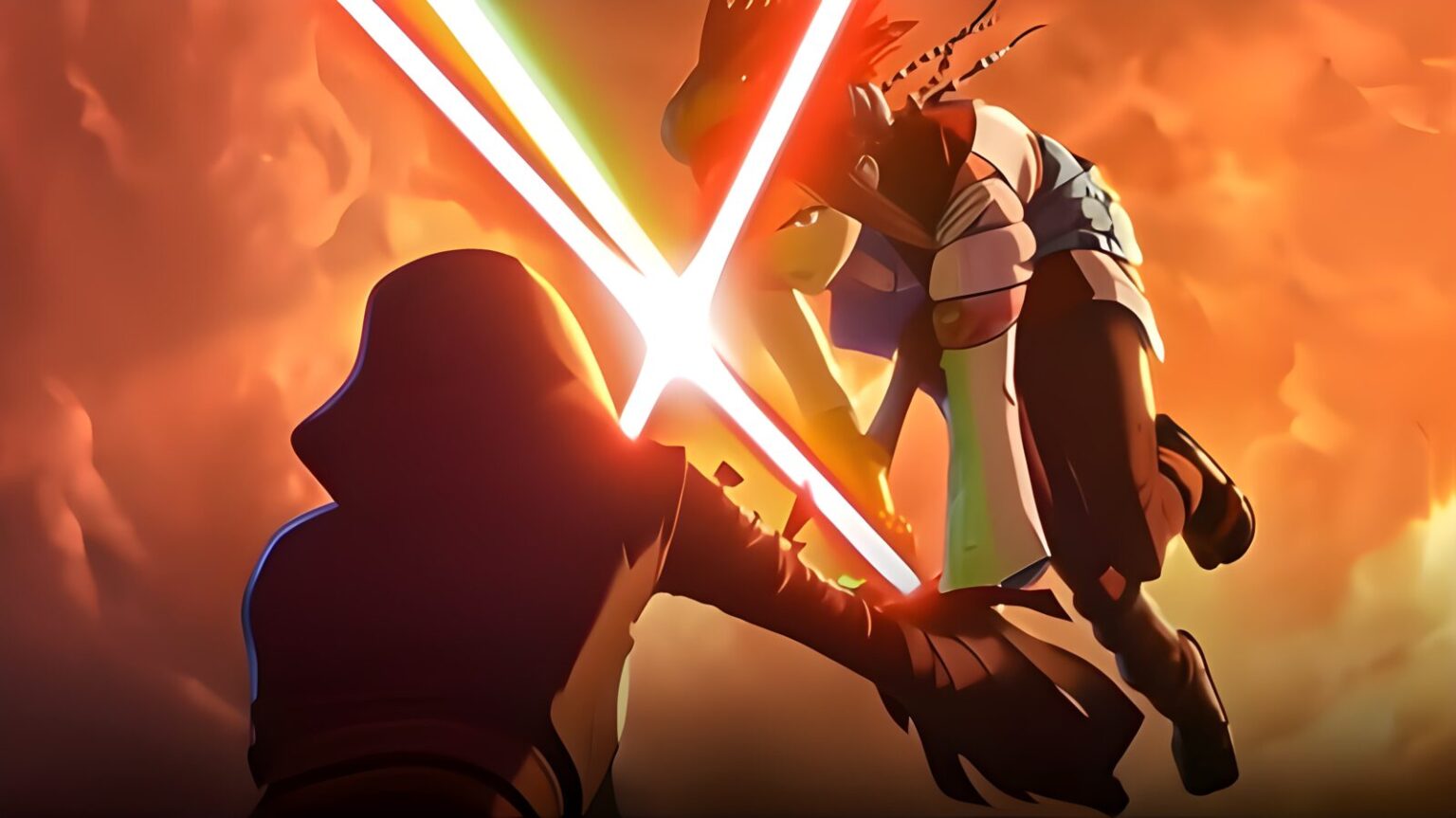
Let’s start with the opener, The Duel: Payback. The original episode was an instant cult classic — a Kurosawa-inspired fever dream rendered in black and white, where every frame looked like it had been carved by a samurai ghost. The sequel picks up that same aesthetic and dials it to eleven.
We’re reunited with The Ronin (voiced again by Brian Tee), a former Sith lord turned monster hunter — the kind of guy who probably hasn’t smiled since the Clone Wars but could outdraw Darth Maul before the opening crawl finishes.
This episode is a masterclass in animated action. The choreography feels almost tactile, like every swing of a saber could slice through your OLED display. The villain is creepy and beautifully designed, and the duel itself belongs in the same breath as Maul vs. Qui-Gon and Obi-Wan in The Phantom Menace. Yeah — it’s that good.
It’s not just a visual spectacle, though. The Ronin has become one of the most interesting antiheroes in the entire Star Wars mythos — and that’s saying something in a franchise full of space monks and daddy issues. He deserves his own standalone series. (Lucasfilm, if you’re listening: you’ve got your next prestige show right here.)
Then comes The Ninth Jedi: Child of Hope, which feels like The Clone Wars by way of Studio Ghibli. It’s got lore, it’s got heart, and it’s got a new droid voiced by Freddie Highmore who’s so charming I’d buy his action figure tomorrow.
It’s also clearly a backdoor pilot for the upcoming spin-off series — but unlike most franchise setups, this one earns it. The worldbuilding is lush, the mythology deep, and the animation smooth as Beskar. There’s a sense of possibility here, a reminder that Star Wars can still surprise us when it stops obsessing over legacy characters and starts inventing new ones.
Finally, The Lost Ones revisits The Village Bride, one of Season 1’s most poetic entries. Karen Fukuhara returns as the quiet Jedi wanderer, observing the small tragedies of ordinary people living under the Empire’s shadow.
Where Payback is kinetic and bloody, The Lost Ones is meditative — a soft-spoken elegy about community, healing, and how the Force flows through even the smallest acts of kindness. It’s pure Andor energy: restrained, humane, and quietly devastating.
No lightsaber fireworks here, but the emotional resonance? Off the charts.
The new, non-sequel shorts are just as audacious. We’re talking X-Wing mech suits. Talking cyborg teddy bears. Assassin droids with multiple personalities. The kind of stuff that would’ve gotten you laughed out of the Lucasfilm boardroom in 1999 but somehow feels completely organic here.
And that’s the secret sauce of Visions: no idea is too weird if it’s executed with sincerity. Every short brings something distinct — a new art style, a fresh emotional hook, a risk that pays off. The animation is jaw-dropping across the board, and the fight choreography? Let’s just say the prequel trilogy finally has some worthy competition in the “lightsaber porn” department.
Each duel feels weighty, expressive, and meticulously crafted — like the animators spent weeks studying every swing of Obi-Wan’s wrist in Revenge of the Sith.
What makes Visions so vital is that it refuses to be shackled by canon. There’s no need to explain where these Jedi fit in the timeline or which Skywalker they’re secretly related to. By cutting the cord of continuity, Visions reminds us why Star Wars mattered in the first place: the thrill of myth, the pull of destiny, and the infinite possibilities of imagination.
It’s ironic that a non-canon series feels more Star Wars than most of the canon content. There’s something liberating — even radical — about letting artists interpret the galaxy in their own way. It’s messy, it’s weird, it’s soulful. It’s everything the franchise needs right now.
If Visions Season 1 was the experiment and Season 2 was the expansion, Season 3 is the coronation — proof that this anthology deserves to stand shoulder to shoulder with Andor, The Clone Wars, and The Mandalorian at the top of the Star Wars food chain.
It’s inventive without being pretentious, nostalgic without pandering, and packed with visuals that could make ILM blush. And most importantly, it reminds us that Star Wars doesn’t have to explain itself — it just has to feel alive.