
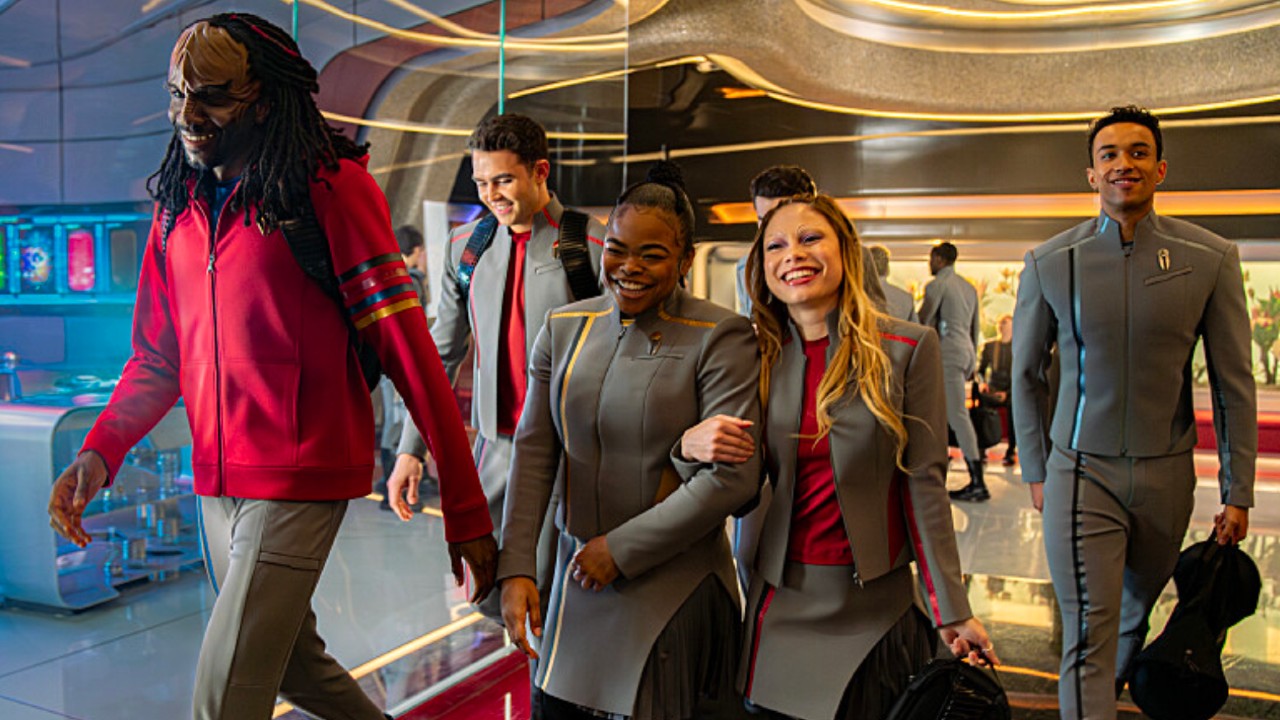
TL;DR: Star Trek: Starfleet Academy blends earnest teen drama with classic Trek moral dilemmas in a way that shouldn’t work but absolutely does. It’s messy, sincere, occasionally awkward, and ultimately a hopeful reminder of what Star Trek is supposed to be about.
Star Trek: Starfleet Academy
I’ll be honest right out of the gate: when Paramount announced Star Trek: Starfleet Academy, my inner Trekkie did that long, weary sigh usually reserved for yet another unnecessary reboot or a prequel no one asked for. A Star Trek show about kids in school, set in the hyper-future continuity of Star Trek: Discovery? On paper, it sounded like someone fed the franchise bible into an algorithm that also binge-watched old CW dramas at 3 a.m. The result felt destined to be a glossy, hollow exercise in brand extension rather than a meaningful addition to Trek canon.
And look, Star Trek hasn’t exactly been batting a thousand lately. 2025 was rough. Like “red alert klaxon stuck on loop” rough. The straight-to-TV misfire Star Trek: Section 31 landed with all the grace of a warp core breach, instantly earning a spot in the lower decks of Trek history. Even Star Trek: Strange New Worlds, usually my comfort food Trek, stumbled a bit in its third season, leaning too hard into self-parody when it should’ve trusted its own emotional stakes. With cancellations piling up and the franchise contracting faster than a damaged nacelle, Starfleet Academy felt less like a bold new mission and more like a last-ditch experiment.
Here’s the thing, though. Against all logic, against my better judgment, and definitely against the knee-jerk reactions of half the internet, Star Trek: Starfleet Academy kind of rules.
Not in a “this will redefine television” way. Not even in a “this is peak Trek” sense. But in a deeply sincere, unexpectedly charming, and occasionally very geeky way that reminded me why I fell in love with this franchise in the first place. It boldly goes straight into teen drama territory, plants its flag, and somehow finds real Star Trek heart there.
The show is set in the 32nd century, roughly 800 years after the era of Picard, Sisko, and Janeway. The galaxy is still reeling from The Burn, the catastrophic event introduced in Discovery that wiped out most active warp travel and nearly shattered the United Federation of Planets. Starfleet, once the gold standard of exploration and diplomacy, became smaller, harder, and more militarized out of sheer necessity. Now, finally, things are shifting again. The Federation is trying to remember who it used to be. The reopening of Starfleet Academy is both a literal and symbolic step toward that future.
That’s where the series begins, following the first class of cadets to attend the Academy in over a century. They’re young, brilliant, emotionally messy, and carrying enough personal baggage to fill a cargo bay. At the center of it all is Chancellor Nahla Ake, played by Holly Hunter with the kind of feral authority that makes you instantly believe she could both out-think you and out-yell you in the same breath. She’s half-Lanthanite, which means she oscillates between playful whimsy and terrifying competence, sometimes in the same scene.
The student ensemble is exactly the kind of eclectic, hyper-diverse lineup you’d expect from a future Federation trying to rebuild itself. There’s Caleb Meir, a brilliant but deeply skeptical tech prodigy whose history with Starfleet is… complicated, thanks to some extremely not-great things done to his family. His Klingon best friend Jay-Den Kraag is a pacifist healer who rejects his warrior heritage, which, as you might imagine, does not go over well with certain corners of Klingon society. There’s Sam, a sentient hologram still figuring out what personhood even means when you can be paused, rebooted, or accidentally duplicated. And yes, there’s a bully, Darem Reymi, whose arc from insufferable jerk to slightly less insufferable jerk is surprisingly thoughtful.
At first, the show leans hard into teen drama rhythms. I’m talking will-they-won’t-they tension that feels like the end of the world, petty rivalries blown up to cosmic proportions, and emotional outbursts that would feel right at home in a John Hughes movie, if John Hughes had access to holodecks and nightmare aliens. It absolutely feels closer to 90210 than The Wrath of Khan in its early episodes, and that’s going to be a dealbreaker for some folks.
For me, it worked. Because Starfleet Academy understands something crucial: adolescence is intense. Everything feels like life or death when you’re that age. Star Trek has always been about big feelings wrapped in speculative fiction, and reframing that through young adults finding their place in a broken galaxy makes a weird amount of sense. When these cadets stress over exams, friendships, or romantic entanglements, it’s not trivial. Their mistakes can ripple outward into diplomatic incidents or ethical disasters. The show constantly toggles between small, personal stakes and massive, galaxy-shaping consequences, and most of the time, it nails the balance.
What really surprised me is how unapologetically earnest the series is. In an era where genre TV often hides behind snark or meta humor, Starfleet Academy leans into sincerity like it’s a feature, not a bug. Yes, there are jokes. Some land better than others. Early on, the dialogue occasionally trips over itself trying to sound both futuristic and youthful, resulting in a few clunky exchanges. But when the show wants to talk about trauma, cultural identity, or the moral weight of Starfleet’s legacy, it does so with real conviction.
There are episodes where the students are pulled into diplomatic crises that could affect billions of lives, forcing them to grapple with Starfleet ideals before they’ve even fully internalized them. There are heated debates over refugee policies, the ethics of advanced technology, and what responsibility the Federation has to worlds it abandoned during The Burn. These aren’t just background details. They’re baked into character arcs and relationships, making the classroom feel like a crucible rather than a safe bubble.
The performances help sell all of this. Holly Hunter is predictably excellent, bringing both warmth and menace to Nahla Ake. Robert Picardo returns as the Doctor from Voyager, and it’s like he never left, delivering razor-sharp sarcasm with the ease of a man who’s been waiting decades to do this again. Among the younger cast, Bella Shepard shines as Genesis Lythe, an overachiever whose confidence masks a quiet fear of failure. Sandro Rosta gives Caleb a simmering intensity without tipping into moody caricature. Kerrice Brooks steals scenes as Sam, finding humor and pathos in what could’ve been a gimmicky role.
And then there’s Paul Giamatti. As Nus Braka, he initially seems like a cartoon villain dipped in space slime, chewing scenery with wild abandon. Over time, though, the performance sharpens. The camp fades just enough to reveal a genuinely unsettling antagonist whose motivations feel uncomfortably plausible in a fractured galaxy. It’s a great reminder that Giamatti can elevate even the weirdest genre roles into something memorable.
That said, the show isn’t flawless. Visually, it’s inconsistent. Some episodes look stunning, with sleek production design and a lived-in sense of future history. Others stumble with questionable CGI or odd cinematography choices, especially during flashbacks that feel unnecessarily stylized. There’s also at least one episode that tries to cram an entire season’s worth of political upheaval into a single hour, resulting in pacing that’s about as graceful as a shuttle crash.
Still, by the time I reached the end of the first batch of episodes, I realized something had shifted. I wasn’t watching Star Trek: Starfleet Academy out of obligation or morbid curiosity anymore. I was genuinely invested. I cared about these characters. I wanted to see them grow, screw up, and hopefully become the kind of officers who might help the Federation live up to its ideals again.
In a franchise moment defined by uncertainty, Starfleet Academy feels like a weirdly hopeful experiment. It doesn’t replace classic Trek. It doesn’t try to. Instead, it asks what Star Trek looks like when the future is fragile and the next generation has to rebuild not just institutions, but values. Wrapping that question in teen drama might sound like heresy, but it turns out to be a surprisingly effective delivery system.
If nothing else, Star Trek: Starfleet Academy proves that the franchise still has new stories to tell, even if they come from a classroom instead of a bridge. And yeah, the kids are alright.