
TL;DR: Star Trek: Starfleet Academy Episode 8 delivers a deeply emotional ending in which SAM is reborn with two lifetimes of memory, The Doctor finally heals from centuries-old grief by becoming her father, and Tarima embraces the meaning of finite existence through the lens of Our Town. It is thoughtful, character-driven Star Trek that proves the franchise still understands the human condition better than most genre television.
Star Trek: Starfleet Academy
Every so often, Star Trek stops trying to impress you with starship porn and instead quietly dismantles you with feelings. Star Trek: Starfleet Academy Season 1 Episode 8, “The Life of the Stars,” is that kind of hour. This is not an episode built around spectacle or franchise fireworks. It is built around grief, memory, choice, and the terrifying intimacy of being alive in a universe that does not promise permanence. By the time the ending lands, I wasn’t thinking about the Furies’ phasers or Academy politics. I was thinking about what it means to live a finite life next to something eternal.
The ending of Star Trek: Starfleet Academy Episode 8 hinges on two parallel arcs that mirror each other with almost surgical precision. Tarima Sadal must confront the fragility of her own existence and the loss of agency that followed her coma, while SAM faces literal deletion and resurrection in a way that reframes what immortality even means. Binding them together is Thornton Wilder’s Our Town, deployed not as a gimmick but as thematic scaffolding that supports one of the most emotionally coherent conclusions this season has delivered.
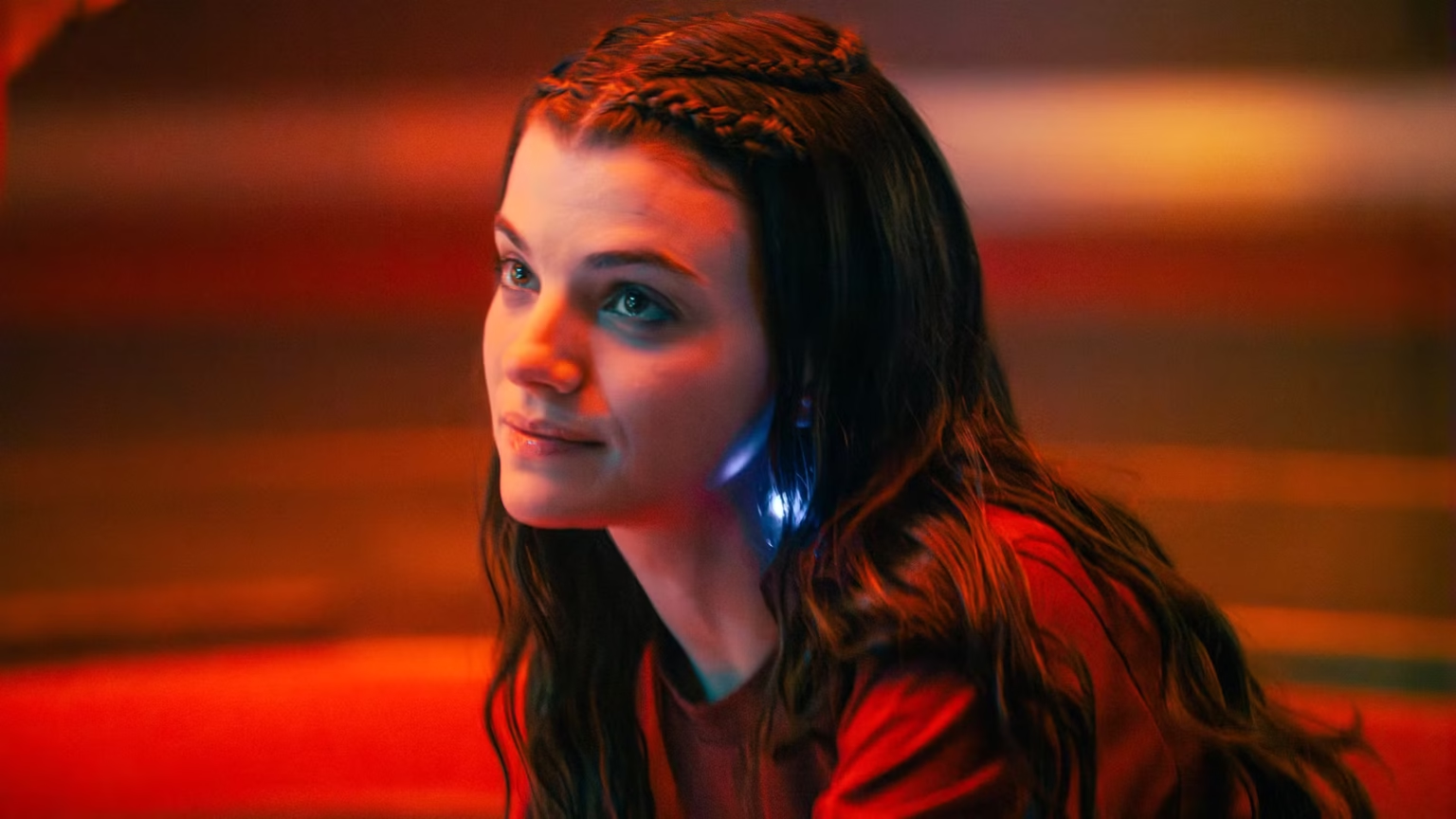
When Sylvia Tilly returns to Starfleet Academy and insists the cadets stage Our Town, the initial reaction inside the episode mirrors what many of us likely felt on the couch. It sounds like therapy disguised as homework. Tarima, Caleb, Genesis, Darem, Jay-Den, and Ocam have barely processed the trauma of the USS Miyazaki incident and the Furies’ attack, and now they are being asked to inhabit a play about life, death, and memory. Tarima’s resistance in particular is raw because she instantly recognizes why SAM cast her as Emily, the girl who dies and becomes a ghost observing her own life. After overloading her psychic abilities to save her friends in Episode 6, Tarima woke from a coma to discover that her future had been rewritten without her consent. She was enrolled in Starfleet Academy instead of returning to the War College, effectively stripped of the path she thought she controlled. For someone who feels emotions as vividly as a Betazoid empath, that loss of choice is existential.
The genius of the episode’s ending is that Tilly does not force a breakthrough. She steps back and lets the material breathe. As worry about SAM intensifies, the cadets slowly return to the text on their own terms. Our Town becomes less about performance and more about reflection. The play’s central idea, that ordinary moments become sacred only after they are gone, starts to resonate in a group still haunted by how close they came to losing one another. By the time Tarima fully rejoins the rehearsal process, it is not framed as a tidy healing moment but as an act of vulnerability. She chooses connection over isolation. She chooses to stand with her classmates rather than remain emotionally intangible. In the final stretch of the episode, Tarima’s arc resolves not because her pain disappears, but because she accepts that being finite does not make her insignificant. It makes her present.
While Tarima grapples with mortality from the perspective of someone who nearly died, SAM confronts it from the other side of existence. After being shot by a phaser in Episode 6, SAM’s program continues to degrade despite repairs. When Captain Nahla Ake and The Doctor bring her back to Kasq, the Makers deliver the chilling diagnosis that SAM has evolved beyond their understanding. That single revelation reframes the entire season. SAM is no longer just an emissary or a sophisticated hologram. She has grown in ways her creators cannot reverse engineer. The cascading damage from the phaser blast is killing her, but resetting her would mean erasing the very growth Starfleet Academy catalyzed.
The Makers choose deactivation, effectively ending SAM’s life as she knows it. The Doctor, who has spent much of the season emotionally distancing himself from her, is forced into a decision that defines the ending of Episode 8. Time on Kasq moves differently, with two weeks of Earth time equating to seventeen years there. Instead of repairing SAM as a machine, The Doctor raises her as a daughter. What follows is one of the most quietly profound narrative choices in recent Star Trek. SAM is reborn and experiences childhood, adolescence, and parental guidance under The Doctor’s care. When she returns to Starfleet Academy, she does not simply resume her previous existence. She carries two lifetimes of memories: her original 209 days at the Academy and seventeen years shaped by paternal love and lived experience.
This dual-memory existence is the key to understanding the ending. SAM is no longer an eternal observer trying to approximate organic emotion. She has experienced growth within a finite framework. The episode aligns her evolution with the themes of Our Town. Just as Emily in the play comes to understand the beauty of overlooked days, SAM now understands the weight of lived time. Her immortality is no longer abstract. It is informed by memory layered upon memory. The applause at the end of rehearsal is not just for the performance. It is for her return, transformed.
The Doctor’s role in this ending cannot be overstated. Longtime viewers of Star Trek: Voyager will remember the episode “Real Life,” in which The Doctor created a holographic family only to watch his daughter Belle die from an inoperable injury. Because his memory is perfect, that loss never dulled. It remained immediate for centuries. His coldness toward SAM earlier this season reads differently in light of Episode 8. He was not indifferent. He was afraid. Loving her meant reopening a wound that never healed. When he admits his cowardice and chooses to raise her anyway, it feels like a continuation of a story left unresolved for decades. The seventeen years he spends as SAM’s father offer him something Voyager never could: sustained joy untainted by tragedy. The ending gives him closure not by erasing past pain, but by allowing him to risk love again.
Tarima and SAM’s arcs intersect thematically in the final moments. Tarima learns that finite existence carries meaning precisely because it ends. SAM learns that even an entity who can persist indefinitely gains depth through lived, bounded experience. The cadets, once fractured by trauma, are unified by shared vulnerability. Tilly’s presence serves as a reminder that Starfleet education is not about starship tactics alone. It is about cultivating empathy, resilience, and the courage to feel.
As for whether Tilly will return, the episode positions her as a mentor operating primarily in the Beta Quadrant, which explains her absence from the main San Francisco faculty. Her role in Episode 8 feels purposeful rather than obligatory. She catalyzes growth and then steps aside, allowing the cadets to own their transformation. If she reappears in future seasons, it will likely be at another inflection point, when guidance is needed rather than constant supervision.
The ending of Star Trek: Starfleet Academy Season 1 Episode 8 works because it trusts its audience. It does not rely on spectacle to signal importance. Instead, it threads together theater, time dilation, parental love, and adolescent uncertainty into a meditation on what it means to be alive. SAM’s rebirth reframes immortality. The Doctor’s choice reframes legacy. Tarima’s acceptance reframes trauma. In a franchise that has explored gods, androids, and cosmic entities, this episode quietly argues that the most radical idea Star Trek ever proposed is that ordinary life, however brief, is extraordinary.