
TL;DR: The new Smurfs movie is a glittering blue shell with no pearl inside. Rihanna adds charm, and JP Karliak’s villains briefly stir some life, but this is a joyless, sterile, and profoundly unmagical outing. Kids deserve better. So do the Smurfs.
Smurfs 2025
Welcome to the Smurfocene Epoch
There’s a particular kind of fatigue that settles in when you realize you’re watching the cinematic equivalent of a corporate PowerPoint deck disguised as children’s entertainment. You lean back, the glow of synthetic CGI brushing your cheek like a cold whisper, and somewhere in your soul, you whisper: “I remember when these used to be movies.”
The new Smurfs film—no subtitle, no guts, no glory—emerges from that sludge pool of IP necromancy, where ancient characters are resuscitated not for love or curiosity, but because someone in a licensing office still owns the rights and has a quarter-three earnings gap to close. And yet, despite the best efforts of a star-stuffed voice cast including Rihanna, James Corden, and John Goodman, the film face-plants into the blue goo of its own creative torpor.
Let me say it plainly: the Smurfs deserve better. And so do we.
Nostalgia on Life Support
As someone born in the tail end of Smurf-mania’s first wave (I was more Animaniacs and Darkwing Duck, to be honest), my exposure to Peyo’s little blue sociocrats came mainly through dusty VHS tapes and the occasional “retro” programming block. The original Smurfs cartoon was bizarre, moralistic, and slow—but it had heart. It also had that warm, weirdness that defined imported animation before globalization smoothed all the edges off kids’ media.
This movie, however, is all edges—sharp, sterile, and meticulously engineered for maximum algorithmic safety. Directed (or perhaps better described as project-managed) by Troy Quane, The Smurfs 2025 leans heavily into visual polish and hollow worldbuilding, delivering a high-gloss narrative with all the emotional resonance of a YouTube autoplay ad.
Rihanna as Smurfette: A Star in a Storyless Void
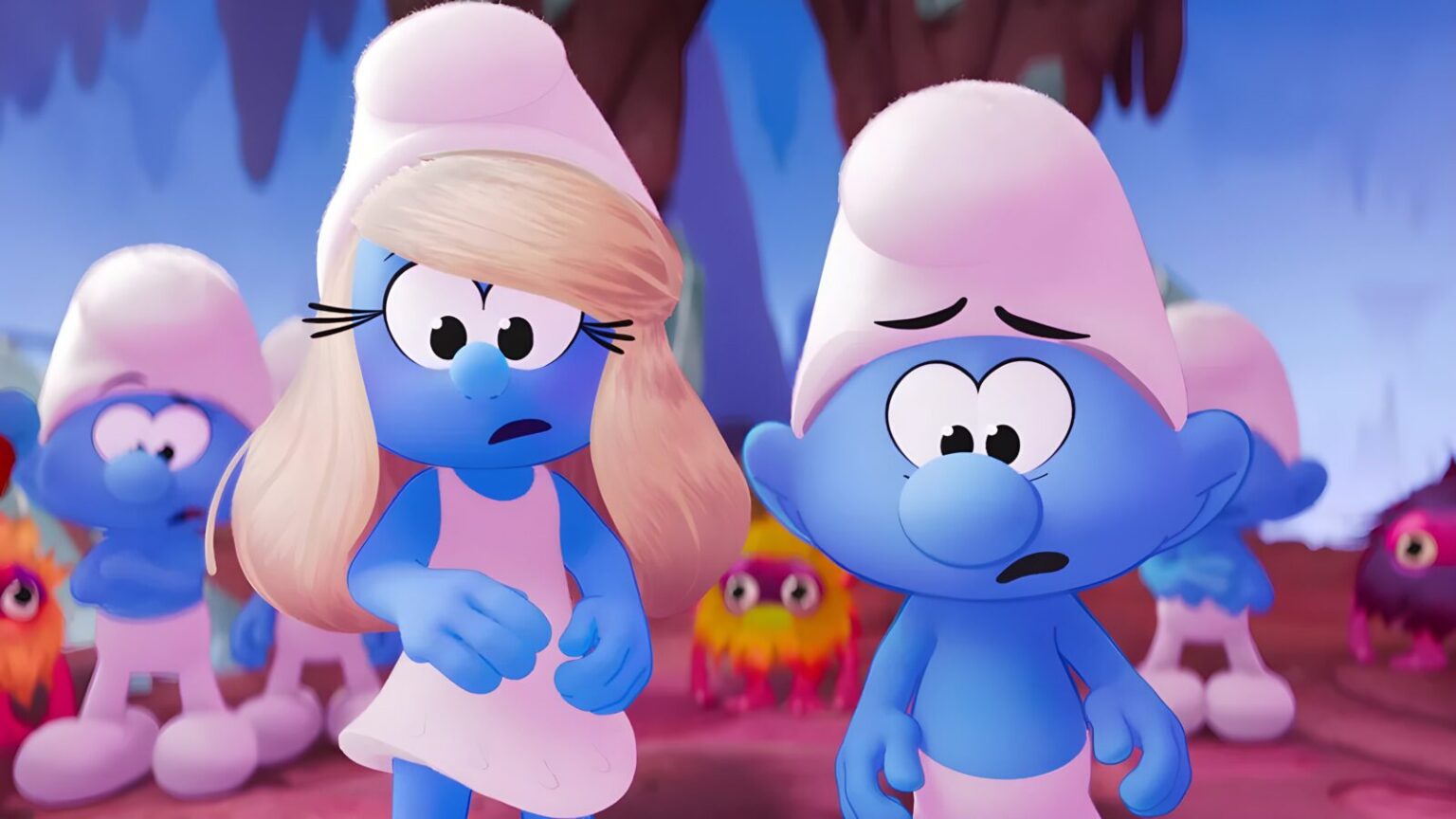
Let’s give credit where it’s due: Rihanna’s Smurfette is the single flickering ember in this otherwise cold hearth. She brings a natural charm to the role, purring her lines with that effortlessly cool Barbadian cadence that makes even the lamest exposition feel like a song you almost remember from a pool party.
But here’s the rub—she doesn’t get to do anything. Smurfette is still stuck in the weird Smurfian purgatory of being “The Girl One,” a gendered oddity in a mushroom commune of male archetypes. The writers gesture at agency—she kicks a few butts, leads a few scenes—but you can feel the hesitancy, the corporate discomfort around evolving the formula too far. It’s 2025, and yet Smurfette is still written like she wandered off a 1991 Happy Meal box.
The great irony? The film has no music to speak of. Rihanna, pop goddess and fashion oracle, is here—and they give her no songs. That’s like hiring Serena Williams to stand courtside and do commentary. It’s almost hostile.
James Corden’s Existential Smurf Crisis
Enter No Name Smurf, voiced by James Corden, in what feels like the cinematic equivalent of casting the loudest kid in the school play as Hamlet. Corden’s take on an unremarkable Smurf discovering he has magical, universe-saving powers is meant to be the emotional spine of the story. Instead, it’s more like a series of forced quips and half-baked punchlines masquerading as character growth.
No Name’s arc is bizarrely overcomplicated. First he’s a nobody. Then he’s The Chosen One. Then he’s shooting magical lightning from his mushroom-shaped fingertips, and we’re supposed to feel something about the power of self-belief. But the journey is so devoid of friction, so safe and manufactured, that it barely registers as a story.
Corden tries. You can hear the effort, like someone tap-dancing on a Zoom call. But the script doesn’t give him anything human to hold onto. It’s all snark and no soul.
John Goodman’s Papa Smurf and the Curious Case of Background Acting
Let me remind you: John Goodman is incredible. A vocal powerhouse. A legend of warmth and comic timing. Here, he plays Papa Smurf like he’s reading cue cards for a pharmaceutical ad. Goodman’s sleepy, vaguely paternal delivery is a tragic waste of talent, but also symptomatic of a larger problem—no one in this movie knows what kind of movie they’re in.
Are we doing zany slapstick? Soft Pixar pathos? Saturday morning nonsense? The tone wobbles like a Smurf on roller skates, never finding its rhythm. There’s no gravity, no stakes, no reason to care about anyone.
Papa Smurf gets kidnapped in the first act, and the film treats it like a scheduling inconvenience. We’re told he holds a magic book that can unlock the universe, but nobody—including the villains—seems all that concerned about it. Even the quest itself feels more like a VR tour of “Smurf Locations We Can Sell Toys From” than an actual adventure.
The Villains Almost Save It (Almost)
Bless JP Karliak, the film’s one true secret weapon. As Razamel and Gargamel, he delivers a dual performance that’s sly, nasty, and genuinely funny. Whenever these two cackle their way onto the screen, you can feel the movie suddenly inhale and remember it’s supposed to be entertaining.
Their scenes are short, but they sparkle—one-liners that land, animated expressions that twitch with menace and mischief. You almost wish the movie had been built around them: a villainous road trip through weird dimensions, sabotaged by bumbling wizardry and evil ego. Instead, they’re shoved to the side, like spicy pickles in an otherwise soggy sandwich.
Pretty Pictures, Dead Eyes
Visually, the film is… fine. The textures are high-res, the colors pop, and the environments are crisp and clean in that uncanny way modern animation tends to be. There’s even a few creative moments in the alt-universe sequences—shifting landscapes, gravity-defying antics, scenes that borrow vaguely from Doctor Strange’s mirror realm with a dash of Lisa Frank.
But none of it sticks. Nothing lingers. The movie’s visual style is polished but deeply impersonal, like watching a screensaver that occasionally cracks a joke. There’s no visual identity, no sense of creative risk. The mushrooms, the forest, the magic—all of it feels rendered but not imagined. It’s theme park animation: safe, smooth, and soulless.
The Great Crime of Mediocrity
At the heart of this blue mess is a crime I consider worse than failure: apathy. This film isn’t a bold misfire or an ambitious flop. It’s a spreadsheet with lip-sync. A checklist disguised as a narrative. It assumes kids won’t notice the lack of story, won’t care about the characters, and won’t mind the tonal whiplash or the emotional hollowness—as long as everything is bright and bouncy enough.
And maybe that’s what bothers me most. Kids are smart. They crave stories that mean something. They’ll watch Inside Out and sob. They’ll watch Spider-Verse and feel like their brain just went supernova. They’ll revisit Shrek a thousand times because it’s sharp and weird and full of heart.
This Smurfs film has none of that. Just vibes. Just noise.
Final Thoughts: A Smurf Too Far
I don’t hate the Smurfs. I want to love the Smurfs. I want them to be weird and whimsical and vaguely European again. I want them to be brave and funny and unapologetically strange.
But this movie isn’t for that kind of fan. It’s for the autoplay queue, the tie-in merch, the app integration. It’s built for screens, not hearts.
Rihanna is wasted. Goodman is wasted. The Smurfs themselves—those bizarre blue symbols of childhood optimism—are stuck in creative purgatory. And unless someone smurfs up the courage to truly reimagine them, they’ll stay there.