
TL;DR: Shelter is a familiar, competently made Jason Statham action thriller that borrows heavily from Bourne and Wick without ever escaping their shadows. It’s narratively bland but technically solid, elevated by tight fight choreography and Statham’s effortless command of the genre. Not memorable, but reliably entertaining comfort food for action fans.
Shelter
I’ve reached a point in my Jason Statham-watching career where I can tell what kind of movie I’m getting within the first three minutes. The beard length. The jacket texture. The amount of dialogue before someone gets headbutted into unconsciousness. Shelter, directed by Ric Roman Waugh, announces itself early and loudly as a Certified Statham Vehicle. And honestly? I made my peace with that before the opening credits finished rolling.
This is yet another entry in what I lovingly call the Statham Rogue Sleeper Agent Cinematic Universe, a place where men with extremely specific moral codes try very hard to live quietly until the universe pokes them with a stick. If you’ve seen The Beekeeper, Wrath of Man, Parker, The Mechanic, or that one where he wears a hoodie and looks disappointed in humanity, you already know the shape of this thing. Shelter does not reinvent that wheel. It doesn’t even rotate it particularly fast. What it does do is deliver a competently assembled, occasionally electric action thriller that knows exactly who its audience is and refuses to apologize for that.
I watched Shelter the same way I rewatch a Bourne movie on cable at 11:30 p.m. Not because it’s redefining cinema, but because there’s comfort in the rhythm. There’s comfort in watching Jason Statham glare at a man who has made a very poor life choice.
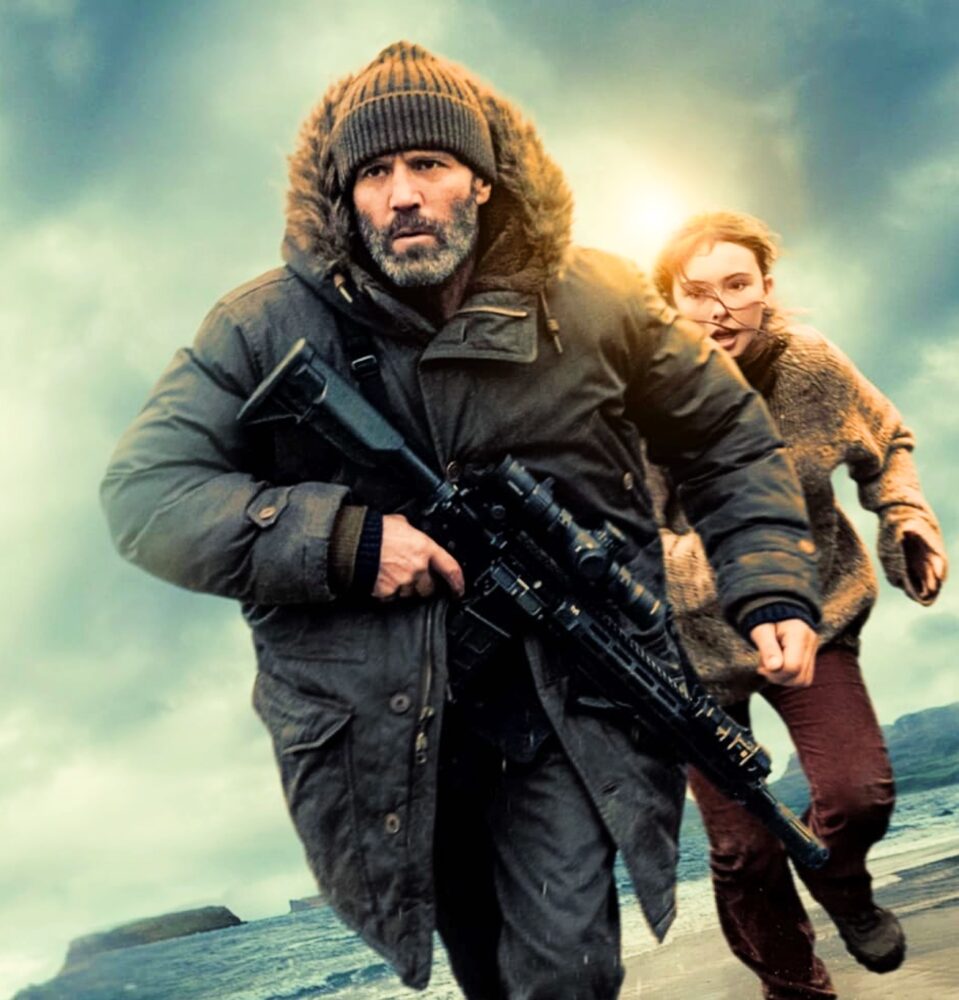
Statham plays Michael Mason, which might be the most aggressively generic action-hero name since Jack Ryan accidentally wandered into a gym. Mason lives in self-imposed exile on a remote island in the Outer Hebrides, surrounded by violent weather, a husky with better emotional intelligence than most humans, and enough vodka to fuel an entire Russian novel. He’s hiding. From whom, exactly, is initially unclear, but the movie communicates very quickly that this is a man who has done things and would really prefer not to do them again.
This is prime Statham territory. He doesn’t say much, but every line lands with that clipped, slightly weary delivery that suggests he’s already had this conversation in three other movies and is annoyed he has to repeat himself. Mason spends his days staring at the ocean like he’s daring it to start something, playing chess against himself, and sleeping fully clothed like a man who assumes violence could break out at any moment. Honestly, relatable.
The inciting incident arrives in the form of Jesse, a young girl who brings Mason supplies once a week via boat. When the boat capsizes in a storm, Mason does the thing he swore he wouldn’t do anymore: he intervenes. He saves her, injures her in the process, and is forced to leave his carefully constructed isolation to get her help. The moment he steps into civilization, the plot does what plots like this always do. It notices him.
From there, Shelter slides neatly into familiar grooves. MI6 enters the picture. A shadowy off-the-books program known as the Black Kites is revealed. Old sins come knocking. The past, as always, refuses to stay buried.
If you’ve ever thought, hey, what if The Bourne Identity but with less amnesia and more Scottish coastline, Shelter is basically that thought rendered into a feature film. The bones are unmistakable. A former elite operative hunted by the very system that created him. Government surveillance that may or may not be legal. Bureaucrats arguing over collateral damage while Statham solves problems with his fists.
The movie borrows liberally, and not always subtly. The dynamic between Mason and Jesse has clear echoes of Léon: The Professional, though without the same emotional specificity. The mythologizing of Mason as an unstoppable force with a buried conscience gestures toward John Wick, minus the operatic excess. And the surveillance-heavy paranoia clearly wants to sit at the Bourne table, even if it never quite earns a seat.
That’s the thing about Shelter. It is deeply, unapologetically non-distinctive. The plot revelations are serviceable but never surprising. When motivations are finally revealed, they land with a shrug rather than a gasp. I could feel the screenplay checking boxes in real time, and if I’m being honest, that familiarity is both its greatest weakness and its weirdest strength.
I didn’t lean forward in my seat because I was desperate to know what would happen next. I leaned forward because I wanted to see how Statham would break the next guy’s arm.
Ric Roman Waugh knows how to stage action. This is not in question. When Shelter commits to kinetic movement, it sings. The hand-to-hand combat is tight, brutal, and refreshingly legible. You can see what’s happening. You can feel the weight behind the blows. There’s one extended fight sequence that ranks among the better Statham brawls of the last decade, the kind that makes you involuntarily mutter, yeah, that’ll do it.
Statham, at this point, moves like a man who has perfected the art of cinematic violence. There’s no wasted motion. No flourish for the sake of flourish. It’s efficient, almost bored brutality, which somehow makes it more convincing. He’s not angry. He’s just disappointed you forced him to do this.
Where the film stumbles is in trying to make me emotionally invest in Mason’s bond with Jesse. The script wants their relationship to anchor the film, but it never quite earns that weight. Mason’s devotion to protecting her escalates so quickly that it feels less like character development and more like narrative necessity. I understand why the movie needs him to care. I’m less convinced that he actually would, at least not to this extent.
Early on, Shelter flirts with the idea of being about something. There’s talk of illegal data harvesting. AI-driven surveillance systems that flag innocent people. Ethical gray areas within intelligence agencies. For a brief moment, I thought the film might actually interrogate the consequences of turning society into a spreadsheet.
And then it… doesn’t.
Those threads are introduced, teased, and largely abandoned in favor of more straightforward cat-and-mouse plotting. Characters talk about the dangers of surveillance, but the movie never fully commits to exploring them. It’s thematic window dressing, not a structural concern. That feels like a missed opportunity, especially given how relevant those ideas are right now.
Bill Nighy does what Bill Nighy always does, which is elevate the material through sheer presence. Naomi Ackie is solid but underused, mostly reacting to screens and delivering exposition with admirable professionalism. The cast is better than the script deserves, but not better enough to transcend it.
By the time Shelter wrapped up, I felt exactly how I expected to feel. Mildly entertained. Slightly unsatisfied. Weirdly comforted. This is not a movie that lingers. It’s a movie that does its job, cleans up after itself, and leaves the room.
Statham is so at ease in this role that it fits him like a perfectly tailored black cardigan. He doesn’t strain for depth. He doesn’t overplay the regret. He just shows up, hits his marks, and reminds everyone why he remains one of the most reliable action stars working today. He papers over a lot of script issues through sheer competence, which might be the most Statham thing imaginable.
Do I want him to take more risks? Absolutely. Do I want him to stop making movies like this? Not really. There’s value in a performer who knows his lane and drives it well.
Shelter is not going to redefine the genre. It’s not going to spawn think pieces or inspire Halloween costumes. But if you’re in the mood for a cleanly shot, efficiently violent action thriller where Jason Statham looks grumpy in nice jackets and ruins a series of bad men’s evenings, it gets the job done.