
TL;DR: Pluribus Episode 6 delivers the show’s most jaw-dropping reveal yet, featuring a perfectly unhinged John Cena cameo that explains the Others’ taboo food source. Carol hits new emotional lows, Diabaté remains the king of apocalypse luxury, and the season’s slow-burn tension finally erupts into full cosmic unease. A haunting, weirdly heartfelt chapter in a sci-fi series that keeps leveling up.
Pluribus
I’ve joked for weeks that watching Pluribus is like being strapped into a self-driving Tesla with the ghost of Vince Gilligan whispering “trust me” from the back seat. Episode 6, titled HDP, finally confirmed what my lizard brain feared from the start: this show is just getting started, and it has no intention of letting any of us get out with our dignity intact. We’re entering the final third of the season, which feels ridiculous because I still haven’t recovered from the premiere. But like any good sci-fi junkie, I keep showing up for more, ready to let the emotional damage accumulate like XP.
This week, our girl Carol Sturka, patron saint of self-inflicted misery and romance novels no one appreciates enough, kicks open another door in the mystery of the Others. I’ve spent six episodes watching her barge into existential horror the way I barge into an Apple Store pretending I don’t know exactly which MacBook I’m going to buy, and HDP rewards that doomed curiosity with a discovery so disturbing the show has to bring out John Cena to explain it like a cosmic guidance counselor. Yes, that John Cena. Yes, he’s canon in the hivemind. And yes, I screamed.
What struck me most about Episode 6 is how deceptively quiet it is. Gilligan and company throttle back the adrenaline and let the dread simmer like a pot someone forgot on the stove three episodes ago. The pacing slows, the camera lingers, and every interaction feels weighted, like we’re watching tectonic plates shift beneath a world already past the point of no return. It’s the calm before a storm we don’t have a name for yet, but you can feel it in your teeth.
Carol Opens the Worst Freezer in America
We pick up exactly where Episode 5 launched us into fight-or-flight: Carol stumbling out of the Agri-Jet warehouse looking like she’s just witnessed a deleted scene from Hannibal. Her immediate urge to vomit hits so close to home that I had to pause the episode and remind myself she’s not real and I’m not actually smelling whatever eldritch funk was in there. But Carol, being Carol, doesn’t run. She goes right back inside with a camera, leaning full Blair Witch but with the emotional exhaustion of someone who has already lived through multiple pandemics and one too many writer’s retreats.
And honestly, the scene is terrifying precisely because it’s so mundane. Industrial freezers. Plastic-wrapped… things. A meat grinder so massive it feels like Chekhov’s Weapon waiting for its second-act comeback. The Others may be universally pleasant and incapable of cruelty, but this room looks like the workplace safety violation to end all workplace safety violations.
The kicker? Carol hesitates to send the footage to the Others. And I don’t blame her. I spent three seasons trusting Better Call Saul to keep my heart intact, and look how that turned out. If there’s one lesson Gilligan works into every project, it’s that systems—whether criminal or cosmic—don’t always reward honesty.
Diabaté Is Still Living His Best Post-Apocalyptic Life
Since she can’t trust the hivemind to behave like a reliable FedEx branch, Carol heads to Las Vegas to track down Koumba Diabaté. And look, I adore this man. Every time he’s on screen, he radiates pure chaotic joy, like someone who accidentally got all the character perks Carol didn’t choose.
Las Vegas has been completely transformed into Diabaté World, an aesthetic mashup of Bond films, Rat Pack nostalgia, and Probably Not OSHA Approved In Any Universe jacuzzi parties. The Others have crafted a full 1960s casino fantasy for him, complete with actors who clap when they’re supposed to be evil. It’s immersive wish fulfillment bordering on cosmic improv theater, which makes it even more interesting that the moment Carol gets too close to the city limits, the Others bail. Completely. They ghost Vegas like someone spotted their ex at the bar.
This moment is tiny but huge. For the first time, the hivemind chooses boundaries over bliss. They remove themselves from service rather than risk being coerced into something uncomfortable—an echo of the moment Carol drugged Zosia to demand answers. It’s the closest thing the show has given us to a warning shot.
The Cena Reveal: Humanity’s Most Wholesome Protein Spokesperson
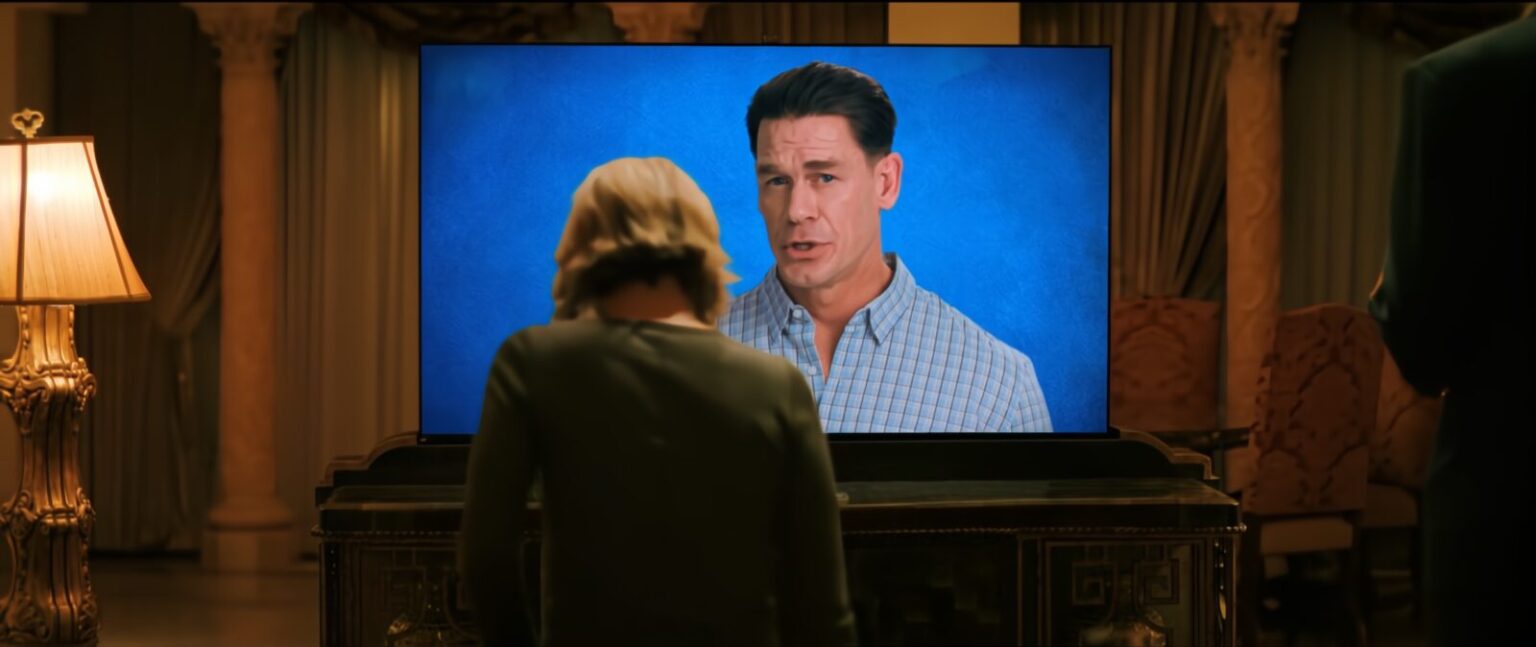
Now we get to the cameo of the decade. Diabaté, in his infinite ability to make friends everywhere, has a video made by the Others starring John Cena. Yes, they use Cena as their official explainer-in-chief. In a universe where seven billion people share a single mind, somehow he’s still booked and busy.
Cena calmly lays out the truth like he’s hosting an educational children’s show about sustainable cannibalism. The Others can’t harm any living thing. Not plants. Not animals. Not people. Their diet consists of whatever naturally falls to the earth or whatever humanity left behind in warehouses and supermarkets. But with billions of mouths to feed, that stash is dwindling faster than my willpower during Steam sales.
Enter HDP: Human Derived Protein.
It’s exactly what it sounds like. The Others harvest the 100,000 people who die each day from accidents, old age, disease—anything natural. They don’t kill. They simply… repurpose. And they hate doing it. But they also don’t want their entire species to starve to death while performing perfect ethical gymnastics.
It’s grotesque and compassionate at the same time, which is Pluribus in a nutshell. The show keeps forcing me to confront my own biases about morality, survival, and whether an alien collective consciousness should be expected to abide by vegan ethics they didn’t sign up for.
Diabaté and the Loneliness Carol Pretends She Doesn’t Feel
The emotional sucker punch of the episode isn’t the freezer. It isn’t even Cena. It’s Carol learning she’s been voted out of the immune survivors’ Zoom group. The Others didn’t ostracize her first. The humans did.
Carol excuses herself to cry in the hotel bathroom, and in that moment she’s so achingly, painfully real. Because loneliness isn’t just her mood—it’s her arc. She pushes people away because connection is dangerous, then resents them when they take the hint.
Diabaté tries to help, but even he gently taps out. He tells her the Others have figured out how to assimilate the immune—via a stem-cell-targeted virus requiring a needle to the hip—but they won’t touch her unless she agrees. Carol calls the Others’ voicemail (a detail I find funnier than I should) to confirm the info. They answer. She rejects the offer.
And somewhere out there, another immune—Manousos—receives Carol’s earlier plea and finally leaves his bunker. A small, fragile thread of humanity connecting two lonely people.
The show isn’t about survival. It’s about community. The one Carol fears, the one the Others want, the one the remaining humans don’t know how to rebuild.
Verdict
HDP is slower, stranger, and sadder than the episodes before it. It deepens the mythology, sharpens the emotional stakes, and sets Carol on a path that feels as inevitable as it is heartbreaking. Every week I think I know where Pluribus is heading, and every week I am proven delightfully wrong.