


TL;DR: Pluribus Episode 5 delivers an unexpectedly intimate and haunting chapter built entirely around Carol’s descent into isolation and discovery. Through meticulous pacing and emotionally rich storytelling, the series uses silence, dread, and grief to create its most compelling hour yet, anchored by Rhea Seehorn’s magnetic performance. The result is a tense, thoughtful, and deeply affecting episode that pushes the season into darker and more intriguing territory.
Pluribus
Pluribus Episode 5 arrives at a fascinating moment in the season’s rhythm, slipping onto Apple TV a full two days ahead of schedule as if the series itself understood that viewers needed something tense and thought-provoking to brace for the chaos of a holiday week. Instead of delivering a simple table-setting chapter or a narrative breather, the show ventures in completely the opposite direction, dropping one of its most intense and emotionally complicated episodes so far. Titled Got Milk, this hour is a carefully sustained descent into solitude and psychological pressure, a story constructed almost entirely around Rhea Seehorn’s performance as Carol. It works precisely because it chooses to narrow the focus rather than expand it, allowing the series to explore texture, fear, and grief in ways that would be impossible with a larger ensemble sharing the screen.
The episode picks up immediately after Carol’s impulsive and deeply unsettling decision to drug Zosia in hopes of extracting information from the hivemind. Pluribus has always maintained a delicate balance between sci-fi curiosity and human frailty, and this moment pushes that tension into dangerous territory. The Others’ collective response to Carol’s breach is not violent, not explosive, and not even confrontational. It is complete and total withdrawal, a sudden severing of presence that leaves Carol stranded in Albuquerque with only her own spiraling thoughts for company. The way the series frames this abrupt silence provides a striking contrast to the constant hum of hive-connected communication that has been present since Episode 1. The absence of the Others immediately becomes its own form of emotional violence, a quiet but heavy judgment that communicates everything Carol has refused to acknowledge about the consequences of her actions.
From here, the episode transitions into what is essentially a one-woman psychological odyssey. Bottle episodes often risk feeling like technical exercises, but this one avoids that trap by grounding its tension in mundane details that gradually slide into dread. Carol wanders through an empty hospital, calls a voicemail that has replaced the hivemind’s real-time communication, and climbs to the top of the Crowne Plaza hotel in a futile attempt to catch sight of the Others driving away in every direction possible. The imagery feels as if the show has temporarily transformed into a hybrid of Better Call Saul, a post-apocalyptic open-world game, and an abandoned suburban thriller. Albuquerque becomes a hollowed-out echo chamber, a landscape that feels familiar but wrong in all the ways that matter.
As the episode settles even more firmly into Carol’s solitude, the series reveals how unprepared she is for the oppressive quiet that follows the departure of the hivemind. She tries to reassert control through routine—recording messages for the other immune survivors, leaving instructions for the absent Others, and attempting to shape her fear into work—but the veneer cracks quickly. The moment she hears wolves tearing into the trash outside her cul-de-sac, the episode starts leaning into a creeping sense of nature pushing back against human abandonment. The hivemind’s departure and the citywide power conservation measures combine to create an eerie environment where the boundary between civilization and wilderness thins. Carol’s attempt to shoo away the wolves with a golf club feels less like a comedic beat and more like a moment of raw instinct, the kind of thing a person does when logic has begun its slow collapse.
Carol’s restless night in the house she once shared with her wife, Helen, deepens the episode’s emotional weight. The visual of her lying in bed, unable to look at the empty pillow beside her, becomes a quiet meditation on grief that the show hasn’t fully addressed until now. In stripping her of the Others’ constant background presence, Pluribus exposes how profoundly Carol has been using irritation and cynicism to distract herself from loneliness. It is a subtle but intentional shift, the kind of storytelling choice that gains impact because it is built from stillness rather than spectacle.
The discovery of the strange, amber-colored “milk” substance marks the episode’s transition from psychological drama into more traditional sci-fi mystery. Carol’s decision to investigate the milk cartons scattered across Albuquerque initially feels like an attempt to regain control of something, anything, in a world that has abruptly emptied out. Her analysis of the liquid using pH and water test strips from her hot tub blends dark humor with a genuine sense of curiosity, a reminder that the show’s strongest moments often arise when human improvisation collides with an alien phenomenon. The fact that every single carton—regardless of flavor—contains the same viscous, odorless substance pushes the narrative further into conspiratorial territory. Something about the hivemind’s dietary habits is fundamentally wrong, and Carol cannot let the question go unanswered.
The return of the wolves for a second night drives the episode into one of its most harrowing emotional crescendos. As soon as Carol realizes they are attempting to dig up Helen’s grave, the tone shifts sharply. Her frantic dash toward the police cruiser and the desperate decision to plow through her own backyard fence with lights and sirens blaring captures both the fierceness of her grief and the total breakdown of normalcy in her life. This moment is not played for shock value; instead, it illustrates the lengths she will go to protect the few pieces of her world that remain intact. Watching her spend the following day reinforcing the grave with heavy outdoor tiles and painting a handmade headstone is one of the most quietly devastating sequences in the series so far. It becomes a moment of painful clarity, showing how much of Carol’s emotional energy has been dedicated not to survival, but to holding onto the memory of the person she lost.
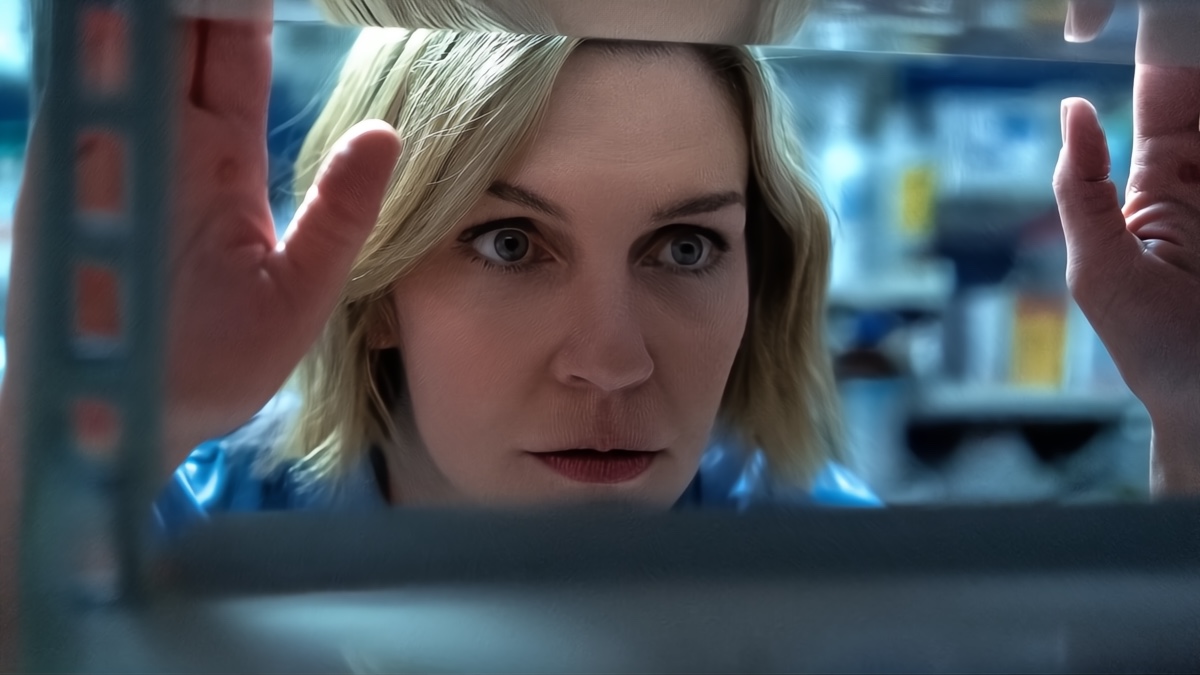
The final stretch of the episode introduces the most ominous development yet. Carol tracks the white powder used in the hivemind’s strange milk mixture to a pet food brand processed locally at a facility called Agri-Jet. Her exploration of the abandoned plant mirrors classic Gilligan-verse tension, using long hallways, cold industrial rooms, and the sharp beam of her flashlight to slowly tighten the narrative coil. When she discovers a walk-in storage area filled with produce and plastic-wrapped stock, the framing deliberately withholds the true contents from viewers. The camera stays on Carol’s face as she pulls back a sheet of plastic and reacts with a horrified gasp. The restraint makes the moment far more disturbing than explicit imagery ever could. The viewer is left with the unmistakable sense that this discovery is about to reframe the entire premise of the hivemind, the survival of the Others, and the alien force that binds them.
Pluribus Episode 5 stands out as the strongest entry in the series so far because it trusts stillness, trusts character work, and trusts the audience to sit in discomfort without rushing toward answers. It allows the tension to accumulate across long passages of solitude and grief, transforming a simple narrative structure into something deeply immersive. Rhea Seehorn carries the emotional and thematic weight of the episode with remarkable precision, guiding the viewer through fear, discovery, desperation, and the faintest flicker of hope. By the time the credits roll, it becomes clear that this hour has quietly reshaped the entire season, expanding the show’s mythology while collapsing its focus onto one character’s raw humanity.