
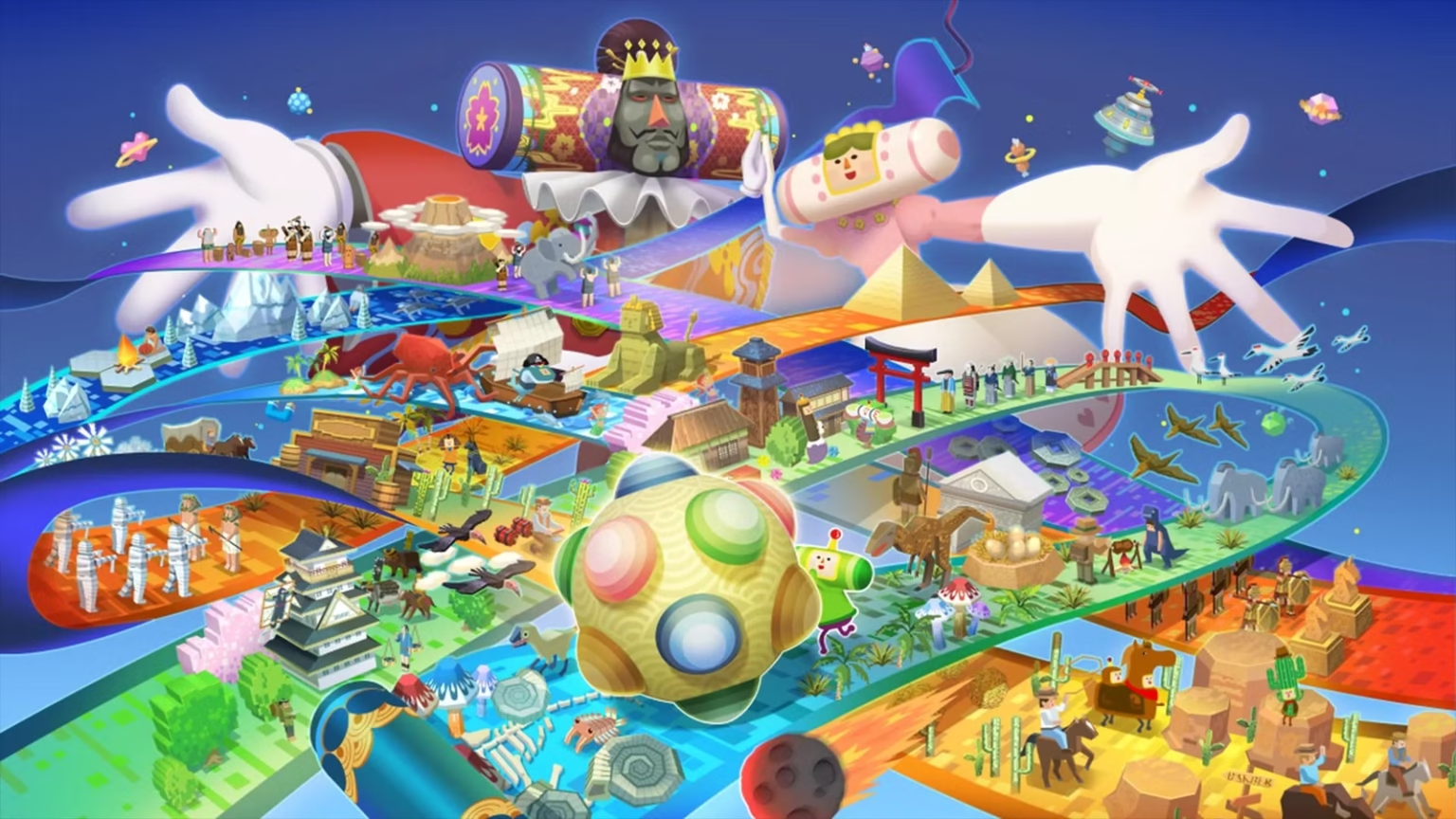
TL;DR: Once Upon a Katamari turns history into a playground of absurdity and wonder. Some restrictive missions drag, but its time-traveling creativity, gorgeous presentation, and eternal charm make it a near-perfect evolution of the franchise.
Once Upon a Katamari
There are few game series that feel like a personality test disguised as chaos quite like Katamari Damacy. Some people roll the ball because they crave efficiency, optimizing routes like tiny cosmic accountants of clutter. Others—like me—roll because it’s the closest thing we have to turning the sheer noise of modern life into something tangible, something absurd, something that makes sense only once it’s spinning out of control. So when Once Upon a Katamari was announced, promising time travel, cowboy duels, Edo-era banquets, and kraken battles, I didn’t just expect a sequel. I expected therapy—through debris.
That’s the magic trick of Katamari: the art of accumulation. Every eraser, teacup, and screaming villager you pick up isn’t just an object—it’s a memory, a cultural relic, a punchline rolled into the ever-growing snowball of cosmic junk. And after decades of iterative sequels and remasters, Once Upon a Katamari dares to answer a question that’s haunted the franchise: what do you do when you’ve already rolled up the entire planet? The answer, it turns out, is to roll through timeitself.
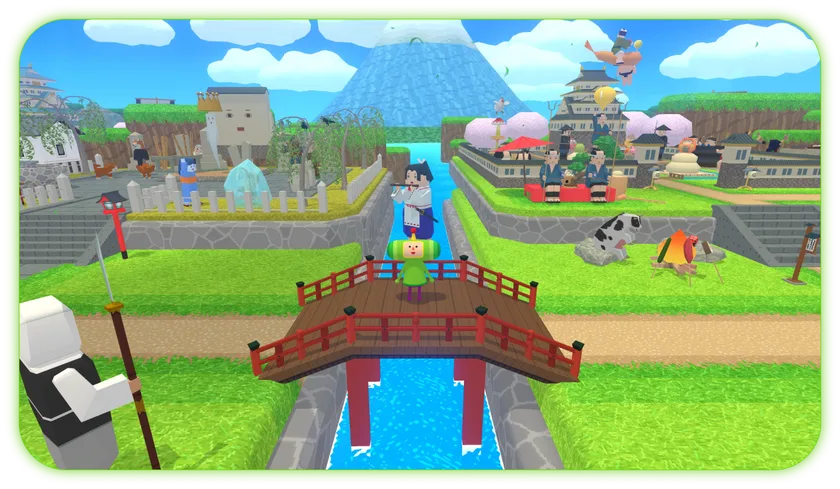
The first time I launched the game, I was greeted by that familiar low-poly perfection—sharp enough to be nostalgic, soft enough to be timeless. The Prince of All Cosmos, that little green bowling pin with antennae, once again looks like he’s perpetually on the verge of an existential meltdown. His father, the King of All Cosmos, remains a disco deity who oscillates between benevolent guidance and divine trolling. But this time, instead of just reassembling the stars or cleaning up after Dad’s hangover, you’re sent rolling through history’s greatest hits: Ancient Egypt, Edo Japan, the Wild West, the freakin’ Ice Age.
And it works. It really works.
See, Katamari’s always been about scale—about that intoxicating leap from picking up paperclips to snatching entire skyscrapers. But Once Upon a Katamari doesn’t just go bigger; it goes smarter. The time-travel conceit gives every level a distinct flavor, turning what could’ve been another colorful clean-up job into a parade of cultural remixing. One moment you’re rolling a snowball in the Ice Age, scooping up mammoths while dodging volcanoes; the next, you’re stealing gold bars from a saloon shootout as tumbleweeds bounce off your growing mass. It’s like someone mashed up Bill & Ted’s Excellent Adventure with the world’s most satisfying physics toy.
The magic here is in how the familiar controls—the double-analog-stick ballet that’s both intuitive and absurd—still manage to feel fresh. There’s a meditative rhythm to rolling your katamari: push, pivot, dash, u-turn, collect, grow. It’s tactile chaos, but it’s always under your fingertips. And though the power-ups (magnets, speed bursts, brief invincibility) don’t add much to the core joy of rolling, they don’t get in the way either. They’re seasoning on an already perfectly weird meal.
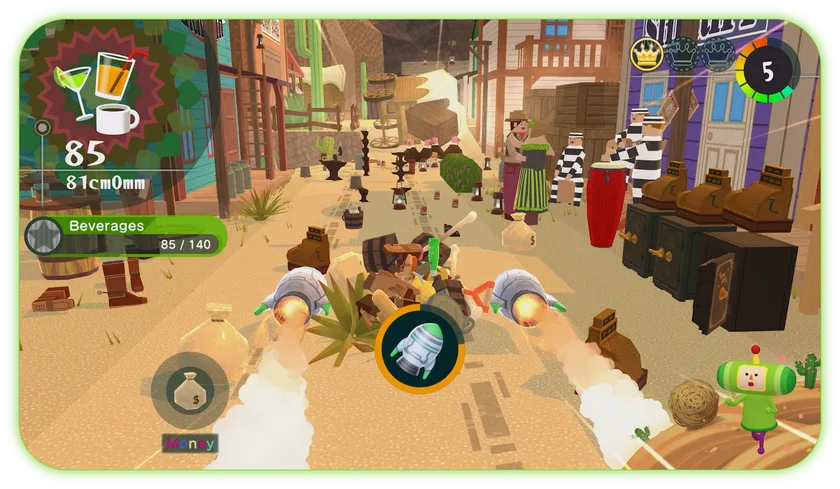
The real evolution, though, is in the structure. The game’s missions aren’t just about size anymore. Sure, you’ll still have those five-to-ten-minute time trials to reach a certain diameter, but Once Upon a Katamari sprinkles in delightful set pieces that riff on historical tropes. In Edo Japan, you’re rolling a gluttonous noble around a feast, fattening him up so he can fit into a ceremonial armor set. In Ancient Greece, you’re tasked with assembling a debate team by literally rolling up philosophers. On a pirate ship, the stage evolves mid-level into a sea battle against a kraken, which you eventually absorb like some tentacled garnish. Every time you think you’ve hit peak absurdity, the game finds a new way to escalate.
And it’s all so stupidly beautiful. The lo-fi aesthetic that once felt like a technical limitation now reads as deliberate art direction. There’s something deeply comforting about how these polygonal dioramas still feel like toys from a bygone era—little cardboard theaters where every chicken, samurai, or cactus is performing its tiny pantomime before being consumed by your cosmic boulder. It’s nostalgic without being cloying, modern without being sterile.
But for all its inventiveness, Once Upon a Katamari isn’t perfect. Some of the restrictive missions—like collecting only coins or roses—sap the anarchic joy right out of the experience. Katamari isn’t about restraint; it’s about indulgence. The second the game tells me, “You can only roll up these specific things,” I feel like I’m being punished for wanting too much. The battle mode, too, feels like an afterthought—functional, fine, but never as gleefully chaotic as the single-player campaign. It’s like being invited to a dance party where everyone just kind of shuffles politely.
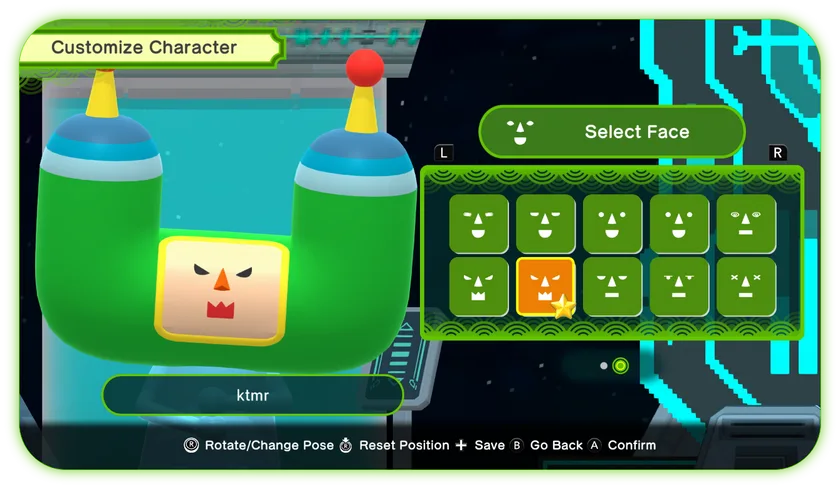
Still, those are blips on an otherwise stellar cosmic résumé. For every dull challenge, there’s a moment of pure, stupid bliss that makes me grin like I’m seeing the series for the first time again. The soundtrack helps—a collage of jazz, J-pop, chiptune, and something that sounds like if Daft Punk scored a Renaissance fair. It’s the kind of game music that worms its way into your brain and refuses to leave, the perfect accompaniment for a time-traveling trash collection tour.
It’s easy to forget how quietly revolutionary Katamari was when it first landed in the PS2 era. It wasn’t just weird—it was defiantly weird. It looked different, played differently, thought differently. It made you laugh at the absurdity of creation itself. Once Upon a Katamari honors that lineage by not trying to reinvent the wheel (or ball, as it were), but by letting it roll through history, gathering everything it can along the way: dinosaurs, myths, pop culture, and our own nostalgia. It’s less a sequel and more a celebration of why we fell in love with rolling in the first place.
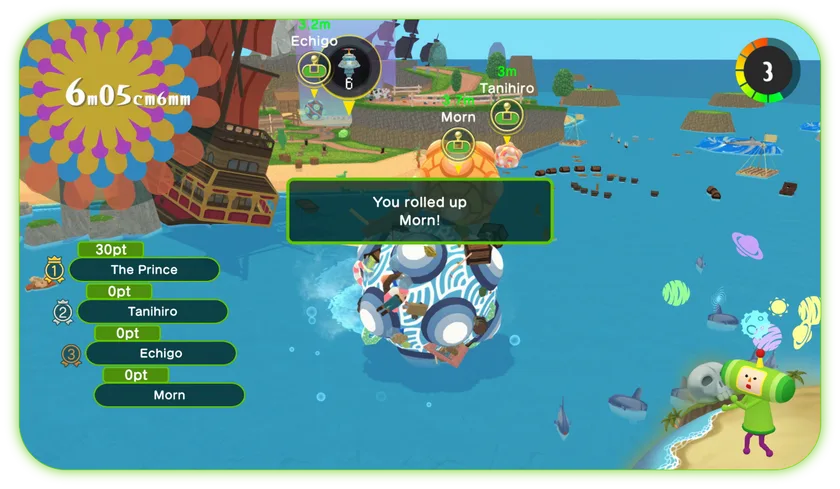
By the end, when the King of All Cosmos inevitably delivers his mix of praise and shade, you realize that Once Upon a Katamari isn’t just another entry in the franchise—it’s a reminder of why play can still feel miraculous. Even in 2025, a game about rolling junk can make you laugh, reflect, and momentarily forget the real junk piling up in your inbox.
Verdict
Once Upon a Katamari is the series at its most inventive since the original. It trades scale for depth, chaos for craft, and nostalgia for reinvention. Its historical vignettes, set piece missions, and timeless art direction make it one of the most joyous, meditative games you can play this year. It’s a reminder that even after twenty years, Katamari’s still got it—and it’s still rolling forward.