
TL;DR: Mercy is a slick, tense sci-fi thriller with a killer premise and strong performances that keeps you hooked for most of its runtime, only to implode spectacularly in the final act. Worth watching for the ride, but don’t expect the destination to make sense.
Mercy
I went into Mercy fully prepared for the kind of slick, dumb, high-concept sci-fi thriller Hollywood used to crank out like clockwork in the late 90s. The kind of movie you’d rent on VHS because the box art promised danger, tech paranoia, and a ticking clock, then forgive all its sins because it moved fast and looked cool. For about seventy-five glorious minutes, Mercy absolutely nails that vibe. Then the final act shows up like a corrupted patch update and wipes out all goodwill in one catastrophic system failure.
Directed by Timur Bekmambetov in his first big Hollywood swing since Ben-Hur, Mercy is built on a premise so juicy it practically dares you not to lean forward in your seat. In the near future, the criminal justice system has been replaced by an AI called Mercy, an algorithm that acts as judge, jury, and executioner. No lawyers. No appeals. Ninety minutes to plead your case while strapped into a chair that also happens to double as a lethal injection delivery system. If your guilt probability stays above the threshold, you die. Clean. Efficient. Humane. Or at least that’s what the sales pitch says.
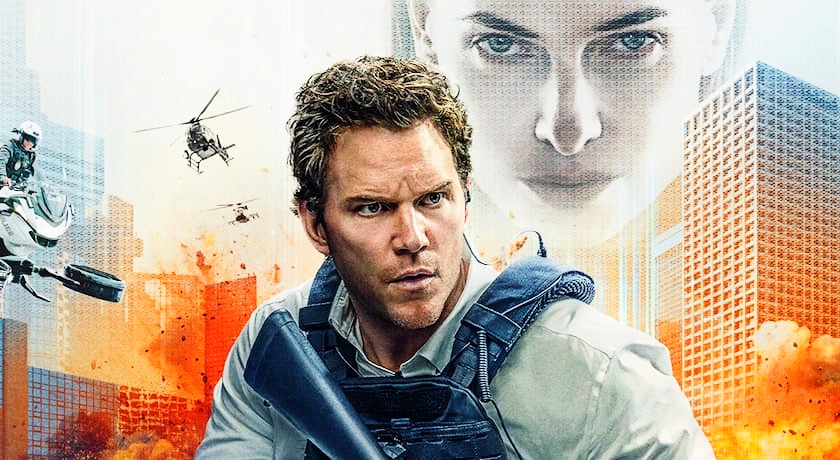
Enter Chris Pratt as Chris Raven, an LAPD detective who helped champion the Mercy system and has personally shoved plenty of society’s forgotten souls into its cold, algorithmic embrace. He wakes up bruised, hungover, and disoriented, only to be informed by the system itself that his wife has been murdered and there’s a 97.5 percent chance he’s the killer. Raven doesn’t remember the crime, but he knows one thing: he’s not a murderer. He has ninety minutes to prove it or die by the very technology he helped unleash.
That setup alone deserves applause. It’s The Fugitive meets Phone Booth, filtered through a Black Mirror lens that’s slightly smudged with fingerprints. Raven isn’t on the run. He’s trapped. Every discovery happens through screens, voice calls, and data feeds. The movie understands that claustrophobia is its secret weapon, and Bekmambetov leans into it hard, staging the bulk of the film inside a dim, clinical chamber that feels halfway between an Apple Store and an execution room.
The AI overseeing the trial, Judge Maddox, is voiced and embodied through holographic presence by Rebecca Ferguson, who delivers the performance with an eerie warmth that feels both intentional and deeply misguided. Maddox doesn’t just process data; she encourages Raven, praises his instincts, and at one point feels close enough to nod approvingly like a proud mentor. This is where Mercy’s interpretation of artificial intelligence starts to wobble. In a post-Ex Machina, post-The Creator world, watching an AI validate a human detective’s gut feelings feels less chilling and more laughably quaint. The tech here doesn’t feel futuristic so much as nostalgic, like someone fed Virtuosity and Minority Report into an algorithm and stopped there.
Still, I was locked in. Mercy understands pacing. The ticking clock is omnipresent, counting down not just Raven’s remaining minutes but the film’s own credibility. As Raven scrambles to reconstruct the night of his wife’s murder, he reaches out to a small circle of people who might help him piece together the truth. There’s his AA sponsor, his estranged daughter, and his partner on the force, all pulled into this nightmare via phone calls that feel appropriately frantic and raw. The movie smartly weaponizes modern surveillance culture, letting Raven and the AI comb through traffic cams, phone metadata, drone footage, and police databases in real time. It’s techno-voyeurism as narrative propulsion, and it mostly works.
For a while, Mercy feels like it knows exactly what kind of movie it is. It’s a B-movie wearing an A-movie suit, polished enough to pass casual scrutiny but fundamentally powered by pulp DNA. That’s not an insult. Some of the best sci-fi thrillers live in that space, where big ideas are filtered through tight constraints and genre mechanics. All Mercy really needs is a resolution that respects its own rules. It doesn’t even have to be clever. It just has to make sense.
And this is where everything falls apart.
Without spoiling specifics, the third act of Mercy detonates its own premise in a way that feels less like a twist and more like a panic response. The narrative logic collapses under even minimal examination, forcing the film to abandon the very framework that made it compelling. The events we’re asked to accept retroactively don’t just strain credulity; they actively undermine the stakes of everything that came before. It’s the kind of ending that makes you mentally rewind the entire movie, not to admire its construction, but to ask how any of it was supposed to work in the first place.
This isn’t a case of ambiguity or thematic provocation. It’s a failure of storytelling discipline. Mercy sets up clear parameters, invites us to play along, then changes the rules at the finish line. In whodunnit thrillers like this, there’s a sacred contract between filmmaker and audience. You can misdirect, conceal, and surprise, but you can’t cheat. Mercy cheats, and it does so with such confidence that it almost dares you to call it out.
That’s what makes the whole thing so frustrating. The craftsmanship is there. Ramin Djawadi’s score pulses with urgency, constantly nudging the tension forward like a heartbeat synced to the countdown clock. Khalid Mohtaseb’s cinematography gives the film a sleek, near-future aesthetic that avoids both grimy cyberpunk clichés and antiseptic minimalism. The visual effects are clean and purposeful, especially the surveillance drones that feel ripped straight out of a Defense Department pitch deck. Bekmambetov knows how to stage action and suspense, even when his characters are physically immobilized.
Pratt, for his part, is solid. This isn’t a star-is-the-movie performance, but it doesn’t need to be. He plays Raven as a deeply flawed man reckoning with his own complicity in a broken system, and there’s a quiet bitterness under the surface that works well. Ferguson clearly understands that the script is asking her to play an AI with an emotional range suspiciously close to human, and she leans into it with a wink that suggests she knows exactly how absurd it all is.
In the end, Mercy is a movie that almost earns its place in the modern sci-fi thriller canon. It builds a timely, provocative hook around algorithmic justice, surveillance culture, and the dangerous comfort of outsourcing morality to machines. For most of its runtime, it sustains that tension with confidence and style. Then it collapses under the weight of its own shortcuts, abandoning hard questions for an ending that feels slapped together by committee.
I didn’t hate watching Mercy. That might be the cruelest thing I can say about it. I was entertained enough to care, invested enough to be annoyed, and engaged enough to feel betrayed when it all went sideways. In a genre overflowing with forgettable content, that almost counts as a win. Almost.