
TL;DR: Tessa Thompson’s Hedda Gabler is a feast for the eyes but a famine for the heart. Nia DaCosta’s update is visually lush and thematically ambitious, but it forgets to make us care about the chaos it conjures. Nina Hoss saves the day with a stellar performance, but even she can’t stop this soirée from overstaying its welcome.
Hedda
There’s a fine art to updating a classic. Some filmmakers reinvent; others remix. Nia DaCosta, to her credit, usually does both — she’s like that one friend who can turn leftovers into a Michelin-star meal. Her Candyman revival spun horror into a social thesis, her Marvels sequel actually had fun (a crime in the MCU these days), and her upcoming 28 Years Later: The Bone Temple is already the most metal title of 2026. So when I heard she was taking on Hedda Gabler — Ibsen’s 1891 feminist fever dream of repression, manipulation, and existential dread — I was ready for fireworks.
Instead, Hedda feels like someone lit the fuse, poured a glass of wine, and forgot to come back. It’s stylish, sure. It’s daring, occasionally. But it’s also hollow — a film so in love with its own cleverness that it forgets to give its characters something real to burn for.
Tessa Thompson Reloads as Hedda Gabler — But the Bullet Never Lands
We meet Tessa Thompson’s Hedda not amidst the scandalous bustle of a 19th-century parlor, but under interrogation, post-gunfire. Right away, DaCosta tries to modernize Ibsen’s structure: she starts at the end. A gun’s gone off. A scandal’s brewing. Hedda looks smugly detached, as if she’s watching the world burn from behind a glass of Prosecco.
It’s a killer setup — literally — but it gives away too much too soon. Once we flash back to the night before, we already know where we’re heading. The tension’s DOA.
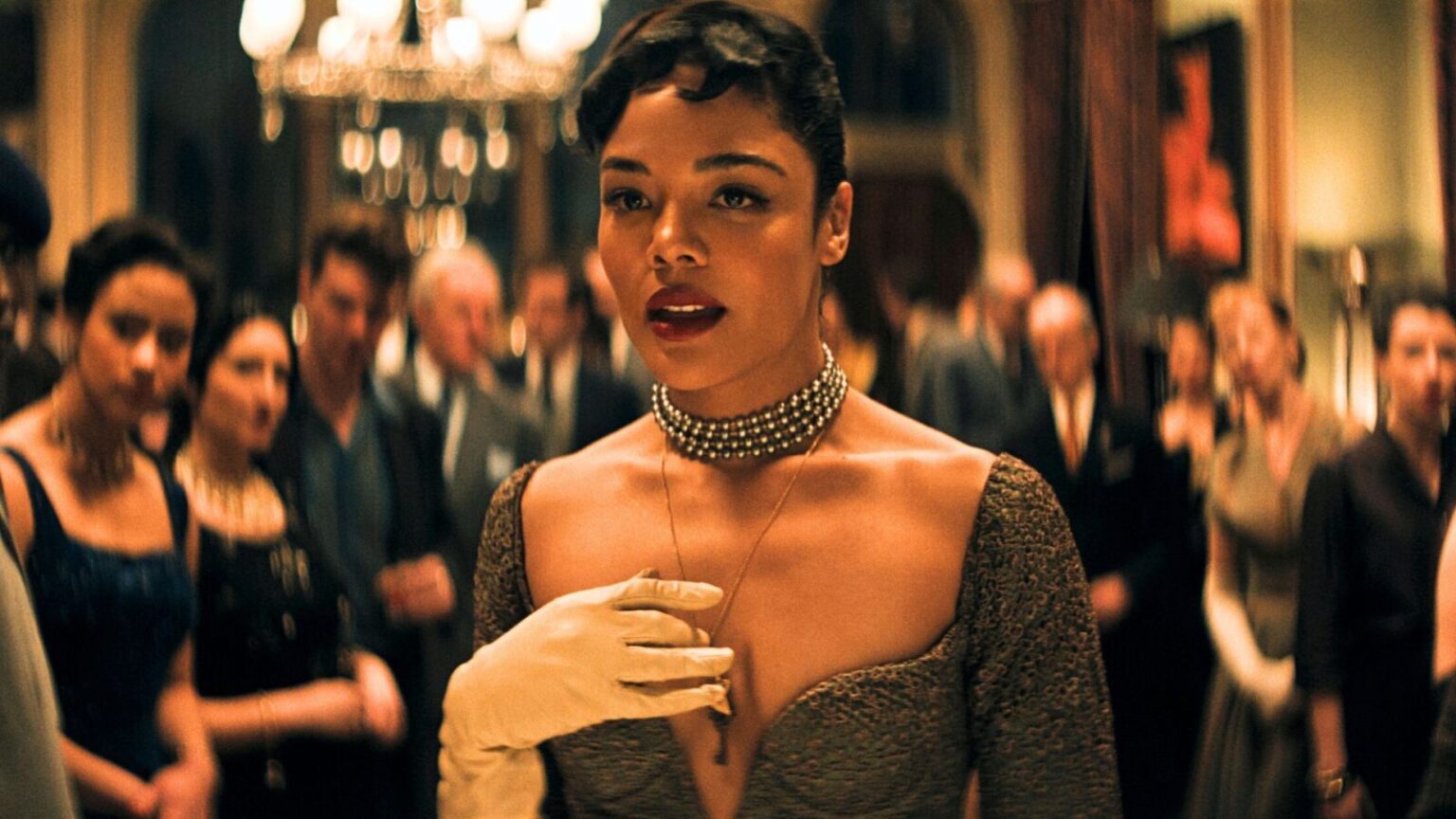
At her lavish party — part victory lap, part human experiment — Hedda struts through her new mansion like a cat in a room full of rocking chairs. Her husband, George Tesman (Tom Bateman), is an academic himbo desperate to impress his boss, Professor Greenwood (Finbar Lynch). The party’s real agenda, though, is chaos. Hedda invites her bohemian ex-lover Eileen Lovborg (Nina Hoss, gender-swapped and sensational), Eileen’s new partner Thea (Imogen Poots), and her current fling, the ever-slick Judge Brack (Nicholas Pinnock). Oh, and she has a literal box of guns — a legacy from her late father — because subtlety is for the bourgeoisie.
The night devolves into what can only be described as “queer chaos with literary references.” Hedda flirts, manipulates, and provokes, not out of revenge or ideology, but sheer boredom. She’s a social arsonist lighting matches in silk gloves.
It’s intoxicating — for about 20 minutes.
Hedda Wants to Be a Satirical Powder Keg, But It Mostly Just Smolders
Here’s the thing: Hedda Gabler as a character has always been a cipher. Ibsen’s original text gave us a woman who wielded cruelty as self-defense — brilliant, trapped, and terrifyingly aware of her own limits. DaCosta’s version tries to crank that up to 21st-century decadence, but in doing so, she flattens Hedda into a meme: “That girl who wants to watch the world burn.”
Tessa Thompson is a magnetic performer — she can command a scene with a single raised eyebrow — but here, she’s stranded by a screenplay that mistakes detachment for depth. Her British accent wobbles, her motivations are all surface, and her emotional beats hit like a metronome: predictable, precise, and lifeless.
The film’s rhythm doesn’t help. Once you’ve seen Hedda sabotage one relationship for sport, you’ve basically seen them all. DaCosta’s script cycles through confrontation, seduction, humiliation, rinse, repeat. It’s like watching Succession if everyone were less interesting and the stakes were whether someone would spill wine on the wallpaper.
And the sound design? Oh boy. Composer Hildur Guðnadóttir (a genius, normally) layers the score with actual gasps — yes, human gasps — like an audience surrogate reminding us when to be scandalized. The first time, it’s bold. The fifth, it’s parody. By the tenth, I was half-expecting a laugh track.
Nina Hoss Strolls In and Steals the Whole Damn Movie
If Hedda has a pulse, it’s beating in Nina Hoss’s scenes. Her Eileen Lovborg — reimagined as a once-rebellious artist now shackled by ambition — is the emotional core the rest of the film lacks. When she enters the room, DaCosta’s camera literally floats toward her on a double dolly shot, like Hedda’s gravitational pull has suddenly found its match.
Hoss plays Eileen with brittle poise and buried fury. She’s the only character who feels like she belongs to both Ibsen’s world and ours. Her relationship with Hedda — tinged with sexual tension, jealousy, and old wounds — is where the movie briefly ignites. When the two women lock eyes, the air sizzles. When they part, everything dims.
It’s telling that I left Hedda more invested in Eileen’s lost manuscript than in Hedda’s gun.
Gorgeous, Yes. Meaningful, Not So Much.
Cinematographer Sean Bobbitt (12 Years a Slave, The Place Beyond the Pines) shoots Hedda like a baroque fever dream. Every frame drips with gold light, every reflection hides someone lying. The production design by Cara Brower and art direction by Andrew Ackland-Snow are jaw-droppingly meticulous — it’s the kind of movie that makes you want to live inside its Pinterest board.
But beautiful surfaces can’t disguise the emptiness underneath. DaCosta’s adaptation flirts with big ideas — gender politics, creative ownership, performative liberation — but it never commits to any of them. There’s a scene where Hedda mixes aristocrats and bohemians into one chaotic soirée, a perfect setup for class commentary. Instead, the film shrugs: “Both sides party too hard.”
It’s like The Great Gatsby without the tragedy, Phantom Thread without the obsession, or Saltburn without the self-awareness. All vibe, no venom.
The Hedda Gabler Problem, 130 Years Later
The cruel irony of Hedda is that it misunderstands the very woman it wants to empower. Ibsen’s Hedda was trapped by her time — a genius caged by marriage, motherhood, and reputation. DaCosta’s Hedda is trapped by her own writing. She’s already free, but somehow still boring.
That’s not Thompson’s fault — it’s the script’s. For a film about a woman who literally sets fire to her own world, Heddaspends a lot of time watching her wander through candlelight looking mildly inconvenienced
Verdict
Nia DaCosta’s Hedda is a bold but uneven remix of Ibsen’s classic — an adaptation that trades emotional heft for aesthetic dazzle. Tessa Thompson looks stunning but feels miscast; her Hedda is all surface and no soul. Nina Hoss, on the other hand, gives a career-best performance that briefly elevates the film into the provocative, modern drama it wants to be.
It’s an elegant party you’ll remember for the décor, not the guests.